Best 10 Dog Breeds for Busy Families — Chosen by Dog Experts & Real Owners
Quick Answer
The best dog breeds for busy families are adaptable, calm, and easy to care for. Top picks include the Labrador Retriever, Cavalier King Charles Spaniel, French Bulldog, Basset Hound, and Pug. The right breed depends on your schedule, living space, and kids’ ages — not just what looks cute.
Top 10 dog breeds for busy families at a glance:
- Labrador Retriever — patient, gentle, forgiving of chaos
- Cavalier King Charles Spaniel — calm, cuddly, low-demand
- French Bulldog — low-energy, low-maintenance, apartment-friendly
- Basset Hound — laid-back, independent, slow-paced
- Pug — short walks, maximum cuddles, great indoors
- Golden Retriever — gentle, patient, loves kids
- Beagle — compact, cheerful, moderate energy
- Shih Tzu — low exercise needs, calm disposition
- Bernese Mountain Dog — gentle giant, very calm indoors
- Maltese — tiny, affectionate, minimal exercise required
What to look for in a breed for a busy household:
- Low to moderate daily exercise needs (under 60 minutes)
- Calm temperament that tolerates being alone for short periods
- Low or manageable grooming requirements
- Gentle, predictable behavior around children
You walk in the door at 6pm. Homework is due. Dinner isn’t made. And a puppy bouncing off the walls is the last thing you need. But what if the right dog didn’t add to the chaos — it actually calmed it down?
I’m Thomas Cutter, and I’ve spent years researching dog breeds for families with packed schedules. Not every dog suits a busy home. Some breeds need 2 hours of exercise a day. Others fall apart if left alone. Get the wrong fit and everyone suffers — you, the kids, and the dog.
This guide gives you the 10 best dog breeds for busy families — with honest stats, real owner quotes, and a clear decision guide at the end. If you’re also weighing options for younger children, check out this guide to the best dog breeds for families with toddlers.
- Low-energy breeds work best when family schedules are unpredictable
- Short-coated or single-coated breeds save hours of grooming each week
- Some “family dogs” need more exercise than busy families can give — avoid those
- The best breed for your family depends on home size, kids’ ages, and work hours
- A calm temperament matters more than breed popularity


What Makes a Dog Breed Right for a Busy Family?
Busy families don’t need a dog that demands constant attention. They need one that fits into real life — school runs, late nights, and weekends full of soccer practice.
Most experts agree on four traits that separate great family dogs from high-maintenance ones. First, a predictable temperament. A calm dog won’t spiral into destructive behavior if dinner runs late. Second, matched energy. If your family walks 20 minutes a day, pick a breed that thrives on 20 minutes — not 2 hours. Third, low grooming needs. A dog that needs weekly brushing beats one that needs daily combing every time. Fourth, tolerance for short alone-time. Most busy families are out for 6 to 8 hours a day. The right breed copes with that without destroying the sofa.
As a starting point, the American Kennel Club’s guide to the best family dogs is the most widely trusted resource for breed temperament data.
Some of the most popular breeds — Border Collies, Dalmatians, Huskies — are actually terrible fits for busy families. They need 2+ hours of daily activity or they develop anxiety and destructive behaviors. Popularity is not the same as suitability.
The 10 Best Dog Breeds for Busy Families — Reviewed
Every breed below was chosen based on four key criteria: daily exercise needs, grooming time, child-friendliness, and tolerance for being left alone. Here’s the full breakdown.
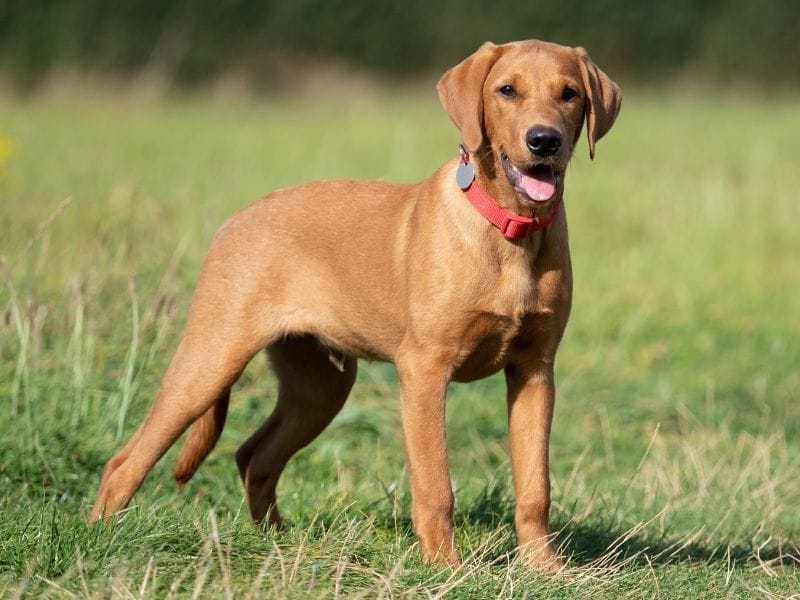
1. Labrador Retriever — “The Busy Family’s Best Friend”
 Save
Save| Weight | 55–80 lb |
| Height | 21.5–24.5 inches |
| Lifespan | 10–12 years |
| Energy Level | Moderate — 45–60 min/day |
| Grooming Need | Low — brush once a week |
| Shedding | Moderate — seasonal spikes |
The Labrador Retriever is America’s most enduring family dog, known for a gentle, forgiving temperament that adapts beautifully to noisy homes. Labs weigh 55 to 80 lb and need about 45 to 60 minutes of daily exercise — manageable for most families. They’re patient with young children, recover quickly from the accidental tail pull, and bond deeply with everyone in the household.
Labs have a short, dense double coat that sheds moderately. They come in yellow, black, and chocolate. Their broad head, expressive eyes, and trademark “otter tail” make them instantly recognizable. One detail most people miss: Labs have webbed feet — a hint at their original job as water retrievers in Newfoundland.
You probably know Labs as friendly. What you might not know is that they also have an unusually high pain tolerance. That makes them exceptionally patient with rough play from toddlers. And here’s the surprising part: Labs are one of the few large breeds that rarely resource-guard — meaning they don’t snap when kids approach their food bowl.
“Our Lab has survived three toddlers, a cat, and two international moves. He just rolls with everything. I’ve never once seen him grumpy.”
— Sarah M., Labrador Retriever owner for 9 years
- Extremely patient with children of all ages
- Short coat needs only weekly brushing
- Adapts well to busy, unpredictable routines
- Sheds noticeably — especially in spring
- Needs 45–60 minutes of exercise daily
- Can become destructive if under-exercised
Best for: Families with older kids · Households with a yard · Owners who can do a daily walk
→ See how Labs compare in our guide to the best family dog breeds for kids
2. Cavalier King Charles Spaniel — “The Lap Dog That Loves Your Chaos”
| Weight | 12–18 lb |
| Height | 12–13 inches |
| Lifespan | 9–14 years |
| Energy Level | Low — 20–30 min/day |
| Grooming Need | Moderate — brush 2–3x/week |
| Shedding | Moderate — manageable year-round |
The Cavalier King Charles Spaniel is a small, silky-coated companion breed built for indoor family life. Weighing just 12 to 18 lb, Cavaliers need only 20 to 30 minutes of daily exercise. They’re naturally calm, deeply affectionate, and won’t demand attention on your busiest days — but they’ll always be ready for a cuddle when you finally sit down.
Cavaliers carry a silky, feathered coat in four recognized colors — Blenheim (chestnut and white), tricolor, ruby, and black-and-tan. Their large, round dark eyes and soft expression give them a permanently gentle look. Their long, feathered ears need regular inspection for moisture and debris, which is easy to overlook.
Everyone knows Cavaliers are gentle. What most don’t realize is that they adjust their energy level to match their owner’s. Busy day? They’ll nap. Active weekend? They’ll happily hike a few miles. That emotional flexibility makes them one of the most adaptable small breeds for families. The surprising fact: Cavaliers were bred for centuries to be lap companions for British royalty — and that DNA still shows in how naturally they settle.
“On days I work 10 hours, she just sleeps. The second I sit down she’s on my lap. It’s like she reads my schedule somehow.”
— James T., Cavalier King Charles Spaniel owner for 6 years
- Needs only 20–30 minutes of daily exercise
- Adapts energy level to your pace
- Excellent with gentle children and seniors
- Prone to heart conditions after age 5
- Ears need weekly cleaning
- Coat tangles without 2–3x weekly brushing
Best for: Apartment families · Families with gentle kids · Owners with limited exercise time
3. French Bulldog — “The Couch Partner That Still Makes You Laugh”
| Weight | Under 28 lb |
| Height | 11–13 inches |
| Lifespan | 10–12 years |
| Energy Level | Low — 15–20 min/day |
| Grooming Need | Very low — wipe-down weekly |
| Shedding | Low — minimal year-round |
The French Bulldog is a compact, bat-eared companion that thrives in busy households with minimal outdoor time. Weighing under 28 lb, Frenchies need just 15 to 20 minutes of daily exercise. Their short, smooth coat requires almost no grooming. They’re playful and entertaining but equally happy spending a long evening on the sofa — exactly what tired parents need.
Frenchies have a muscular, compact body with a broad flat face, bat-like ears, and a short corkscrew tail. Their short coat comes in brindle, fawn, cream, and white patterns. The skin folds around their nose need weekly cleaning to prevent moisture buildup — a small task that makes a big difference.
Most people think Frenchies are lazy. They’re not — they have real bursts of playful energy and love roughhousing with kids. What most don’t know is that they’re also unusually intuitive. Frenchies often mirror the mood of the room. When the house is calm, they’re calm. When kids are excited, they match that energy. Here’s the surprising part: French Bulldogs became the #1 most popular breed in the US in 2022 — largely because busy urban families discovered they’re one of the easiest dogs to own.
“We both work full-time and have two kids under 8. Our Frenchie is the calmest creature in the house. He does his walk, eats his dinner, and then just becomes part of the furniture.”
— Priya K., French Bulldog owner for 4 years
- Needs only 15–20 minutes of daily walking
- Almost no grooming — wipe face folds weekly
- Quiet — rarely barks excessively
- Can’t handle hot weather — overheats fast
- Vet bills can be high due to breathing issues
- Snoring and snorting — a nightly reality
Best for: City-dwelling families · Apartment living · Parents with very limited walking time
4. Basset Hound — “The Low-Rider That Never Rushes Anyone”
| Weight | 40–65 lb |
| Height | Up to 15 inches |
| Lifespan | 12–13 years |
| Energy Level | Low — 30 min/day (slow pace) |
| Grooming Need | Low — weekly wipe and brush |
| Shedding | Moderate — steady all year |
The Basset Hound is a heavy-bodied, short-legged scenthound with one of the most laid-back temperaments in the dog world. Weighing 40 to 65 lb despite their low build, Bassets need just 30 minutes of slow-paced daily walking. They’re independent enough to handle home time alone, patient with children, and genuinely content to do very little on slow days.
Bassets carry a short, hard coat in classic tricolor or bicolor patterns. Their most distinctive features are their impossibly long, velvety ears — which serve a real purpose, dragging scent particles toward their nose. Their drooping eyes and permanently mournful expression make them one of the most recognizable breeds alive.
You’d expect a Basset to just sleep all day. They do love napping. But what surprises most owners is how stubborn and willful Bassets can be — especially if they catch a scent outdoors. They’ll follow a smell with total focus and selective deafness. That said, they rarely display aggression. Bassets have one of the lowest recorded bite rates of any medium-to-large breed — making them genuinely safe around children.
“He literally does not care if I’m gone for 8 hours. When I come back he looks up, sniffs me, then goes back to sleep. Low maintenance doesn’t cover it.”
— Mark R., Basset Hound owner for 7 years
- Handles being alone well during work hours
- Very low aggression — safe with young kids
- 30-minute slow walks are enough daily
- Howls loudly — not great for thin walls
- Ears need weekly cleaning to avoid infection
- Drools heavily — expect wet furniture
Best for: Families in suburban homes · Parents who can’t do long daily runs · Homes with relaxed routines
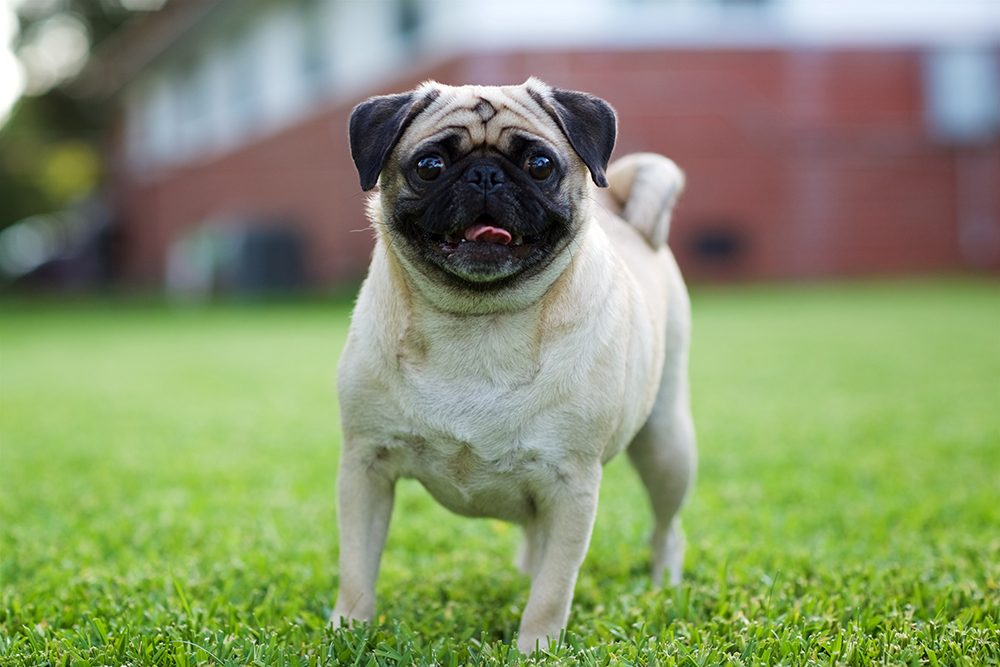
5. Pug — “The Comedian That Runs on Cuddles and Short Walks”
 Save
Save| Weight | 14–18 lb |
| Height | 10–13 inches |
| Lifespan | 13–15 years |
| Energy Level | Low — 20–25 min/day |
| Grooming Need | Low — weekly wipe and brush |
| Shedding | Moderate — sheds more than expected |
The Pug is a small, flat-faced companion breed that thrives on indoor family life and short daily walks. Weighing 14 to 18 lb, Pugs need just 20 to 25 minutes of daily exercise. They’re good-natured, entertaining, and naturally gentle with children. Their biggest talent is turning a stressful evening into something that makes everyone laugh.
Pugs have a square, sturdy body with deep facial wrinkles, a tightly curled tail, and a soft velvety coat in fawn or black. Their large, round eyes and furrowed brow create an expression of permanent concern — which most owners find irresistible. Those facial wrinkles need a quick daily wipe to prevent skin irritation.
Most people know Pugs as clowns. That’s true — they genuinely enjoy performing for attention. What most don’t realize is that Pugs were kept as court companions by Chinese emperors and were later favorites of European royalty. That long history around humans means they’re deeply people-oriented. The surprising fact: despite their small size, Pugs are actually quite sturdy and handle children’s rough affection better than most toy breeds.
“My 6-year-old drags him around in a doll stroller. He just sits there with that look on his face like he’s royalty. Never snaps, never growls.”
— Anita D., Pug owner for 5 years
- Extremely tolerant with children — rarely snaps
- Short walks are all they need
- Long lifespan — 13 to 15 years average
- Breathing problems — overheats in summer
- Sheds heavily for their small size
- Face wrinkles need daily wiping
Best for: Apartment families · Kids aged 4 and up · Families in cooler climates
6. Golden Retriever — “The Perpetually Patient Family Anchor”
| Weight | 55–75 lb |
| Height | 21.5–24 inches |
| Lifespan | 10–12 years |
| Energy Level | Moderate — 60 min/day |
| Grooming Need | Moderate — brush 2–3x/week |
| Shedding | Heavy — especially in spring and fall |
The Golden Retriever is one of the most patient and child-friendly breeds in the world, consistently recommended by pediatric therapy programs for its gentle nature. Weighing 55 to 75 lb, Goldens need about 60 minutes of daily exercise but offer extraordinary tolerance in return. They rarely snap, rarely resource-guard, and are deeply devoted to every family member.
Goldens carry a dense, water-repellent outer coat in shades from cream to deep gold. Feathering appears along the legs, tail, and chest. Their coat is beautiful — but it sheds heavily twice a year and moderately all year round. Families should budget 2 to 3 brushing sessions per week to keep it manageable.
Most people see Goldens as classic family dogs and leave it at that. What’s less known is that they’re one of the top breeds used in pediatric cancer wards and trauma therapy programs — specifically because of how intuitively they respond to a child in distress. The wow factor: Golden Retrievers are one of very few breeds that actively seek physical contact with crying or upset children, without being trained to do so.
“My daughter has anxiety. When she has a bad night, the dog finds her in the dark and just lies on her. No one taught him that. He just does it.”
— Claire B., Golden Retriever owner for 8 years
- Exceptional patience with children of any age
- Easily trained — learns quickly and remembers
- Intuitive emotional support for anxious kids
- Sheds heavily — brush 2–3x per week
- Needs a full 60 minutes of exercise daily
- Puppies are boisterous — can knock toddlers over
Best for: Families with older kids · Homes with a yard · Families who can commit to daily walks
7. Beagle — “The Happy Little Hound That’s Always Ready to Go”
| Weight | 20–30 lb |
| Height | 13–15 inches |
| Lifespan | 10–15 years |
| Energy Level | Moderate — 45 min/day |
| Grooming Need | Low — brush once a week |
| Shedding | Moderate — manageable with brushing |
The Beagle is a compact, cheerful scenthound with a sturdy build and a genuinely upbeat personality. Weighing 20 to 30 lb, Beagles need about 45 minutes of exercise daily — enough to keep them happy without exhausting busy parents. They’re resilient, friendly with kids, and recover fast from the noise and unpredictability of busy family life.
Beagles carry a short, dense coat in classic tricolor, lemon and white, or red and white. Their large brown eyes and long, rounded ears give them one of the most expressive faces in dogdom. Their compact size means they fit comfortably in most homes without overwhelming a small space.
Beagles are known for being friendly. That’s true. What most don’t realize is that they’re also enormously food-motivated — which makes them surprisingly easy to train compared to other scent hounds. But here’s what catches most new owners off guard: Beagles howl. Not just occasionally — it’s their primary form of communication. In a house with good soundproofing, it’s funny. In a thin-walled apartment, it’s a problem.
“Three kids, two dogs, constant chaos — and our Beagle just bounces through it all with his tail up. He’s the emotional anchor of this whole household.”
— Tobias W., Beagle owner for 6 years
- Naturally cheerful — lifts the household mood
- Compact enough for smaller homes
- Food motivation makes training effective
- Howls loudly — not for apartments
- Strong nose leads to escape attempts
- Needs a secure, fenced yard
Best for: Suburban families · Homes with fenced yards · Kids aged 5 and up
8. Shih Tzu — “The Royal Lap Dog That Asks for Almost Nothing”
| Weight | 9–16 lb |
| Height | 9–10.5 inches |
| Lifespan | 10–18 years |
| Energy Level | Low — 20 min/day |
| Grooming Need | Moderate-high — daily brush or puppy cut |
| Shedding | Very low — minimal shed year-round |
The Shih Tzu is a small, long-coated companion breed with one of the lowest exercise needs on this list. Weighing just 9 to 16 lb, Shih Tzus need only 20 minutes of light daily activity. They shed almost nothing and are a strong choice for families with mild allergies. Their calm, affectionate personality makes them ideal for quieter households with young children.
Shih Tzus carry a long, flowing double coat that comes in nearly every color combination. Most busy families opt for the “puppy cut” — a short, manageable trim that reduces grooming to a quick daily comb rather than a lengthy session. Their round, dark eyes and short nose give them a soft, owl-like expression that children find irresistible.
Most people see Shih Tzus as delicate. They’re actually tougher than they look. What most don’t know is that they were originally bred to live inside Tibetan monasteries, where they served as alert watchdogs despite their small size. They’ll still bark when strangers approach — useful in a family home. The surprising fact: Shih Tzus can live up to 18 years, making them one of the longest-lived breeds on this list.
“We got a puppy cut and suddenly grooming takes 5 minutes a day. Low shed, gentle with my 4-year-old, fits on any sofa. I honestly can’t fault her.”
— Fatima H., Shih Tzu owner for 10 years
- Sheds almost nothing — great for allergy families
- 20 minutes of daily walking is enough
- Lifespan up to 18 years — long commitment
- Long coat tangles daily without grooming
- Face hair must be tied back to protect eyes
- Can be stubborn with house training
Best for: Families with allergy concerns · Apartment dwellers · Gentle kids aged 5 and up
→ Explore more low-shedding options in our guide to the best dog breeds for families with allergies
9. Bernese Mountain Dog — “The Gentle Giant That Never Forgets to Be Calm”
| Weight | 70–115 lb |
| Height | 23–27.5 inches |
| Lifespan | 7–10 years |
| Energy Level | Moderate — 30–45 min/day indoors calm |
| Grooming Need | Moderate-high — brush 3x/week |
| Shedding | Heavy — especially in shedding seasons |
The Bernese Mountain Dog is a large, tri-colored working breed with a famously calm and gentle indoor temperament. Weighing 70 to 115 lb, Berners are surprisingly mellow inside the home — they don’t bounce off walls or demand constant activity. They’re deeply loyal, patient with children, and steady under the pressure of a noisy, busy household.
Berners carry a thick, silky tri-colored coat — jet black with rich rust and clear white markings in a distinctive pattern. Their build is powerful but their movement is unhurried. That contrast — a big working dog with a gentle soul — is what draws families to them. Their thick coat does shed heavily and needs brushing at least three times a week.
Most people assume big dogs need huge amounts of exercise. Berners break that rule. They’re moderate-energy dogs that are genuinely calm indoors — more than many smaller breeds. What most don’t know is that Berners were bred in the Swiss Alps as farm and cart-pulling dogs, which gave them a calm, methodical nature rather than the high-strung energy of a working sheepdog. The catch: their lifespan is shorter than other breeds at 7 to 10 years — something families should consider.
“He weighs more than my kids and is somehow the calmest one in the house. My 3-year-old sleeps using him as a pillow. He hasn’t moved in four years.”
— Lena S., Bernese Mountain Dog owner for 5 years
- Extremely calm indoors — won’t bounce off walls
- Deeply gentle and patient with toddlers
- Loyal to every family member equally
- Heavy shedder — brush 3x per week
- Shorter lifespan — 7 to 10 years
- Size means high food and vet costs
Best for: Families with space and a yard · Homes with toddlers · Owners who can handle heavy shedding
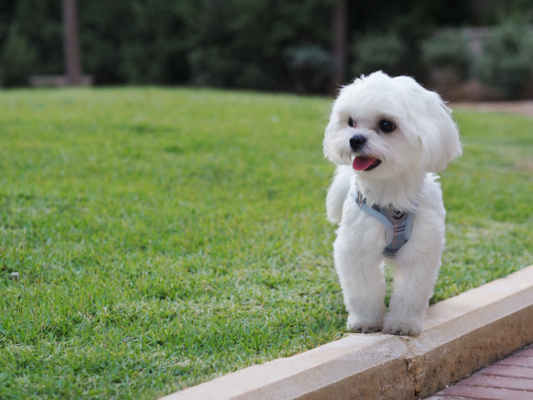
10. Maltese — “The Pocket-Sized Companion That Earns Its Place Every Day”
 Save
Save| Weight | Under 7 lb |
| Height | 7–9 inches |
| Lifespan | 12–15 years |
| Energy Level | Low — 15–20 min/day |
| Grooming Need | Moderate — daily comb or short trim |
| Shedding | Very low — barely sheds |
The Maltese is one of the smallest and lowest-shedding breeds available to busy families. Weighing under 7 lb, Maltese dogs need just 15 to 20 minutes of daily activity. Their single-layer silky coat sheds minimally, making them one of the better choices for families with mild allergies. They’re affectionate, playful in short bursts, and perfectly sized for apartment or small-home living.
The Maltese coat is pure white, floor-length, and silky — one of the most striking in the toy group. Many owners keep them in a short “sport clip” for easy care. Their dark eyes and black nose contrast beautifully against the white coat. Despite their dainty appearance, their build is compact and sturdy for their size.
Most people think Maltese are fragile. They’re not as delicate as they look — but they’re also not suited to very young or rough children. What most don’t know is that the Maltese is one of the oldest dog breeds in recorded history, with depictions going back to ancient Greece and Rome. That longevity reflects a breed that has been refined over centuries for one purpose: human companionship. The surprise: Maltese are surprisingly bold for their size and will stand their ground with much larger dogs.
“She weighs 5 lb and has zero fear of our neighbor’s German Shepherd. And she barely sheds. My vacuum hasn’t worked this hard since she arrived — wait, I mean the opposite.”
— Nina P., Maltese owner for 11 years
- Barely sheds — very low allergen load
- Tiny size suits apartments perfectly
- 15–20 minutes of walking is enough
- Too fragile for very young children
- Long coat mats without daily combing
- Can develop separation anxiety if left too long
Best for: Families with kids aged 7+ · Apartment dwellers · Families with mild dog allergies
Quick Comparison Table — All 10 Breeds Side by Side
Here’s every breed at a glance so you can compare exercise needs, grooming, and size in one place.
| Breed | Weight | Exercise/Day | Shedding | Kid-Friendly |
|---|---|---|---|---|
| Labrador Retriever | 55–80 lb | 45–60 min | Moderate | ⭐⭐⭐⭐⭐ |
| Cavalier King Charles | 12–18 lb | 20–30 min | Moderate | ⭐⭐⭐⭐⭐ |
| French Bulldog | Under 28 lb | 15–20 min | Low | ⭐⭐⭐⭐⭐ |
| Basset Hound | 40–65 lb | 30 min | Moderate | ⭐⭐⭐⭐ |
| Pug | 14–18 lb | 20–25 min | Moderate | ⭐⭐⭐⭐⭐ |
| Golden Retriever | 55–75 lb | 60 min | Heavy | ⭐⭐⭐⭐⭐ |
| Beagle | 20–30 lb | 45 min | Moderate | ⭐⭐⭐⭐ |
| Shih Tzu | 9–16 lb | 20 min | Very Low | ⭐⭐⭐⭐ |
| Bernese Mountain Dog | 70–115 lb | 30–45 min | Heavy | ⭐⭐⭐⭐⭐ |
| Maltese | Under 7 lb | 15–20 min | Very Low | ⭐⭐⭐ (older kids) |
Which Dog Breed Is Right for Your Busy Family?
Not every family is the same. Here’s how to match your real situation to the right breed — not just the most popular one.
- If you live in an apartment with limited walk time → French Bulldog or Pug. Both need under 25 minutes a day and barely bark.
- If you have toddlers or very young children → Labrador Retriever or Bernese Mountain Dog. Both have extraordinary patience and very low snap risk.
- If your family has mild dog allergies → Shih Tzu or Maltese. Both shed minimally and produce less dander.
- If you want a small dog that’s active on weekends but calm in the week → Cavalier King Charles Spaniel. It matches your energy level naturally.
- If your kids are older and love outdoor time → Beagle or Golden Retriever. Both thrive with active families.
- If you want a calm large dog without huge exercise demands → Bernese Mountain Dog. Surprisingly low-energy indoors for a dog that size.
This article covers breeds suited to standard busy family schedules — two working parents, school-aged or younger children, and typical suburban or urban homes. If your situation involves extreme working hours (10+ hours away daily), a farm environment, or a child with special needs, additional breed research or a consultation with a vet or certified trainer may help you narrow your choice further.
If you also share your home with a cat, some of these breeds are a better fit than others. Check out our guide to the best dog breeds for families with cats before you decide.
What Most Busy Families Get Wrong When Choosing a Dog Breed
Here’s the most common mistake: picking a breed based on popularity instead of lifestyle fit. In 2026, French Bulldogs hold the top spot in US popularity — and they work brilliantly for many families. But the second most common mistake is choosing a breed based on looks alone without checking exercise needs.
You might be thinking: “All dogs need the same amount of exercise, right?” They absolutely don’t. A Husky needs 2 hours a day. A Maltese needs 15 minutes. That difference determines whether your dog is happy or anxious, calm or destructive.
The third mistake is underestimating grooming time. A beautiful long-coated dog sounds lovely until you realize it needs brushing every single day. Busy families do better with short coats or breeds kept in a puppy clip. Grooming is a time commitment — just like exercise.
Before getting any dog, do a one-week trial run of the exercise routine you plan to give. If you plan to walk 20 minutes a day — walk 20 minutes every day for a week. If it feels realistic, the low-energy breeds on this list will thrive with you. If it feels hard — go even lower energy.
Essential Care Tips for Dogs in Busy Households
Even low-maintenance breeds need consistent care. Here’s what every busy family should set up before the dog arrives.
Routine is everything. Dogs thrive on predictability. Feed, walk, and play at the same times each day — even if those times aren’t ideal. A consistent schedule reduces anxiety and cuts down on destructive behavior by a significant margin. Research consistently shows that dogs with predictable routines show lower stress hormone levels than those in chaotic schedules.
Set up a calm space. Every dog needs a spot that’s theirs. A crate, a bed, or a corner — somewhere they can go when the house gets loud. This is especially important in busy homes with children. It gives the dog an emotional exit when they need one.
Puzzle feeders and chew toys save furniture. A bored dog is a destructive dog. Puzzle feeders, stuffed Kongs, and chew toys give dogs mental work to do while you’re at school pick-up. Five minutes of setup can save an afternoon of chewed cushions.
Ask your vet about routine care at your first appointment. The American Veterinary Medical Association’s pet owner resources include practical guides on preventive care, vaccination schedules, and dental health — all areas where staying ahead saves both money and time.
Frequently Asked Questions
What is the easiest dog breed for a busy family?
The French Bulldog and Cavalier King Charles Spaniel are widely considered the easiest dog breeds for busy families. Both need under 30 minutes of daily exercise, have low-to-moderate grooming needs, and have calm, adaptable personalities. They suit apartments and houses equally well and cope with the unpredictable routine of family life without developing anxiety or destructive behavior.
What dog breeds do well when left alone during the day?
Breeds that handle alone time well include the Basset Hound, French Bulldog, Shih Tzu, and Maltese. These breeds have lower separation anxiety risk than velcro breeds like the Vizsla or Australian Shepherd. That said, no dog should routinely be left alone for more than 6 to 8 hours without a break. A dog walker or midday check-in helps even the most independent breeds.
Is a Labrador Retriever good for working parents?
Yes — Labradors are a strong choice for working parents, provided they get 45 to 60 minutes of daily exercise. Labs are patient, adaptable, and tolerate brief alone-time well. They do need consistent exercise to stay calm indoors. Without it, even the most good-natured Lab can develop chewing habits. A morning walk plus an evening play session typically keeps them settled and content.
What dog breeds are low maintenance for kids?
Low-maintenance breeds for families with kids include the Pug, Beagle, Labrador Retriever, and Cavalier King Charles Spaniel. All four have predictable, gentle temperaments, require manageable grooming, and tolerate the noise and energy of children well. Most experts agree these four consistently appear at the top of child-friendly breed lists based on bite statistics and temperament assessments.
How do I know if a dog breed suits our family’s schedule?
The simplest test: add up how many minutes per day your family realistically has for dog care — exercise, feeding, brushing, and play. Then match that number to the breed’s daily needs. If a breed needs 60 minutes and you have 30, move down the list. A breed that fits your real schedule — not your ideal schedule — will be happier and so will your family.
Picking the right dog for a busy family comes down to one thing: honesty. Be honest about your schedule, your home size, and your kids’ ages. Then match the breed to your real life — not your best-case version of it.
The breeds on this list were chosen because they work in the real world, not just on paper. Start with the comparison table above. Narrow it to two or three options. Then talk to a vet or a reputable breeder before you decide. I’m Thomas Cutter, and in my experience, the families who do that homework end up with dogs that become the best part of their day — not another item on the to-do list.
One thing to do right now: Pick the three breeds from the comparison table that best match your daily exercise time. Write them down. Then show that shortlist to your vet or a trusted dog trainer this week — before anything else.

Thomas Cutter is a lifelong dog owner and the founder of FindOutAboutDogs.com. With over 10 years of hands-on experience owning multiple breeds, Thomas created this site to provide honest, research-based dog advice that real owners can actually trust.
