Which Brush Is Best for Long Dog Coats? 2026 Guide
Quick Answer
For most long-coated dogs, a long-pin slicker brush is the best all-around choice because it reaches through longer hair and removes loose fur and small tangles. A pin brush works well for gentle everyday grooming, while double-coated dogs often need an undercoat rake too. The American Kennel Club’s dog brush guide also recommends choosing tools according to coat type rather than using one brush for every dog.
Best brushes for long coats
- Long-pin slicker: Best general choice for separating long hair, catching loose fur, and preventing small tangles.
- Pin brush: Best for routine brushing of silky, flowing coats when heavy de-shedding is not needed.
- Undercoat rake: Best for long-haired dogs with a dense double coat and loose undercoat.
- Metal comb: Best as a final check for hidden tangles close to the skin.
- Correct pin length: Pins must be long enough to enter the coat instead of skimming over its surface.
My simplest setup
- Use a long-pin slicker or pin brush for routine grooming, add an undercoat rake for dense double coats, and finish with a metal comb.
Long dog coats can look beautifully smooth while hiding tangles underneath. That is why choosing the right brush matters more than simply brushing more often.
I’ve found that the best setup depends on whether the coat is silky, curly, thick, or double layered. In this guide, I’ll show you which tool fits each type and how I use it without pulling at the skin.


What Type of Brush Is Best for a Long-Haired Dog?
A long-pin slicker brush is the most versatile choice for many long-haired dogs. Its longer pins can separate hair below the surface while collecting loose fur and small tangles.
A pin brush is another strong choice when the coat is flowing and relatively tangle-free. I prefer it for gentle maintenance rather than serious mat removal.
A long-coat dog brush is a grooming tool with pins or teeth long enough to move through the full depth of a dog’s coat without simply polishing the surface.
- Long-pin slicker brush: Useful for long, thick, curly, or tangle-prone coats.
- Pin brush: Useful for silky coats and everyday finishing.
- Undercoat rake: Useful when dense undercoat sits beneath longer guard hairs.
- Metal comb: Useful for finding tangles that a brush missed.
- Bristle brush: Better as a finishing tool than a primary long-coat detangler.
The main mistake I see is using a brush with pins that are too short. The top layer looks neat, but knots keep tightening closer to the skin.
Which Brush Should You Use for Different Long Coat Types?
 Save
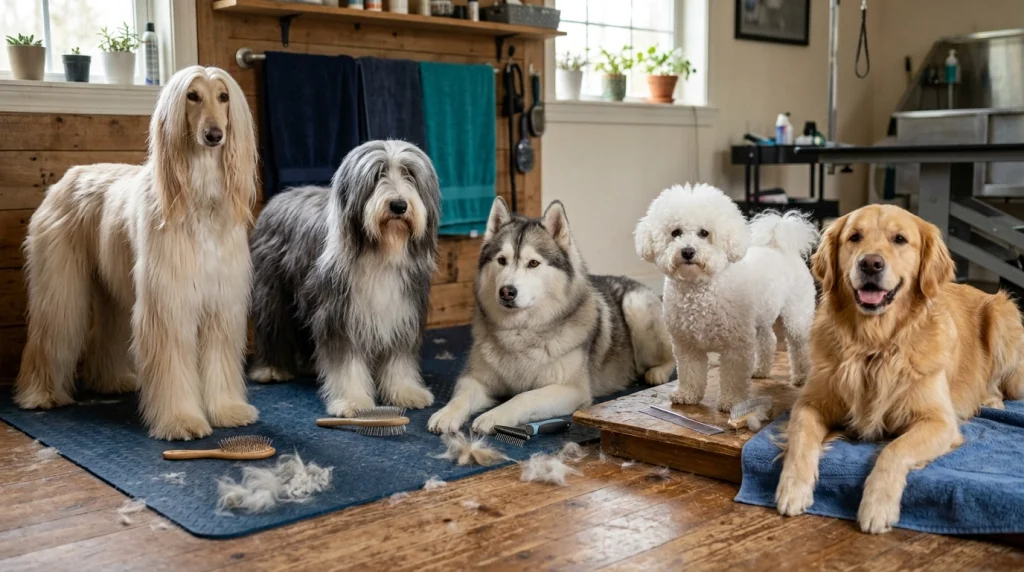
SaveThe best brush depends on the structure of the coat, not simply its length. A Yorkshire Terrier and a Rough Collie can both have long hair, yet their grooming needs are quite different.
As of 2026, I still prefer matching the tool to coat density before worrying about brand names.
| Long Coat Type | Best Main Brush | Useful Second Tool | Main Grooming Goal |
|---|---|---|---|
| Silky and flowing | Pin brush | Metal comb | Separate hair without excessive pulling |
| Long and dense | Long-pin slicker | Metal comb | Reach deeper tangles and loose hair |
| Long double coat | Undercoat rake | Long-pin slicker | Remove loose undercoat beneath guard hairs |
| Curly or woolly | Long-pin slicker | Steel comb | Prevent knots from tightening near the skin |
| Feathered coat | Pin brush | Slicker brush | Manage tangles behind ears, legs, and tail |
Dogs with a true double coat need special attention beneath the visible hair. My guide to choosing a brush for a Husky explains that deeper coat structure in more detail.
Is a Slicker Brush or Pin Brush Better for Long Hair?
A slicker is better for tangles and dense hair, while a pin brush is better for gentle maintenance and finishing. I don’t consider either tool automatically better for every long-haired dog.
The choice comes down to how easily the coat tangles and how much hair sits between the brush and the skin.
When I would choose a slicker brush
- The coat is thick enough that a normal pin brush skims over it.
- Small tangles appear regularly.
- The dog has curly or woolly hair.
- You need to work through the coat in sections.
- Loose hair builds up below the visible surface.
The AKC describes slicker brushes as useful for medium, long, wire, and curly coats. They can remove loose hair and help with mat prevention when used gently.
When I would choose a pin brush
- The coat is long but relatively straight and silky.
- You brush often enough that large tangles rarely develop.
- You want to smooth feathering on the ears, legs, chest, or tail.
- Your main goal is routine coat maintenance rather than de-shedding.
Pin brushes resemble human hairbrushes, but their longer spaced pins make them more useful on flowing canine coats. I like them when I want less resistance through already maintained hair.
For example, the Andis grooming range includes large pin brushes made for detangling and smoothing medium-to-large dogs.
Do Long-Haired Double-Coated Dogs Need an Undercoat Rake?
Yes, many long-haired double-coated dogs benefit from an undercoat rake because a normal brush may not remove loose hair beneath the outer coat. The rake should remove loose material without being dragged aggressively against the skin.
Examples include long-coated or heavily furnished breeds with soft undercoat beneath stronger guard hairs.
- Start gently: Use short strokes in the direction the coat grows.
- Work in sections: Separate longer outer hair so you can see what the tool is doing.
- Don’t chase every hair: Continued loose fur does not mean one patch needs endless brushing.
- Finish with a slicker: Pick up loosened hair closer to the surface.
- Check with a comb: Stop if the comb meets a hard snag rather than forcing through it.
If seasonal shedding is the main problem, my guide on managing heavy double-coat shedding covers a full rake, slicker, and comb routine.
Safari by Coastal also makes double-row undercoat rakes with rounded rotating pins for thick coats. That style is more suitable for dense undercoat than a short rubber curry brush.
How Do You Brush a Long-Haired Dog Without Causing Pain?
 Save
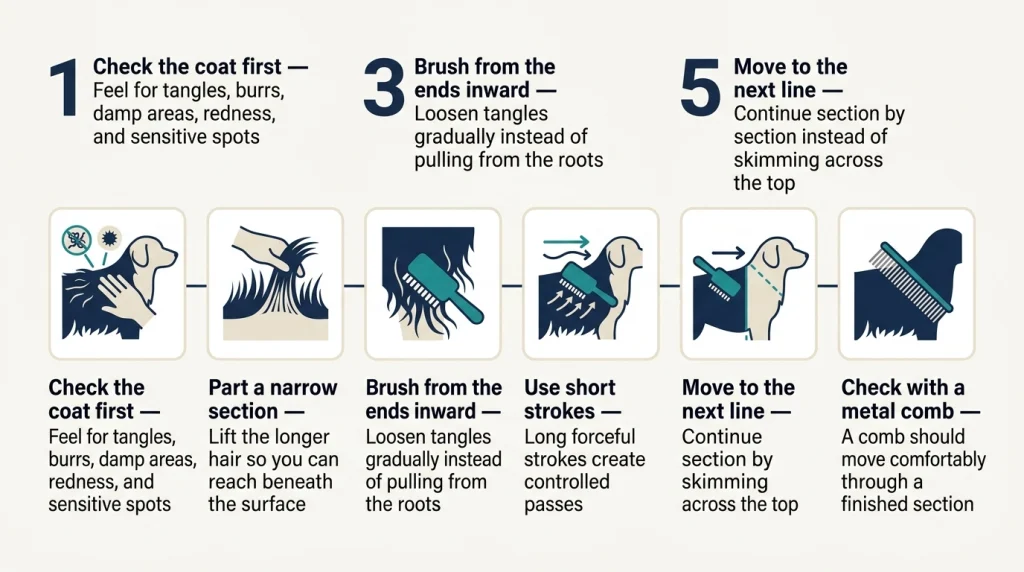
SaveBrush in small sections using light pressure, and never pull hard through resistance. A careful technique matters just as much as the brush you buy.
I use a simple line-brushing approach when the coat is thick enough to hide the skin.
- Check the coat first. Feel for tangles, burrs, damp areas, redness, and sensitive spots.
- Part a narrow section. Lift the longer hair so you can reach beneath the surface.
- Brush from the ends inward. Loosen tangles gradually instead of pulling from the roots.
- Use short strokes. Long forceful strokes create more pulling than controlled passes.
- Move to the next line. Continue section by section instead of skimming across the top.
- Check with a metal comb. A comb should move comfortably through a finished section.
This takes longer than running a brush across the dog’s back. It also shows me exactly where hidden tangles are developing.
The AKC’s home grooming guidance also recommends working through the coat gently and checking areas where mats commonly form.
Where Do Long-Haired Dogs Mat Most Easily?
Mats often form where long hair rubs, bends, stays damp, or receives less brushing. I check those high-risk spots before spending time on easier areas such as the middle of the back.
- Behind the ears: Fine hair moves constantly and tangles quickly.
- Under the collar: Friction can tighten loose hair.
- Armpits: Leg movement repeatedly rubs the coat together.
- Chest: Thick feathering can hide tangles underneath.
- Rear legs: Long furnishings often catch debris and loose fur.
- Tail: Dense feathering can look smooth on top while knotting underneath.
PetMD recommends consistent brushing for long coats and using a metal comb to find hidden mats below the top layer. That final comb check is one of the habits I find most useful.
If a mat is tight against the skin, don’t attack it with scissors. Dog skin can pull upward into a mat, making accidental cuts easier than many owners expect.
How Often Should You Brush a Dog With Long Hair?
Most long-haired dogs need brushing several times per week, and some need daily attention. The right schedule depends on coat texture, density, activity, and how quickly tangles develop.
- Silky long coat: Every day or every few days if tangles form quickly.
- Dense double coat: Thoroughly at least weekly, with more sessions during heavy shedding.
- Curly long coat: Frequent brushing and combing to stop small knots tightening.
- Outdoor dog: Check the coat after walks through brush, mud, burrs, or wet vegetation.
- Recently trimmed coat: Continue brushing because shorter hair can still mat as it grows.
Consistency is easier than repairing neglected matting. Ten calm minutes every few days can accomplish more than one stressful hour after knots have become tight.
What Should You Look for When Buying a Brush for Long Dog Hair?
Look at pin length, tip quality, brush flexibility, head size, and handle comfort before buying. A label saying “for long hair” doesn’t guarantee that the tool suits your dog’s actual coat.
- Pin length: Long coats usually need longer pins to reach below the top layer.
- Smooth pins: Rough edges can snag hair and make brushing unpleasant.
- Flexible cushion: Some flex can help the brush follow the dog’s body.
- Head size: Large brushes cover the body quickly, while smaller heads help around legs and ears.
- Comfortable grip: Long-coat grooming involves many repeated strokes.
- Coat-specific design: A heavy double coat needs a different tool from fine silky hair.
I also avoid buying purely because a product advertisement shows a huge pile of removed hair. Removing the most hair possible is not the same as grooming comfortably or correctly.
Can You Use Only One Brush on a Long-Haired Dog?
You can sometimes manage a simple long coat with one good brush, but two tools usually give a better result. I prefer a brush for the main work and a metal comb for checking what the brush missed.
For double-coated dogs, three tools can make sense because the undercoat creates a separate grooming job.
- Simple silky coat: Pin brush + metal comb.
- Dense long coat: Long-pin slicker + metal comb.
- Long double coat: Undercoat rake + long-pin slicker + metal comb.
- Curly coat: Long-pin slicker + metal comb.
The metal comb is not just a finishing accessory. I use it as a test because it quickly reveals tangles that a brush passed over.
Brushes I Would Consider for Long Dog Coats
 Save
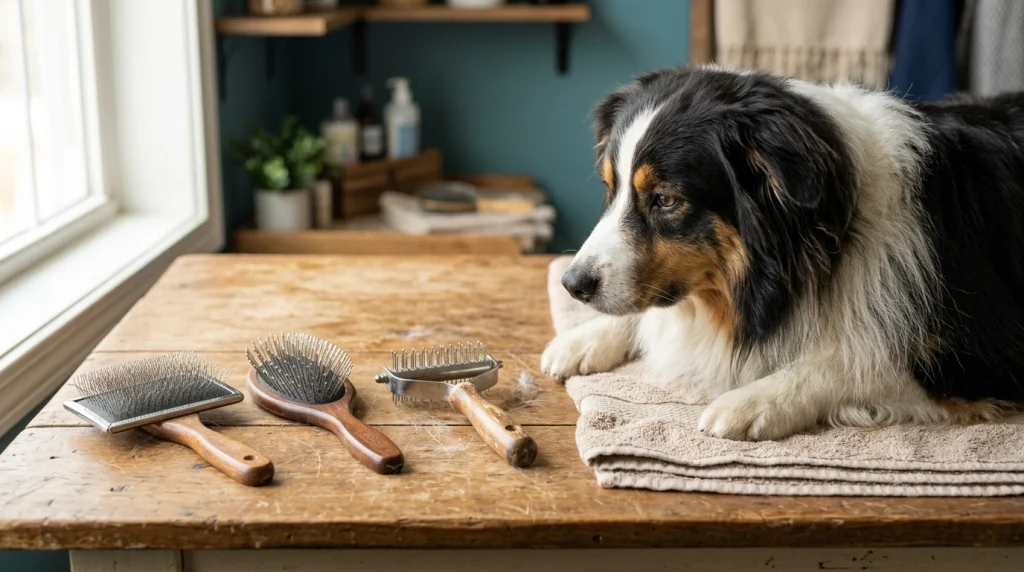
SaveIf you’re ready to choose a tool, I’d start with products that perform genuinely different jobs rather than buying several nearly identical brushes.
🏆 Best for Dense Long Coats
Chris Christensen Big G Slicker Brush
★★★★½
The Big G uses 27 mm pins and is designed for long coats. I like this type when shorter slicker pins barely reach through dense hair and section-by-section brushing is needed.
✨ Best for Silky Long Hair
Andis Large Pin Brush
★★★★☆
Its long-pin design is intended for brushing, detangling, smoothing, and finishing larger areas of coat. I would choose this style for maintained flowing hair where gentle separation matters more than aggressive undercoat removal.
🐾 Best for Thick Undercoat
Safari Double Row Undercoat Rake With Rotating Pins
★★★★½
The double-row rake uses rounded rotating pins designed for thick and heavy coats. I would use it before a slicker when a long-haired double-coated dog is releasing dense loose undercoat.
Frequently Asked Questions
Are slicker brushes good for long-haired dogs?
Yes. A slicker brush can work extremely well for long-haired dogs when its pins are long enough for the coat. It is especially useful for dense, curly, or tangle-prone hair, but use light pressure because repeatedly pressing metal pins against the skin can cause discomfort.
Is a pin brush good for long-haired dogs?
Yes. Pin brushes are a good choice for long, silky, flowing coats and for regular maintenance between more intensive grooming sessions. They separate and smooth hair with less resistance than many slickers, although they may not remove dense undercoat or established mats effectively.
Should I brush a long-haired dog wet or dry?
For routine grooming, I usually work on a dry or lightly conditioned coat rather than brushing soaking-wet tangled hair. Water can tighten some existing tangles as the coat dries, so removing obvious knots before bathing often makes the grooming process easier.
How do I know if my dog’s brush reaches the undercoat?
Part the hair and watch how deeply the pins travel. If they only move through the visible outer layer, the brush is too short or your technique is too superficial. A metal comb can also reveal loose undercoat and hidden tangles after brushing.
Can brushing too much damage a dog’s coat?
Yes. Repeated hard strokes, sharp tools, and aggressive de-shedding can irritate skin or pull healthy hair. Brush regularly but gently, change tools when needed, and stop working an area if the skin becomes red or your dog shows discomfort.
Final Takeaway: Match the Brush to the Coat Beneath the Hair
For most long-haired dogs, I would start with a long-pin slicker or pin brush and always keep a metal comb nearby. If the dog has a dense double coat, add an undercoat rake rather than expecting one brush to handle every layer.
The best brush should reach the coat without scratching the skin or constantly snagging. Choose the right pin length, work in small sections, and make regular grooming part of the routine before tangles become mats.
Start with the areas that mat fastest today. Once those stay comfortable and comb-through smooth, maintaining the rest of a long coat becomes much easier.

Thomas Cutter is a lifelong dog owner and the founder of FindOutAboutDogs.com. With over 10 years of hands-on experience owning multiple breeds, Thomas created this site to provide honest, research-based dog advice that real owners can actually trust.
