How to Choose a Dog Brush Based on Coat Type
Quick Answer
Choose a dog brush by matching the tool to your dog’s coat length, density, texture, and undercoat. Smooth coats usually suit rubber or bristle brushes, while long, curly, and double coats often need slickers, combs, or undercoat tools. The American Kennel Club’s dog brush guide also recommends choosing tools according to coat type rather than relying on one brush for every dog.
Choose Your Brush in Five Steps
- Check coat length: Short coats need less penetration than medium or long coats.
- Feel the density: Thick double coats need tools that can reach loose undercoat.
- Notice the texture: Curly, silky, wiry, and smooth coats behave differently when brushed.
- Match the tool: Use rubber, bristle, slicker, pin, comb, or rake according to the coat.
- Check comfort: The brush should move through the coat without scratching or repeated pulling.
One Useful Test
- After brushing, gently run an appropriate comb through longer or dense areas. Resistance can show that loose hair or tangles remain beneath the surface.
Walk into a pet store and you’ll see brushes that all promise easier grooming. The confusing part is that two good brushes can still be designed for completely different coats.
My rule is simple: start with the coat, not the packaging. Once you understand what your dog’s hair is doing, choosing the right tool becomes much easier.


What Does “Choosing a Brush by Coat Type” Mean?
Choosing a dog brush by coat type means matching the brush’s design to the length, texture, density, and layers of your dog’s coat. A tool that works beautifully on a Boxer may barely reach the undercoat of a Husky.
Coat type matters because brushes perform different jobs. Some loosen surface hair, while others separate long hair, remove tangles, or reach shedding undercoat.
- Smooth coat: Short hair lies close to the body and usually needs surface hair removal.
- Short dense coat: Short hair may hide a surprisingly thick shedding layer.
- Medium coat: Hair has enough length to tangle and may include an undercoat.
- Long coat: Long strands need separation, detangling, and careful brushing near the skin.
- Curly coat: Hair can trap loose strands instead of dropping them onto the floor.
- Double coat: A softer undercoat sits beneath protective outer hairs.
- Wire coat: Harsh outer hairs often need more specialized maintenance.
As of 2026, I still wouldn’t trust a label saying “for all coat types” without checking pin length, tooth spacing, and brush design. Those details tell you more than the front of the package.
Which Dog Brush Is Best for Each Coat Type?
 Save
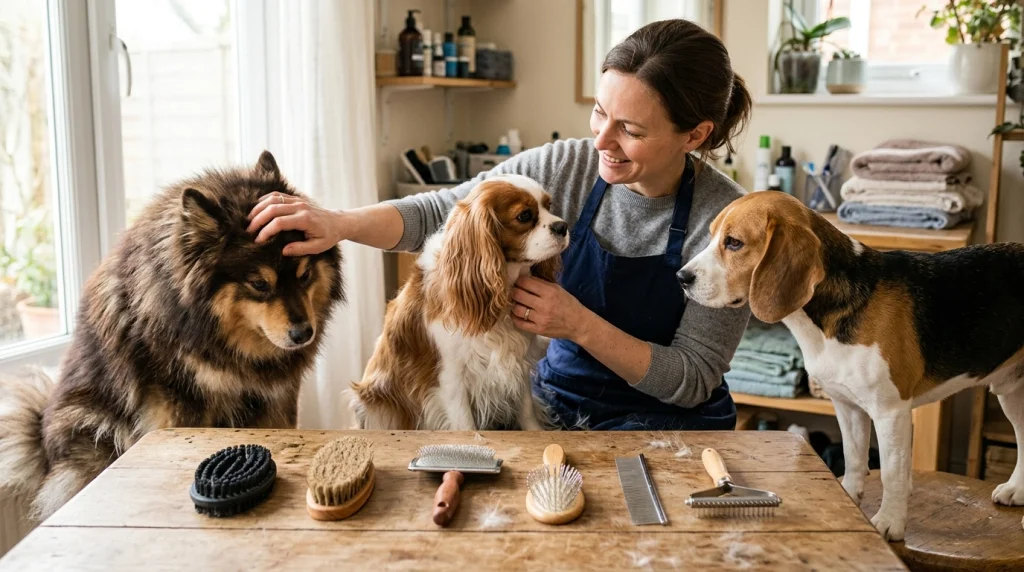
SaveThe best brush depends on what the coat needs the tool to accomplish. Smooth dogs usually need loose-hair removal, while dense or long-coated dogs need more reach.
| Coat Type | Good Starting Tool | Main Job | Examples |
|---|---|---|---|
| Smooth, short | Rubber curry brush or grooming mitt | Lift loose surface hair | Boxer, Pointer, short-coated Chihuahua |
| Short, dense | Bristle brush plus suitable shedding tool | Remove loose dense hair | Labrador Retriever, Pug, Beagle |
| Medium | Slicker or bristle brush with comb | Control loose hair and tangles | Golden Retriever-type coat |
| Long, silky | Pin brush and metal comb | Separate long hair and find tangles | Yorkshire Terrier, long-coated Spaniel |
| Curly | Slicker brush and metal comb | Prevent tangles and trapped loose hair | Poodle, Bichon Frise |
| Double | Undercoat rake plus slicker or comb | Reach loose undercoat | Husky, Corgi, Collie |
What Brush Should You Use on a Short-Haired Dog?
For a smooth short coat, start with a flexible rubber grooming brush, curry brush, or grooming mitt. These tools can lift dead surface hair without requiring long metal pins.
A bristle brush can follow the rubber tool. It helps collect loosened hair and smooth the coat.
- Rubber curry: Useful for massaging through short coats and loosening dead hair.
- Grooming mitt: Comfortable for dogs that dislike a traditional brush.
- Bristle brush: Useful as a finishing tool for smooth coats.
The AKC specifically identifies rubber brushes as useful for short-coated dogs. VCA also recommends flexible grooming gloves or short-bristled brushes for smooth-coated dogs.
You can review broader coat-care guidance at VCA Animal Hospitals.
What Brush Works Best for Long-Haired Dogs?
Long-haired dogs usually benefit from a pin brush, slicker brush, and metal comb rather than one tool alone. The brush separates the coat, while the comb helps find tangles the brush missed.
Pin length matters here. Pins that are too short may skim the surface while leaving deeper hair untouched.
- Separate the coat: Work in small sections rather than sweeping over the whole body.
- Brush gently: Move through the hair without repeatedly pulling against a knot.
- Check with a comb: Pass a metal comb through the section before moving on.
- Inspect friction areas: Pay extra attention behind the ears, under the legs, and around furnishings.
I like the comb check because it exposes false progress. A coat can look smooth on top while small tangles remain closer to the skin.
What Is the Best Brush for a Curly-Coated Dog?
A slicker brush paired with a metal comb is a practical starting combination for curly coats. Curly hair can hold loose strands inside the coat, which increases the chance of tangles developing unnoticed.
VCA specifically lists slicker brushes for curly, non-shedding coats such as Poodles. Gentle technique remains important because metal pins can irritate skin if you press too hard.
- Use sections: Brush a small area thoroughly before moving forward.
- Reach through the coat: Avoid brushing only the visible outer curls.
- Check with a comb: Resistance tells you more detangling may be needed.
- Don’t force mats: Tight matting may require an experienced groomer.
Curly coats are a good example of why shedding level doesn’t equal grooming difficulty. A dog may leave little hair on your sofa but still require frequent coat maintenance.
What Brush Should You Use for a Double-Coated Dog?
Double-coated dogs often need an undercoat rake, appropriate slicker, or long-toothed comb that can reach beneath the outer coat. The goal is to remove loose undercoat without repeatedly scraping the skin.
The AKC describes undercoat rakes as tools designed to penetrate the coat and remove loose undercoat. It also stresses choosing a pin length suited to the dog’s coat length.
- Normal maintenance: Use a suitable slicker, rake, or comb according to coat density.
- Heavy shedding: Focus on loose undercoat using controlled, gentle strokes.
- Final check: A metal comb can help identify packed areas that still need attention.
- Skin safety: Stop if you see redness or your dog reacts to repeated pulling.
For a breed-specific example, double-coated Husky owners can compare how an undercoat rake and slicker brush serve different grooming jobs.
Slicker Brush vs Bristle Brush vs Undercoat Rake: What’s the Difference?
 Save
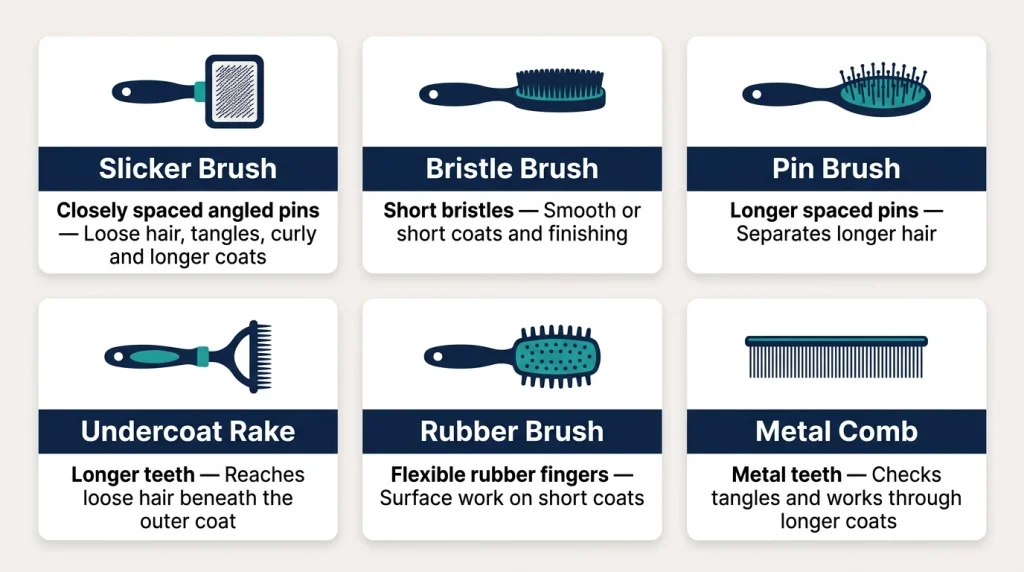
SaveA slicker separates hair and removes loose fur, a bristle brush works closer to the surface, and an undercoat rake reaches deeper shedding layers. They aren’t interchangeable tools.
- Slicker brush: Closely spaced angled pins help with loose hair, tangles, curly coats, and many longer coats.
- Bristle brush: Short bristles work well on many smooth or short coats and as a finishing tool.
- Pin brush: Longer spaced pins help separate longer hair without the density of a slicker.
- Undercoat rake: Longer teeth reach loose hair beneath the outer coat of double-coated dogs.
- Rubber brush: Flexible rubber fingers work mainly at the surface of short coats.
- Metal comb: Useful for checking tangles and working through longer coats carefully.
No tool should require brute force. If a brush repeatedly snags, reconsider the technique, pin length, tooth spacing, or condition of the coat.
How Do You Know if a Dog Brush Is the Wrong Type?
A brush is probably a poor match if it never reaches the loose hair, repeatedly catches the coat, scratches the skin, or makes grooming uncomfortable. More pressure isn’t the solution.
Watch your dog as closely as you watch the brush. Pulling away, sudden sensitivity, or skin redness deserves attention.
- Only surface hair moves: The tool may be too short for a dense coat.
- Constant snagging: The brush may be too dense, or tangles may need separate attention.
- Red skin appears: Pressure may be excessive or the tool may be too harsh.
- The coat stays packed: A double coat may need an undercoat-specific tool.
- Long hair looks smooth but combs poorly: You’re probably brushing only the surface.
Regular brushing also gives you a chance to notice skin changes. AKC grooming guidance recommends checking for cuts, sore spots, debris, and other abnormalities while you work.
See the AKC’s general home grooming guidance for broader brushing, bathing, and coat-care considerations.
How Often Should You Brush Each Coat Type?
There isn’t one brushing schedule that fits every dog. Coat length, density, shedding cycle, activity, and tendency to mat all affect frequency.
| Coat | Practical Starting Point | Increase Brushing When |
|---|---|---|
| Smooth, short | About weekly | Loose hair increases |
| Medium | Several times weekly as needed | Tangles or seasonal shedding increase |
| Long or curly | Frequent brushing, sometimes daily | Friction areas start tangling |
| Double coat | Weekly or more often as needed | Seasonal undercoat loosens heavily |
AKC guidance notes that long-coated dogs may need brushing as often as daily, while some short-coated dogs need considerably less work. Individual dogs still vary.
What Should You Look for When Buying a Dog Brush?
 Save
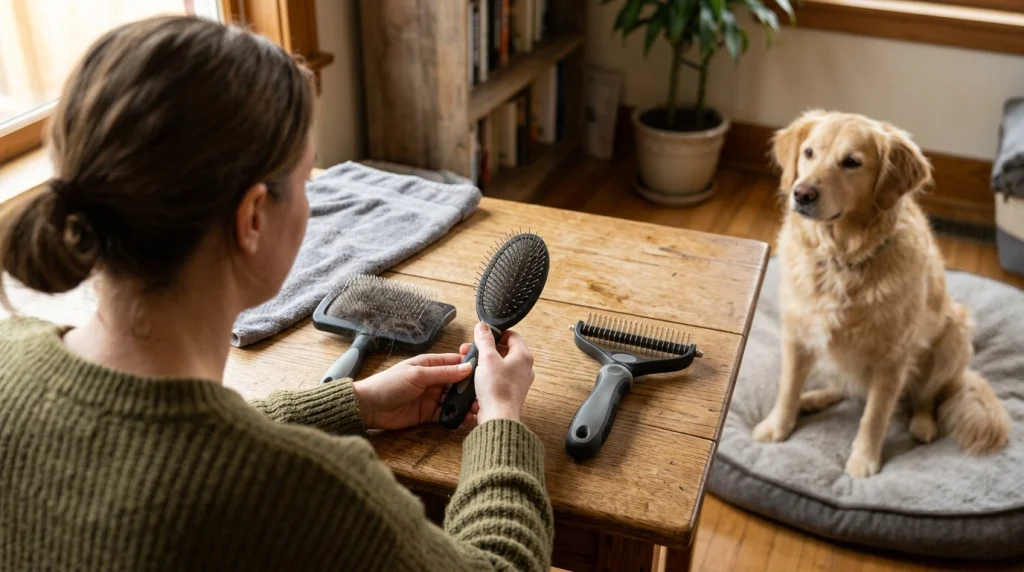
SaveOnce you’ve chosen the right brush category, compare size, pin length, tooth spacing, construction, and handle comfort. These details determine whether the tool works well on your individual dog.
- Correct reach: Pins or teeth should suit the coat’s depth.
- Smooth finish: Rough metal edges can make grooming uncomfortable.
- Appropriate head size: Large heads cover the body faster, while smaller ones offer control.
- Comfortable grip: A good handle helps during longer grooming sessions.
- Easy cleaning: Hair-filled brushes become annoying quickly during heavy shedding.
- Dog comfort: A technically effective tool isn’t useful if it requires harsh pressure.
Don’t judge a brush by how enormous the pile of removed hair looks in an advertisement. The better question is whether it removes the right hair comfortably.
If you’re ready to choose a tool, these are three coat-specific options I’d consider:
Best for Smooth Short Coats
KONG ZoomGroom Dog Brush
★★★★½
Its flexible rubber fingers suit surface-level loose-hair removal and massage on short coats. I prefer this style when long metal pins would add little benefit.
Premium Pick for Long Coats
Chris Christensen Big G Slicker Brush
★★★★½
The Big G uses 27 mm stainless-steel pins and is designed for longer coats. I like the longer-pin concept when a short slicker keeps skating over dense or curly hair.
Best for Loose Undercoat
Maxpower Planet Double-Sided Undercoat Rake
★★★★☆
This double-sided rake is designed for undercoat and detangling work rather than surface brushing. I see it as a specialized option for dense coats, not a universal everyday brush.
Frequently Asked Questions
Can I use the same brush on every dog?
No. Different coat types need different levels of reach, separation, and loose-hair removal. A rubber brush that works well on a Boxer won’t penetrate a Husky’s dense undercoat, while a long metal rake would usually be unnecessary for a very smooth coat.
Is a slicker brush good for all coat types?
A slicker is useful for many medium, long, curly, and dense coats, but it isn’t automatically the best choice for every dog. Smooth short coats may respond better to rubber or bristle tools, and double coats may also need an undercoat rake.
How do I know whether my dog has an undercoat?
Part the coat and look beneath the outer hairs. Double-coated dogs usually have a softer, denser layer close to the skin beneath coarser guard hairs. A groomer, breeder, or veterinarian can help if your dog’s coat structure isn’t obvious.
Should brushing ever hurt my dog?
No. Brushing should not involve repeated scratching, forceful pulling, or skin irritation. If the brush keeps catching, stop and inspect the coat for tangles, mats, debris, or sensitive skin before continuing.
What should I do if my dog’s coat is badly matted?
Don’t aggressively pull or cut close to the skin. Tight mats can sit much closer to the skin than they appear, making home removal risky. An experienced professional groomer or veterinary team can advise on the safest approach.
Final Takeaway: Match the Brush to the Coat
The easiest way to choose a dog brush is to stop asking which brush is universally best. Ask what your dog’s coat needs instead.
Use rubber or bristle tools for many short coats, slickers and combs for longer or curly coats, and undercoat tools for dense double coats. Then adjust the exact pin length, size, and brushing frequency to your individual dog.
Keep pressure gentle and check the skin as you work. A good grooming tool should make coat care easier without turning brushing into a fight.

Thomas Cutter is a lifelong dog owner and the founder of FindOutAboutDogs.com. With over 10 years of hands-on experience owning multiple breeds, Thomas created this site to provide honest, research-based dog advice that real owners can actually trust.
