10 Best Brushes for Long-Haired Dog Mats in 2026
The best brush for long-haired dog mats is the Chris Christensen Big G Slicker Brush, with 27 mm pins designed for dense coats. We compared 10 published product specifications using mat suitability, coat comfort, and ease of use, without performing hands-on tests. A shiny topcoat can still conceal painful tangles near the skin. Whether you groom a doodle, manage a shedding double coat, or handle occasional knots, this guide explains the right tool.
The long angled pins, flexible cushion, and three head sizes make this the most versatile researched option here for regular brushing of dense, curly coats. Hard, skin-level mats still require a professional.


Quick Comparison: All 10 Grooming Tools Ranked
| # | Product | Best For | Editorial fit | Badge | |
|---|---|---|---|---|---|
| 1 | Chris Christensen Big G Slicker Brush | Curly doodles and long, dense coats | 4.6/5 | Best Overall | View → |
| 2 | Maxpower Planet Original Pet Grooming Rake | Thick double coats with loose undercoat | 4.3/5 | Best Budget Rake | View → |
| 3 | GoPets 2-in-1 Dematting Comb | Loosening accessible knots in thicker coats | 4.2/5 | Best for Small Mats | View → |
| 4 | Artero Double Flexible Slicker Brush | Contours and frequent maintenance of long coats | 4.5/5 | Best Flexible Head | View → |
| 5 | FURminator Adjustable deMatting Tool | Localized, loosened tangles on varied coat lengths | 4.2/5 | Best Adjustable Tool | View → |
| 6 | Safari by Coastal Dog De-Matting Comb | Small coarse-coat tangles away from sensitive skin | 4.0/5 | Best Targeted Comb | View → |
| 7 | Andis Large Firm Slicker Brush | Broad areas of dense, long coat | 4.3/5 | Best Large-Coverage | View → |
| 8 | We Love Doodles Large Slicker Brush | Curly and wavy long-coated dogs | 4.5/5 | Best for Doodles | View → |
| 9 | Chris Christensen Big A Slicker Brush | Long coats needing a lighter slicker action | 4.5/5 | Best for Gentle Finish | View → |
| 10 | FURminator Large Dog deShedding Tool for Long Hair | Already-detangled long double coats | 4.0/5 | Best for Shedding | View → |
Editorial fit scores are desk-research judgments based on published features and intended coat types; they are not customer ratings, laboratory findings, or hands-on test results.
How We Selected These Grooming Tools
What we reviewed
10 distinct grooming tools, using published manufacturer descriptions and independent pet-care guidance; no physical testing was performed.
Our three criteria
Mat suitability, coat-comfort features, and everyday ease of use. Each editorial-fit score is out of five.
Safety reference
A veterinarian-reviewed PetMD grooming guide informed the cautions about painful or skin-level mats; no expert was personally interviewed.
What we excluded
Unverifiable performance claims, duplicate variants, and generic tools without enough published details for a meaningful comparison.
What to Look for When Buying a Long-Hair Dog Brush
Different coat problems need different tools. Match your brush to whether you are separating curls, removing shed undercoat, or working on a small, loose knot.
1. Coat type comes first
Curly or woolly hair typically benefits from a long-pin slicker followed by a metal comb, while a double coat often needs a suitable undercoat rake. The goal is to reach the coat below the visible surface without scraping the skin. For the practical technique, follow this step-by-step long coat brushing guide.
2. Pin length and head size
Longer pins can separate deeper coat, but an oversized head is awkward behind ears and at leg joints. Select a head that lets you work in narrow, comfortable sections. A 27 mm long-pin slicker offers a different reach than a short surface brush; neither should be pressed into irritated skin.
3. Safety matters more than speed
Check whether a tool has plain rounded pins or cutting blades: these do different jobs. Serrated dematting tools can cut coat and should be used only on manageable, isolated knots, never tight skin-level mats. The safest next step for painful mats is a professional groomer or veterinarian.
4. Maintenance and comb verification
A self-cleaning head makes routine brushing faster, but a finishing metal comb tells you whether deeper tangles remain. Comb through small sections without forcing resistance, especially behind collars and legs. Learn to check for hidden coat mats after the main brushing step.

Chris Christensen Big G Slicker Brush
Long curly coats can hide tangles even when the surface looks fluffy. The Chris Christensen Big G is a strong primary brush for routine line brushing because its 27 mm angled stainless-steel pins reach into substantial coat depth, and its flexible cushion supports controlled strokes. The manufacturer offers Baby, Medium, and Large head sizes so owners can match the brush to body areas instead of forcing a large head behind small ears. It is intended for detangling and lifting undercoat, not cutting hard felted mats. Expect manual hair removal and a premium investment compared with simple slickers.
- 27 mm angled stainless-steel pins
- Flexible cushion helps moderate pressure
- Three head sizes for different body areas
- Hair must be cleared manually
- Large head awkward behind ears
4.9/5
4.6/5
4.4/5

Maxpower Planet Original Pet Grooming Rake
A heavy-shedding dog can accumulate loose undercoat beneath a clean-looking topcoat. Maxpower Planet offers an accessible rake-style option with nine widely spaced teeth on one side and seventeen closer-spaced teeth on the other. The wider side helps approach manageable tangles, while the narrower side gathers already-loose undercoat. Its nonslip handle is useful when grooming a large dog in short sessions. This is not a substitute for a long-pin slicker on fine, curly doodle hair. Its cutting-style teeth also demand a lighter hand than a plain round-pin comb, particularly near sensitive skin.
- Nine-tooth and seventeen-tooth sides
- Targets trapped loose undercoat
- Nonslip grip for controlled strokes
- Not a finishing brush for curls
- Cutting teeth require careful pressure
4.3/5
4.0/5
4.6/5

GoPets 2-in-1 Dematting Comb
Small, reachable knots sometimes need a specialized tool after ordinary brushing stops working. The GoPets 2-in-1 Dematting Comb combines a twelve-blade side for breaking up manageable tangles with a twenty-three-blade side intended for loose coat removal. Its soft, nonslip handle can improve grip while you support the hair near a knot. Because the curved inner edges cut fibers, this tool may shorten or thin the surrounding coat, which matters for show coats and delicate textures. Do not use it to attack a tight mat stuck to skin; professional removal is safer in that situation.
- 12-blade side targets manageable tangles
- 23-blade side gathers loose hair
- Soft nonslip grip
- Cutting edges can shorten healthy hairs
- Not safe for skin-level felted mats
4.5/5
3.8/5
4.2/5

Artero Double Flexible Slicker Brush
A rigid slicker can feel awkward around shoulders, ribs, and other curved areas on a long-haired dog. Artero uses a semi-articulated body and two pin faces, allowing the brush head to follow contours while you work through loose tangles. The manufacturer lists roughly 0.6-inch pins and separate faces for ordinary brushing and detangling. This makes it an interesting choice when you prefer one tool for routine coat separation and mild knot management. It cannot replace a comb check at the roots, and the firmer detangling face still requires gentle pressure around thin skin or sore areas.
- Semi-articulated brush head
- Two faces for different grooming tasks
- 0.6-inch pins for general brushing
- Shorter pins than specialist long-pin slickers
- Firm face needs careful pressure
4.6/5
4.6/5
4.2/5

FURminator Adjustable deMatting Tool
When one household has dogs with different coat lengths, a fixed dematting cutter can be inconvenient. FURminator makes this specialized tool with adjustable curved cutting edges, a locking slide, and a nonslip grip. The adjustable setting allows the owner to change the exposed working edge, rather than carrying several mat splitters. It is intended for occasional mat management, not as the only daily brush. Cutting tools can damage coat length when used indiscriminately, and the adjustment does not make tightly felted, painful mats safe for home removal. Use a normal slicker and comb for maintenance between problem areas.
- Adjustable curved cutting edges
- Slide lock secures the setting
- Nonslip ergonomic handle
- Cuts hair rather than merely separating it
- Poor substitute for routine brushing
4.2/5
3.9/5
4.4/5

Safari by Coastal Dog De-Matting Comb
Narrow tangles around feathering or a collar sometimes call for a smaller cutting comb instead of a broad slicker head. The Safari by Coastal Dog De-Matting Comb has a single row of serrated stainless-steel blades and a contoured grip designed for medium and long coats. Its compact working area is useful when you can isolate a loose knot and hold the surrounding fur gently. The same serrated edges make it a poor choice for repeatedly dragging through delicate coat sections. Keep it away from sensitive anatomy and stop whenever the dog resists; professional grooming is preferable for close-to-skin mats.
- Narrow head for isolated tangles
- Serrated stainless-steel blades
- Contoured handle
- Can remove healthy coat along with knots
- Not suitable for painful tight mats
4.2/5
3.7/5
4.0/5
Andis Large Firm Slicker Brush
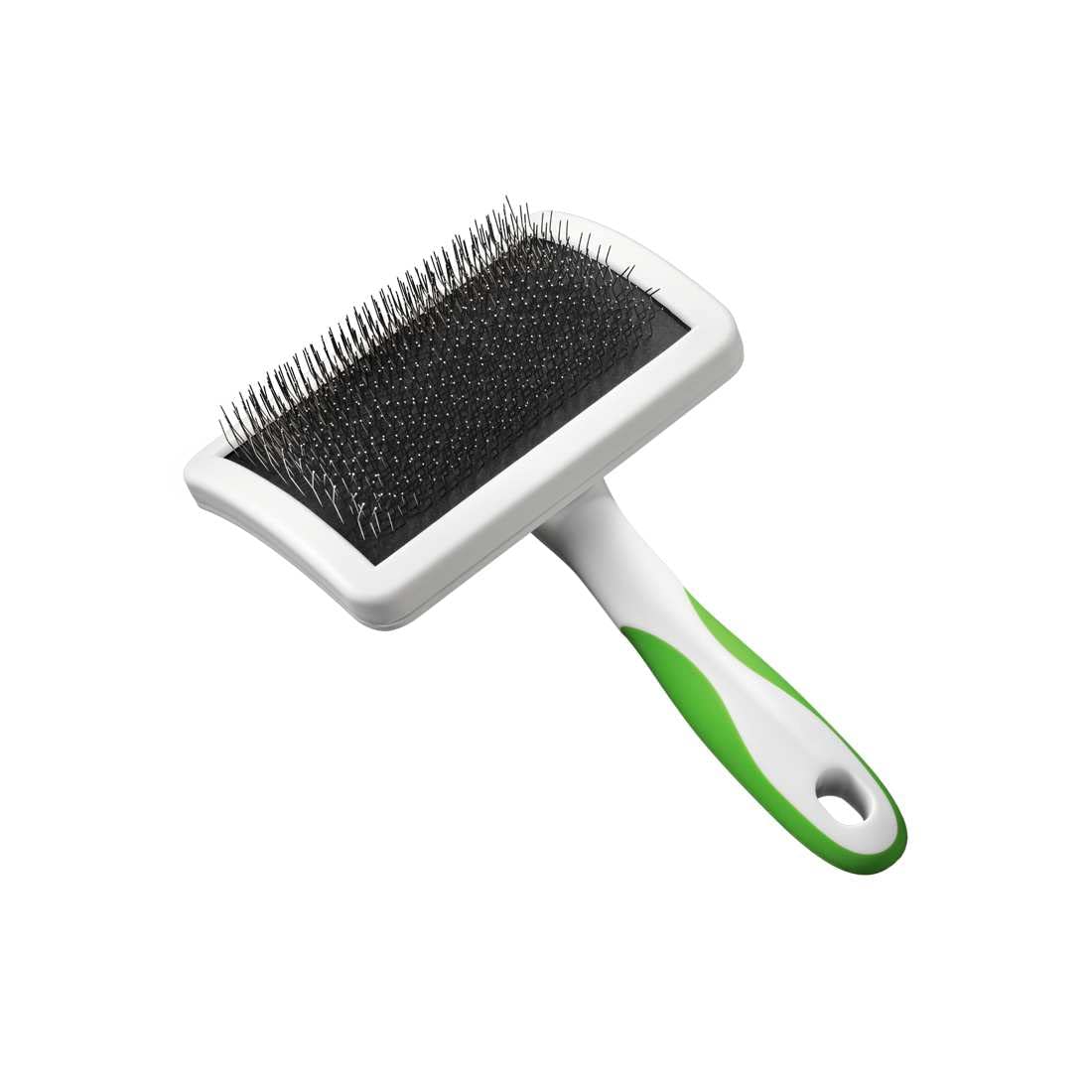
A large dog needs enough brush coverage to make regular maintenance practical. The Andis Large Firm Slicker Brush has a broad working head and firm wire pins intended to reach into dense coats and collect loose hairs. Its simple design suits owners who already know how to separate long hair into small rows and work with light strokes. The firm action is also the key limitation: bony areas, thin skin, and stressed pets may need a softer brush. It does not have a hair-release button or a specialized cutter, so hard mats should not be forced through its pins.
- Broad head covers larger body sections
- Firm pins reach dense coats
- Simple no-adjustment design
- Firm pins may irritate sensitive skin
- No self-cleaning mechanism
4.3/5
4.0/5
4.5/5

We Love Doodles Large Slicker Brush
Curly Goldendoodle and Poodle mixes often need pins long enough to separate hair instead of polishing the surface. The We Love Doodles Large Slicker Brush uses one-inch angled stainless-steel pins and a wide head aimed at dense curls and long coats. Its curved handle may be easier to manage during repeated line-brushing sessions. Owners with shorter-trimmed dogs or small faces should consider a smaller size, since the large head is less precise near ears and legs. As with any slicker, finish with a metal comb: fluffy appearance alone does not prove that deeper knots have been removed.
- One-inch angled stainless-steel pins
- Wide head for curly coats
- Smaller size also available
- Large head lacks detail-area precision
- Requires a finishing comb check
4.7/5
4.3/5
4.4/5

Chris Christensen Big A Slicker Brush
Some long-haired dogs dislike a densely packed slicker even when their coat needs regular maintenance. Chris Christensen positions the Big A as a gentler long-pin option for varied long coat textures, with twenty-seven-millimeter pins and spacing designed for separation and finishing. That makes it a useful alternative when a firmer dematting-focused brush feels excessive for an otherwise manageable coat. It still needs patient handling: any wire pin can irritate skin if pressed too hard, especially over joints. Choose this for preventive brushing and coat finish rather than expecting it to cut out stubborn, felted mats.
- 27 mm pins for substantial coat depth
- Gentler long-coat positioning
- Suitable for preventive line brushing
- Not a cutting dematting tool
- Premium compared with basic slickers
4.4/5
4.8/5
4.2/5

FURminator Large Dog deShedding Tool for Long Hair
A Golden Retriever or similar double-coated dog may look tangled because loose undercoat collects behind longer guard hairs. The FURminator Long Hair deShedding Tool is designed to remove released undercoat after knots have already been addressed. Its stainless-steel deShedding edge reaches through the topcoat, while a hair-ejection button simplifies cleanup. The Large version is intended for dogs in the brand’s 51-to-90-pound sizing range, so it is not a universal fit. This is a shedding-management tool, not a mat cutter. Avoid dragging it through knotted, irritated, or unsuitable coats, and use only as directed.
- Stainless-steel undercoat removal edge
- Hair-ejection button
- Defined long-hair size option
- Does not solve attached mats
- Inappropriate for some non-shedding coats
3.6/5
3.9/5
4.5/5
Top 3 Head-to-Head: Big G vs Maxpower Rake vs GoPets Comb
These three tools address different problems: preventive curl brushing, seasonal undercoat management, and localized manageable knots. Their fit scores are editorial comparisons of documented features, not measured laboratory results.
| Feature | Big G | Maxpower Rake | GoPets Comb |
|---|---|---|---|
| Tool type | Long-pin slicker | Dual-sided rake | Bladed comb |
| Most useful for | Curly preventive care | Dense loose undercoat | Small accessible knots |
| Cutting blades | No | Yes | Yes |
| Daily routine | Primary brush | Supplement | Occasional tool |
| Choose if | Coat is long and curly | Double coat sheds heavily | Loose knots need spot care |
Who These Brushes Are NOT For
No home brush is the right response to every kind of matting.
For dogs that repeatedly flinch, pull away, or guard a body area, see signs brushing is causing discomfort before trying a stronger tool. A groomer can advise whether to brush, trim, or remove the affected coat.
Common Mistakes to Avoid
Most frustrating grooming sessions begin with the wrong tool or too much pressure.
Frequently Asked Questions About Long-Haired Dog Mats
What type of brush is best for long-haired dogs with mats?
For regular prevention, a long-pin slicker brush paired with a metal finishing comb is a strong starting combination for many long and curly coats. A double-coated dog may also benefit from an undercoat rake during shedding. A bladed dematting tool is different: it cuts through limited tangles and is not the safest everyday brush. Choose based on coat texture and stop if the dog shows pain.
Can you brush severe mats out of a dog’s coat?
Severe, tight mats should not be forced out with a brush. Felted hair can pull painfully on skin, hide sores, and make it difficult to see where the coat ends. If a mat lies flat against skin, covers a large area, or causes distress, arrange removal by a professional groomer or veterinarian. Avoid household scissors because a dog may move and the folded skin is easy to cut.
Should I use a slicker brush or an undercoat rake?
Use a slicker brush to separate many long or curly coats and collect loose surface hair; choose an undercoat rake when a suitable double coat holds significant released undercoat. Neither tool fits every dog. Curly, low-shedding breeds may need careful slicker-and-comb maintenance rather than aggressive raking. For long double coats, the tools can complement each other, but always check for tangles before using a deShedding edge.
How often should a long-haired dog be brushed?
Many long, curly, or easily tangled coats need brushing daily or every other day, while other long coats may manage with several thorough sessions per week. Coat length, friction from a harness, outdoor activity, and shedding all change the schedule; see the dog brushing schedule by coat type. Give extra attention to the ears, armpits, collar area, tail, and rear feathering. A groomer can tailor the frequency to your dog’s coat and skin condition.
Can a dematting rake damage a dog’s coat?
Yes. Many dematting rakes use sharpened inner edges that cut through knots and may also sever healthy hair when used repeatedly. That trade-off is acceptable only for the right kind of small, manageable tangle. A bladed rake is not the same as a rounded-pin undercoat rake or regular slicker brush. If the coat is delicate, the dog is uncomfortable, or the knot is near skin, stop and get professional help.
How do I tell whether all hidden knots are gone?
Part the coat into small sections and gently pass a suitable metal comb from the outer hair toward the root. Do not force the comb when it catches. Recheck friction zones such as behind ears, under a collar, and along the legs. Surface fluff is not a reliable indicator because mats can develop below it. Repeated snagging in the same spot suggests more careful detangling or a professional assessment is needed.
Is it safe to cut a matted dog’s hair with scissors?
No. Avoid ordinary scissors for mats, especially close to the skin. A tight knot can draw folds of skin into the hair, making accidental cuts much more likely than they appear. A qualified groomer can assess whether appropriate clipping is safer, and a veterinarian should evaluate painful or damaged skin. At home, focus on prevention and gentle removal of loose tangles rather than cutting attached mats.
Our Final Verdict
For long, curly coats, the Big G is our first-choice brush based on its 27 mm pins, curved design, and flexible cushion. A double-coated shedder may benefit more from a rake, while a small isolated knot can warrant a dedicated tool. None of these products should be used to force painful, skin-level mats.

Thomas Cutter is a lifelong dog owner and the founder of FindOutAboutDogs.com. With over 10 years of hands-on experience owning multiple breeds, Thomas created this site to provide honest, research-based dog advice that real owners can actually trust.
