Dog Brush vs Dog Comb: Which Should You Use?
Quick Answer
A dog brush is usually best for removing loose hair, smoothing the coat, and handling larger areas. A dog comb is better for finding small tangles, checking whether brushing reached the skin, and working carefully around ears, legs, and other detailed areas. For many medium-, long-, curly-, and double-coated dogs, I use both tools rather than choosing only one. If your dog has a dense double coat, this guide to brushes for dense coats shows why tool choice matters.
The main differences
- Brush for coverage: A brush handles large sections of coat quickly and collects loose hair.
- Comb for checking: A comb reveals tangles that a brush may glide over or miss.
- Short coats: A rubber or bristle brush may be all many short-coated dogs need.
- Long coats: A suitable brush followed by a metal comb gives a more complete result.
- Curly coats: Slicker brushes and combs work together to find and prevent hidden tangles.
- Never force either: Stop when a tool catches instead of pulling painfully through resistance.
My simple rule
- Brush to remove and separate hair, then comb to check that you actually finished the job.
I used to think a brush and comb were interchangeable grooming tools. They aren’t.
Once you work with different coat types, the difference becomes obvious. The brush does most of the broad work, while the comb tells you what the brush missed.


What Is the Difference Between a Dog Brush and Dog Comb?
A dog brush uses bristles, pins, wires, or rubber teeth over a wider surface. It is designed to move through larger sections of coat and collect loose hair, dirt, or light tangles.
A dog comb has one or more rows of individual teeth. Those teeth separate smaller sections of hair and make it easier to detect tangles close to the skin.
The difference matters because a dog’s coat can look perfectly smooth on top while still hiding knots underneath.
- Slicker brush: Fine angled wires help separate coat and remove loose hair or small tangles.
- Pin brush: Longer pins work through many medium and long coats with less coat compression.
- Bristle brush: Short bristles suit many smooth and short coats.
- Rubber brush: Flexible rubber teeth lift loose hair from short coats.
- Metal comb: Widely or narrowly spaced teeth help detect tangles and check the finished coat.
The American Kennel Club’s brush guide also matches different brush styles to different coat types.
Dog Brush vs Dog Comb: Which Is Better?
 Save
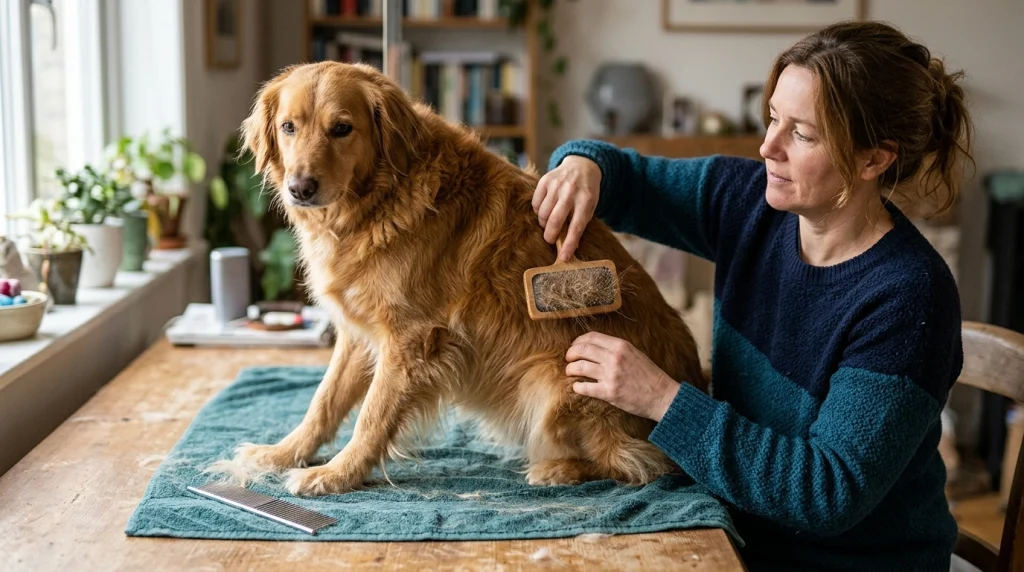
SaveNeither tool is universally better. The right choice depends on what you are trying to accomplish and what type of coat your dog has.
If I need to remove loose fur from an entire body, I reach for a brush first. If I need to check behind the ears or confirm a long coat is tangle-free, I reach for the comb.
| Feature | Dog Brush | Dog Comb |
|---|---|---|
| Best purpose | Loose hair, smoothing, broad grooming | Detail work, tangle detection, final checking |
| Coverage | Large | Small and precise |
| Loose-hair removal | Usually excellent with the correct brush | Useful, but slower |
| Finding hidden tangles | Moderate | Excellent |
| Short coats | Often the main tool | Often optional |
| Long or curly coats | Main grooming tool | Important finishing tool |
| Double coats | Usually essential | Useful for checking dense areas |
When Should You Use a Dog Brush?
Use a dog brush when your main job is removing loose hair, spreading the coat apart, or covering the body efficiently. The exact brush still needs to match the coat.
The ASPCA notes that grooming routines vary by coat type and recommends different tools for smooth, dense, and long coats.
- Smooth short coat: Try a rubber grooming brush or short bristle brush.
- Medium coat: A slicker or suitable bristle brush can remove loose hair.
- Long coat: A pin or slicker brush helps separate hair section by section.
- Curly coat: A slicker can help prevent loose curls from tightening into tangles.
- Double coat: Use tools long enough to reach loose undercoat rather than brushing only the surface.
You can read the ASPCA’s broader dog grooming guidance for coat-specific brushing examples.
Is a brush better for shedding?
Usually, yes. A properly selected brush covers more coat and removes loose hair more efficiently than a standard comb.
That doesn’t mean the most aggressive tool removes hair best. I stop when the coat releases easily instead of repeatedly scraping one patch because more fur continues appearing.
For heavy double-coated shedding, our guide on managing shedding in a Siberian Husky shows why reaching the undercoat matters.
When Should You Use a Dog Comb?
Use a dog comb when precision matters. A comb is one of the easiest ways to discover whether a coat is genuinely tangle-free beneath the surface.
I especially like a steel comb as my final check on longer coats. If the comb travels comfortably from near the skin toward the ends, I know my brushing reached the full coat.
- Behind the ears: Fine hair can tangle where collars, ears, and movement create friction.
- Leg furnishings: Longer leg hair often needs more precise checking.
- Tail: A comb helps separate long tail hair into manageable sections.
- Beard and face: A smaller comb gives more control than a large brush.
- After brushing: The comb can reveal small knots hidden below a smooth surface.
Can you use only a comb on a dog?
You can on some dogs, but it is often inefficient. Combing an entire large or thick coat takes longer because each pass covers less area.
A comb also should not become a tool for ripping out a tight mat. If it meets strong resistance, stop and inspect the area.
Should You Brush or Comb a Dog First?
 Save
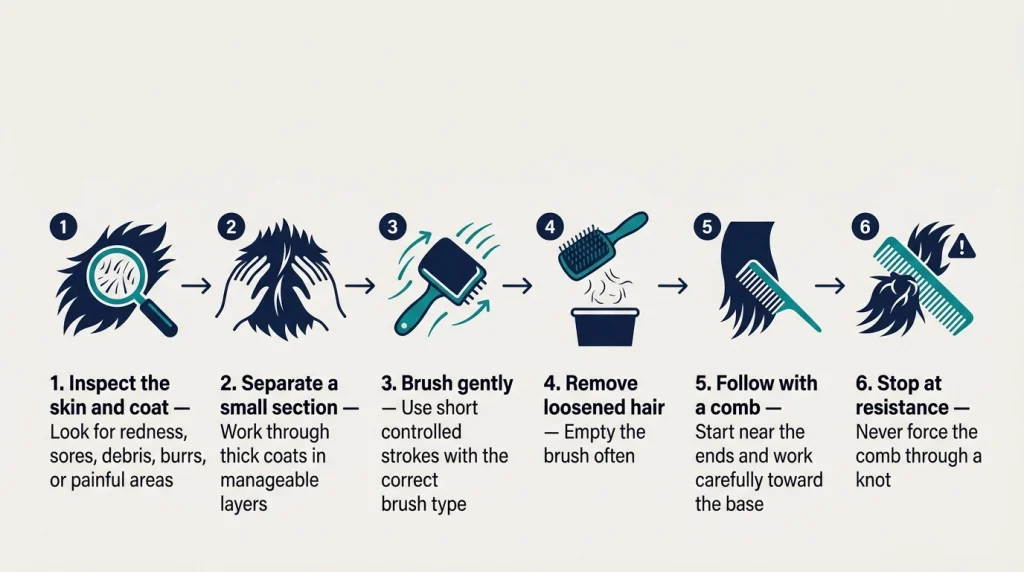
SaveFor most medium, long, curly, or dense coats, I brush first and comb second. The brush removes the easy loose material, while the comb checks smaller sections afterward.
This two-tool routine is simple and gives me much better feedback than brushing alone.
- Inspect the skin and coat. Look for redness, sores, debris, burrs, or painful areas.
- Separate a small section. Work through thick coats in manageable layers.
- Brush gently. Use short controlled strokes with the correct brush type.
- Remove loosened hair. Empty the brush often so it continues working properly.
- Follow with a comb. Start near the ends of tangled hair and work carefully toward the base.
- Stop at resistance. Never force the comb through a knot.
VCA Animal Hospitals recommends choosing tools according to hair-coat type and using gentle technique instead of excessive pulling. Their dog coat-care guidance also explains when combs and different brush styles are useful.
Which Tool Should You Use for Your Dog’s Coat?
Your dog’s coat matters more than the word printed on the package. I would rather use two appropriate basic tools than one expensive tool that does not reach the coat correctly.
- Boxer, Beagle, or similar smooth coat: Start with a rubber grooming brush or soft bristle brush.
- Labrador or other short dense coat: Use a brush suited to shedding and follow with a comb where needed.
- Golden Retriever or spaniel: Use a slicker or pin brush, then check feathering with a metal comb.
- Poodle or curly coat: Use a slicker in sections, then check thoroughly with a comb.
- Collie or long double coat: Use tools capable of penetrating the coat, then comb detailed areas.
- Husky or dense double coat: Focus on loose undercoat first, then finish and check with other tools.
Can a Dog Comb Remove Mats?
A comb can loosen a small, mild tangle, but it should not be forced through a tight mat. A dense mat may sit very close to the skin and can be painful when pulled.
This is one grooming situation where more force makes the problem worse.
- Stop if your dog cries, snaps, flinches, or repeatedly tries to escape.
- Do not yank a comb through a knot.
- Do not use household scissors against a tight mat near the skin.
- Get professional help with large, tight, painful, or sensitive-area mats.
- Ask a veterinarian to check redness, wounds, odor, swelling, or damaged skin.
Current veterinary guidance from PetMD warns that mats can pull on the skin and recommends professional help for severe or painful matting. VCA similarly advises caution because dog skin can be accidentally injured during mat removal.
Common Brush and Comb Mistakes I Avoid
 Save
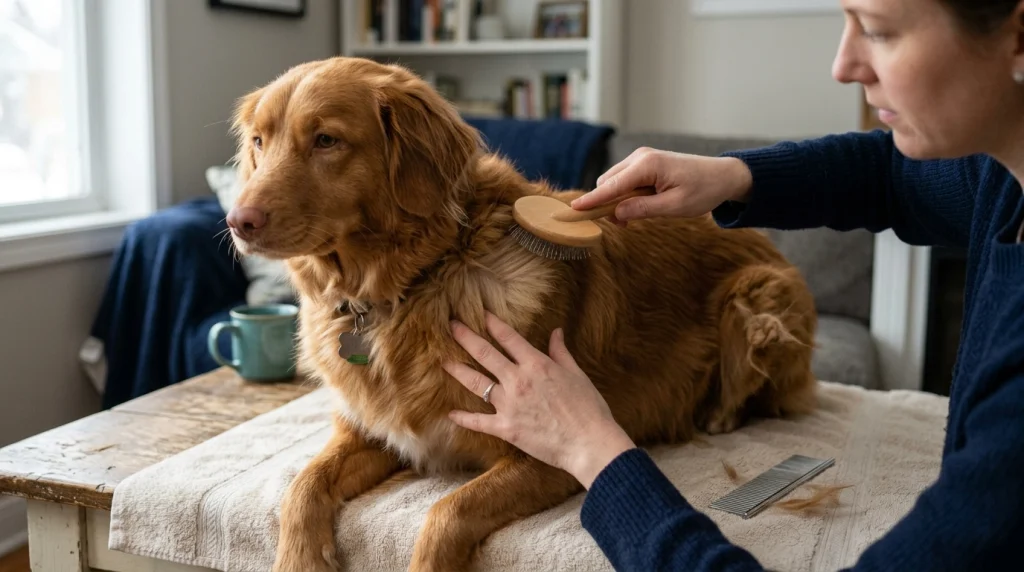
SaveMost grooming problems I see come from technique rather than owning the wrong brand. Even an excellent brush can be uncomfortable when pushed too hard.
- Brushing only the top: A fluffy surface can hide tangles underneath.
- Using too much pressure: Metal pins do not need to scrape the skin to work.
- Pulling through knots: Separate the hair and work gradually instead.
- Ignoring coat type: A short rubber brush cannot perform deep double-coat work.
- Skipping the comb check: This is how small hidden tangles can become bigger mats.
- Grooming too long: Short calm sessions often work better than one frustrating marathon.
As of 2026, my simplest rule remains unchanged: choose tools according to coat structure and use them gently. A dramatic pile of removed hair is not proof of better grooming.
Do You Really Need Both a Dog Brush and Comb?
If your dog has medium, long, curly, feathered, or dense hair, I recommend keeping both. They perform different jobs and work well as a pair.
Owners of smooth, short-coated dogs may need only a rubber or bristle brush for routine maintenance. A comb becomes more useful as coat length, density, or tangle risk increases.
Think of the brush as the cleaning tool and the comb as the inspection tool. That distinction makes choosing equipment much easier.
If you’re ready to build a simple grooming kit, these are three tools I would consider for different jobs:
🏆 Best Everyday Slicker
Hertzko Self-Cleaning Slicker Brush
★★★★½
This widely available slicker design uses fine bent wires and a push-button mechanism that helps release collected hair. I like this style for routine loose-hair removal on suitable medium and longer coats because cleanup is quick between sections.
🔎 Best Finishing Comb
Andis Steel Pet Comb
★★★★½
A straightforward steel comb gives you both wider and finer tooth spacing for checking different areas. I prefer this type after brushing because resistance immediately shows me where the coat still needs attention.
✨ Best Premium Brush
Chris Christensen Big G Slicker Brush
★★★★½
The Big G uses long stainless-steel pins designed for substantial coat depth. I would consider it when a dense or longer coat makes short slickers feel like they are only skimming the surface.
Frequently Asked Questions
Is a dog brush or comb better for tangles?
A brush is usually faster for light tangles across larger areas, while a comb is better for locating small or hidden tangles. I normally brush first, then use a steel comb to check my work. Never pull either tool forcefully through a tight knot.
Can I use a human comb on my dog?
A human comb may work for very light surface grooming, but dog-specific combs are generally more practical. They come in tooth lengths and spacing designed for different coat depths, giving you better control on long, curly, feathered, or dense canine coats.
Should I comb my dog every day?
Daily combing can be appropriate for long or tangle-prone coats, but every dog is different. Smooth short-coated dogs may need much less attention. Adjust frequency according to coat type, activity, shedding, and how quickly tangles begin to develop.
Should I brush my dog before or after a bath?
Brush and remove obvious tangles before bathing. Water can make existing tangles harder to manage. Once the coat is thoroughly dry, another gentle brushing and comb check can remove loosened hair and help you catch any areas that still need attention.
How do I know when my dog’s coat is fully brushed?
I use a metal comb as the final test on medium and long coats. The comb should pass comfortably through small sections without repeatedly catching. If it stops, I separate that section and work on the tangle instead of forcing the teeth through.
Final Takeaway: Use the Brush and Comb for Different Jobs
You do not need to choose a permanent winner in the dog brush vs dog comb debate. For many dogs, the best grooming routine uses both.
Start with the correct brush for your dog’s coat to remove loose hair and work through larger sections. Follow with a comb when you need precision or want to check whether the coat is truly free of tangles.
Keep the pressure light and stop whenever either tool catches hard. A good grooming session should leave the coat easier to manage without leaving your dog sore or frustrated.
Once you find the right combination for your dog’s coat, grooming becomes much simpler. Your brush does the broad work, and your comb confirms that the job is finished.

Thomas Cutter is a lifelong dog owner and the founder of FindOutAboutDogs.com. With over 10 years of hands-on experience owning multiple breeds, Thomas created this site to provide honest, research-based dog advice that real owners can actually trust.
