Brush vs Rake for Double-Coated Dogs: Which Tool Should You Use?
Quick Answer
For most double-coated dogs, a brush and an undercoat rake do different jobs rather than competing for the same one. A rake is better for reaching loose, dense undercoat during heavy shedding, while a slicker or pin-style brush is better for routine maintenance, light tangles, and finishing the outer coat. For a breed-specific example, see my guide to choosing a brush for a Husky.
Brush vs rake at a glance
- Choose a rake: When loose undercoat is packed beneath the visible guard hairs.
- Choose a slicker: For routine brushing, separating hair, and collecting loosened surface fur.
- Choose a pin brush: For gentle finishing on longer coats that are already mostly detangled.
- Use both: During a seasonal coat blow, rake first and brush afterward.
- Use light pressure: A metal grooming tool should move through hair, not scrape repeatedly across skin.
My simple rule
- Use the rake to reach loose undercoat, then use the brush to tidy, separate, and check the coat.
Double-coated dogs can make an ordinary grooming brush look ineffective during shedding season. The fur you see on top is only part of the job.
I treat a brush and an undercoat rake as complementary tools. Once you understand which coat layer each tool targets, grooming becomes much easier and more comfortable for the dog.


What is a double coat on a dog?
A double coat has two distinct layers: a softer undercoat beneath a more protective outer layer of guard hairs. The layers differ in texture, density, and how they shed.
The American Kennel Club explains that the outer coat helps shield the skin, while the dense undercoat provides insulation and sheds more heavily during coat changes.
- Undercoat: Soft, dense hair that provides insulation and often creates most seasonal shedding.
- Guard hairs: Longer outer hairs that help protect the skin and repel dirt or moisture.
- Coat blow: A period when large amounts of loose undercoat are released.
- Compacted coat: Loose undercoat that remains trapped beneath the outer coat instead of falling away cleanly.
Common double-coated breeds include Siberian Huskies, German Shepherds, Golden Retrievers, Border Collies, Australian Shepherds, Labrador Retrievers, Samoyeds, and many northern breeds.
Coat length still matters. A Labrador’s short double coat behaves differently from the longer coat of a Collie, even though both have an undercoat and outer coat.
Brush vs rake for double-coated dogs: what is the main difference?
 Save
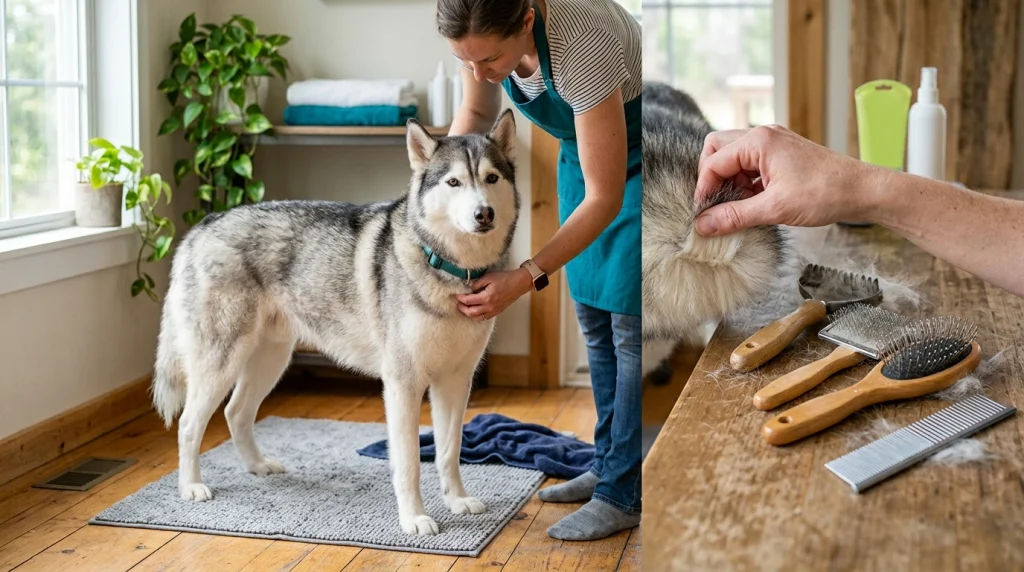
SaveA brush mainly works through the visible coat and loosened hair, while an undercoat rake is designed to reach deeper into dense undercoat. That difference is why one tool rarely replaces the other perfectly.
As of 2026, professional grooming standards from the American Kennel Club specifically identify undercoat raking as a technique for double-coated dogs.
| Tool | Best Job | Undercoat Reach | Best Time to Use | Main Caution |
|---|---|---|---|---|
| Undercoat rake | Loose or packed undercoat | High | Heavy shedding and coat blows | Too much pressure can irritate skin |
| Slicker brush | Loose fur, separation, light tangles | Medium to high, depending on pin length | Routine grooming and finishing | Firm pins can scratch with repeated pressure |
| Pin brush | Smoothing and gentle detangling | Low to medium | Regular maintenance on longer coats | May skim over dense undercoat |
| Steel comb | Checking your work and finding tangles | Medium | Final check after brushing | Never force it through resistance |
When should you use an undercoat rake?
Use an undercoat rake when loose undercoat is the main problem. It becomes especially useful when your dog’s coat starts releasing soft clumps during a seasonal shed.
A properly selected rake reaches beneath the guard hairs without requiring you to repeatedly brush the surface.
- Heavy shedding: The rake removes loose material closer to the base of the coat.
- Dense coats: Longer pins can reach areas a short brush barely touches.
- Seasonal coat blows: It helps remove shedding undercoat in controlled sections.
- Thick furnishings: Areas such as the ruff, thighs, and rear can hold surprising amounts of loose fur.
The Safari Double Row Undercoat Rake is a good example of the design. Its manufacturer describes two rows of rotating, rounded pins made for thicker, dense undercoats.
That does not mean you should drag a rake endlessly through one spot. Once obvious loose undercoat stops releasing easily, move on.
When is a slicker brush better than a rake?
A slicker brush is better for regular coat maintenance, surface loose hair, light tangles, and finishing after deeper undercoat work. Long or firm pins can also reach farther into dense coats than a basic bristle brush.
The AKC recommends slicker brushes as useful tools for longer and double-coated dogs, especially when loose hair needs to be worked out from beneath the outer coat.
- Routine brushing: A slicker keeps loose hair from accumulating between major shedding periods.
- After raking: It catches undercoat that has been loosened but remains trapped near the surface.
- Light tangles: Controlled strokes can separate mild tangles before they tighten into mats.
- Line brushing: A slicker works well when you part the coat and brush small sections from the base outward.
For example, the Andis Large Firm Slicker Brush uses firm pins and a larger brushing surface for dense coats. I see this style as a finishing and maintenance tool rather than a replacement for a true undercoat rake during a major coat blow.
Should you use a brush and rake together?
 Save
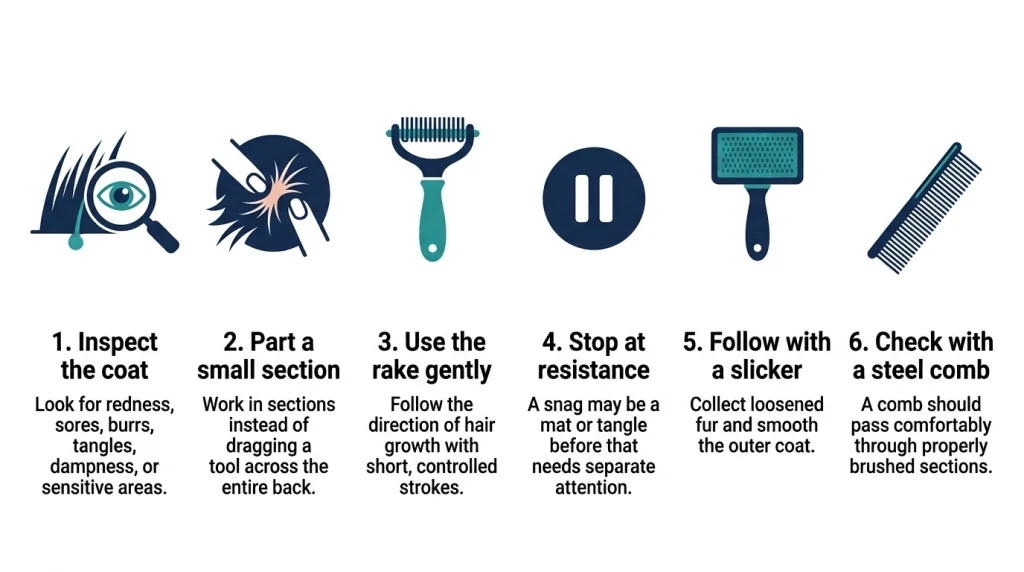
SaveYes. For many double-coated dogs, using both gives better control than expecting a single tool to handle every layer.
My preferred order is simple: inspect, rake where needed, brush the coat, then check dense areas with a comb.
- Inspect the coat. Look for redness, sores, burrs, tangles, dampness, or sensitive areas.
- Part a small section. Work in sections instead of dragging a tool across the entire back.
- Use the rake gently. Follow the direction of hair growth with short, controlled strokes.
- Stop at resistance. A snag may be a mat or tangle that needs separate attention.
- Follow with a slicker. Collect loosened fur and smooth the outer coat.
- Check with a steel comb. A comb should pass comfortably through properly brushed sections.
This two-tool approach is especially useful for heavy-shedding northern breeds. My guide to managing Siberian Husky shedding shows how the same method works during a major coat blow.
How do you rake a double-coated dog without hurting the skin?
Use light pressure and let the teeth move through the hair rather than pressing toward the skin. If you can hear or feel repeated scraping, reduce the pressure.
A good rake should remove loose coat without turning grooming into a contest of strength.
- Match pin length to coat length: Pins that are too short cannot reach the undercoat effectively.
- Choose smooth teeth: Rounded, well-finished pins reduce unnecessary scratching.
- Use short strokes: Long aggressive pulls create more tension on the coat.
- Work in the hair direction: This usually reduces pulling and resistance.
- Watch body language: Flinching, turning, sitting, or trying to leave can signal discomfort.
- Check the skin often: Stop if you notice redness or irritation.
The American Kennel Club’s double-coat grooming guidance also emphasizes regular brushing and appropriate coat-specific tools.
If your dog has painful matting, sores, or skin problems, a professional groomer or veterinarian is the safer next step.
Can you use only a brush on a double-coated dog?
You can sometimes use only a brush when shedding is light and the coat is not compacted. The brush still needs enough reach for the dog’s coat density.
A slicker may be enough for routine weekly maintenance on some dogs. During heavy undercoat shedding, however, a rake usually makes the job faster and more targeted.
- Short double coat: A suitable brush may handle normal maintenance surprisingly well.
- Medium double coat: A slicker plus occasional rake often works better.
- Long or arctic coat: A rake, long-pin slicker, and comb provide more complete coverage.
Do not judge success only by how much fur a tool removes. An aggressive tool can create an impressive pile while still being the wrong choice for your dog’s skin or healthy coat.
Can an undercoat rake replace a slicker brush?
Usually not. A rake excels at undercoat removal, while the slicker handles finishing, separation, and remaining loose hair closer to the surface.
Think of the rake as the deep-work tool and the slicker as the cleanup and maintenance tool.
- Rake first: When the undercoat is releasing heavily.
- Slicker second: To lift remaining loose fur and smooth the coat.
- Comb last: To find areas you may have missed.
Professional grooming education also reflects this tool-specific approach. The AKC’s grooming education standards distinguish undercoat raking from brushing and combing techniques.
What mistakes should you avoid with a double-coated dog?
The biggest mistakes usually involve too much pressure, too many passes, or using the wrong tool for the coat layer. Gentle technique matters more than speed.
- Brushing only the surface: A neat topcoat can hide packed loose undercoat underneath.
- Raking the same spot repeatedly: Metal teeth can irritate the skin if overused.
- Forcing through mats: Stop and separate the tangle instead of pulling harder.
- Using short pins on deep coats: The tool may never reach the layer you are trying to remove.
- Trying to remove all undercoat: Your goal is loose, dead coat rather than healthy attached fur.
- Shaving to control ordinary shedding: Routine shaving is generally discouraged for healthy double coats.
The AKC notes that double coats have protective functions and advises against routine shaving simply to manage shedding. Severe matting or medical needs are different situations.
How often should you brush or rake a double-coated dog?
There is no single schedule for every breed. Coat length, density, climate, season, and the individual dog all affect grooming frequency.
A practical starting point is weekly brushing, then shorter and more frequent sessions during a heavy seasonal shed.
- Normal shedding: Brush about once or twice weekly, adjusted to the individual coat.
- Heavy coat blow: Use short sessions every day or every few days as needed.
- After outdoor activity: Check for debris, moisture, and tangles immediately.
- Dense trouble areas: Check behind the ears, under the legs, around the ruff, and through the rear furnishings.
Consistency beats an exhausting once-a-month grooming marathon. Stop before either you or your dog loses patience.
Which grooming tools would I choose for a double-coated dog?
 Save
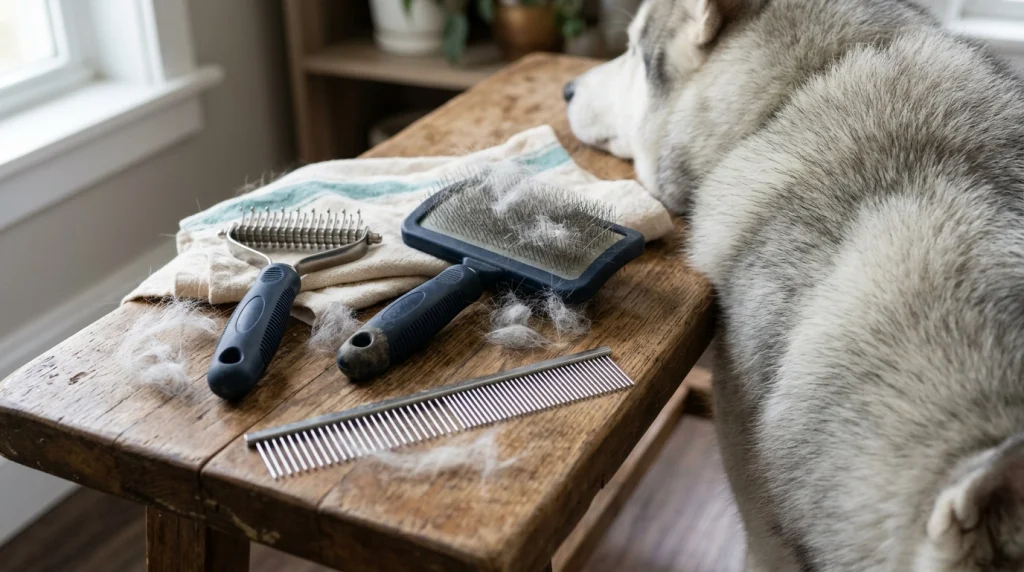
SaveIf you’re building a simple home grooming kit, I would choose tools that perform different jobs rather than buying three versions of the same brush.
🏆 Best Undercoat Pick
Safari Double Row Undercoat Rake
★★★★½
It uses two rows of rotating, rounded metal pins designed for thick, dense undercoats. I like this style when the priority is reaching loose undercoat without turning the rake into an aggressive stripping tool.
✨ Best Finishing Brush
Andis Large Firm Slicker Brush
★★★★☆
Andis uses firm slicker pins and a large brushing surface intended for thicker coats. I would use it after deeper undercoat work or for routine maintenance when you need good coverage and coat separation.
🔎 Best Final Check
Andis 10-Inch Steel Comb
★★★★☆
This 10-inch steel comb has coarse and fine tooth sections for checking tangles, loose hair, and unfinished areas. I use a comb as the test tool: if it stops, that section needs more careful attention rather than more force.
Frequently Asked Questions
Is a rake or slicker brush better for a double-coated dog?
An undercoat rake is better for removing loose undercoat, especially during heavy seasonal shedding. A slicker brush is better for everyday coat maintenance, light tangles, separating fur, and finishing after the rake has loosened deeper hair.
Can I use an undercoat rake every day?
Daily use may be appropriate for short periods during heavy shedding if you use light pressure and the skin remains comfortable. Avoid repeatedly raking the same area simply because a few hairs continue appearing, since overworking the coat can irritate the skin.
Does an undercoat rake cut the dog’s hair?
A traditional pin-style undercoat rake is designed mainly to reach and remove loose undercoat rather than cut healthy hair. Some de-shedding tools use blades or sharpened edges, so check the exact design before using any tool on your dog’s coat.
Do I need a rake if I already have a slicker brush?
You may not need one for a lightly shedding or short double coat. For dense breeds or seasonal coat blows, an undercoat rake can reach loose hair that a slicker may leave beneath the outer coat.
What is the best grooming order for a double-coated dog?
Inspect the skin first, use an undercoat rake where loose undercoat is present, follow with a suitable slicker or pin brush, then check the coat with a steel comb. Stop and investigate any area where a tool catches or causes discomfort.
Brush vs Rake for Double-Coated Dogs: Final Takeaway
If you only remember one thing, remember this: the rake reaches the undercoat, while the brush maintains and finishes the coat. For many double-coated dogs, the best grooming setup includes both.
Use gentle pressure, work in sections, and stop trying to create an empty brush or rake. Your goal is a comfortable dog with loose dead coat removed, not a dog with every possible hair pulled out.
Start with the tool that matches today’s grooming problem. Once you do that, even a dramatic seasonal shed becomes much easier to manage.

Thomas Cutter is a lifelong dog owner and the founder of FindOutAboutDogs.com. With over 10 years of hands-on experience owning multiple breeds, Thomas created this site to provide honest, research-based dog advice that real owners can actually trust.
