How Coat Density Affects Dog Brush Selection
Quick Answer
Coat density affects dog brush selection because the brush must reach the layer that needs grooming without scraping the skin. Low-density coats usually need soft bristles or rubber tools, while dense and double coats often need longer pins, slicker brushes, combs, or undercoat rakes. If your dog has a particularly thick double coat, this Husky brush guide shows why deeper-reaching tools matter.
Match the brush to coat density
- Low-density coat: Use a rubber grooming brush or soft bristle brush for loose surface hair.
- Medium-density coat: A slicker, pin brush, or comb usually gives better reach and control.
- Dense single coat: Choose longer pins that can separate hair instead of skimming the surface.
- Dense double coat: An undercoat rake can reach loose hair beneath protective outer hairs.
- Curly dense coat: Use a suitable slicker and metal comb to detect hidden tangles near the skin.
- Skin comes first: Deeper reach never means harder pressure.
One quick check
- Part the coat with your fingers. If you can barely see the skin, you probably need a tool with more reach than a short surface brush.
I used to think brush choice was mainly about whether a dog had short or long hair. Coat density taught me that hair length tells only half the story.
A short coat can be surprisingly thick, while long hair can feel light and sparse. In this guide, I’ll show you how to judge density and match the tool to the actual coat in front of you.


What Does Coat Density Mean in Dogs?
Coat density is the amount of hair growing within a given area of a dog’s skin. A dense coat packs many hairs closely together, while a low-density coat has more space between individual hairs.
Density is different from hair length. A dog can have short but dense fur, long but relatively light fur, or any combination between those extremes.
Simple definition: Coat density describes how closely packed a dog’s hairs are. Greater density usually means a grooming tool needs enough pin or tooth length to move through the coat instead of brushing only the surface.
Density also changes what your hand feels. A low-density coat separates easily, while a dense coat may feel springy, plush, woolly, or resistant when you push your fingers toward the skin.
Why Does Coat Density Affect Dog Brush Selection?
A brush works only when its working surface reaches the hair you want to remove or separate. Short bristles can perform well on a light coat yet become almost useless against thick undercoat.
The American Kennel Club’s dog brush guidance similarly matches different brush designs to different coat types. Undercoat rakes, slickers, bristle brushes, rubber tools, and combs perform different jobs.
- Pin length controls reach: Longer pins can travel farther through thick or long coats.
- Tooth spacing controls resistance: Wider spacing often moves through dense hair more comfortably.
- Brush flexibility affects comfort: Flexible pins can reduce harsh pulling when used correctly.
- Head size affects control: Large heads cover body areas quickly, while smaller brushes help around legs and tight spaces.
- Coat structure changes the job: Removing loose undercoat is different from smoothing short surface hair.
I pay more attention to what happens beneath the visible coat than to the breed name printed on a brush package. Two dogs of the same breed can still differ in density, coat condition, and grooming tolerance.
Which Brush Is Best for Low-, Medium-, and High-Density Coats?
 Save
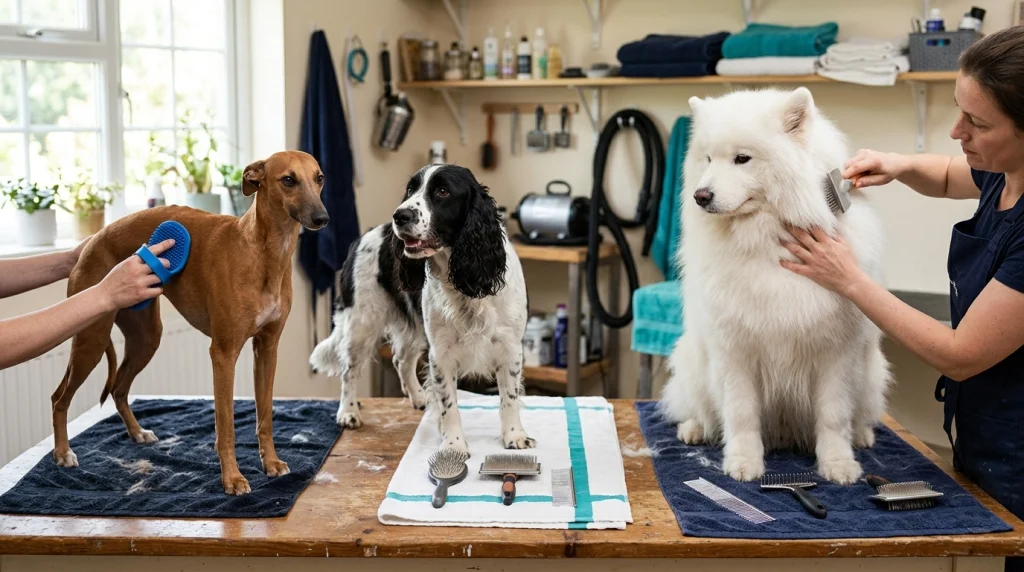
SaveLow-density coats usually need gentle surface grooming, while dense coats need more reach. The best tool should move through the coat with controlled pressure rather than force.
| Coat Density | What It Feels Like | Useful Brush Types | Main Grooming Goal | Common Mistake |
|---|---|---|---|---|
| Low | Skin is easy to reach and hair separates readily | Rubber brush, grooming mitt, soft bristle brush | Loose surface hair, dirt, smoothing | Using unnecessarily sharp or aggressive tools |
| Medium | Some resistance, but the coat parts without much effort | Pin brush, slicker, metal comb | Loose hair, light tangles, coat separation | Brushing only the visible surface |
| High | Hair feels packed, plush, thick, or difficult to part | Long-pin slicker, long-toothed comb, undercoat rake when appropriate | Reach deeper loose hair and prevent hidden tangles | Using excessive pressure to compensate for short pins |
Low-density coats
For a light smooth coat, I usually start with the least aggressive tool that does the job. Flexible rubber brushes and grooming mitts are useful because they grab loose surface hair without needing deep penetration.
A bristle brush can follow for smoothing. The ASPCA’s dog grooming guidance also recommends rubber and bristle tools for smooth, short coats.
Medium-density coats
Medium-density coats need enough reach to separate hair without digging into the skin. A pin brush or appropriately sized slicker often handles routine grooming well.
I like keeping a metal comb nearby. It quickly reveals areas where a brush has passed over the top without reaching small tangles underneath.
High-density coats
High-density coats require the most attention to pin length and tooth design. Short pins may move neatly across the top while leaving loose hair packed below.
Long-pin slickers, longer combs, and undercoat tools can help. The exact choice depends on whether the coat is single, double, straight, curly, or prone to matting.
How Can You Tell How Dense Your Dog’s Coat Is?
You do not need a technical measurement. A simple hands-on inspection usually tells you enough to choose a grooming tool.
- Part the coat with your fingers. Check how easily you can see the skin.
- Push your fingers toward the base. Notice how much resistance the hair creates.
- Lift a small section. Look for a soft second layer beneath the visible outer hair.
- Run a comb gently through it. Notice whether resistance appears near the surface or deeper down.
- Check several body areas. Density may differ around the neck, thighs, tail, chest, and body.
The finger-parting test is the one I use first. If I have to make a deliberate part before I can clearly see skin, I know a tiny short-bristled brush probably will not reach enough of that coat.
Does a Dense Double Coat Need an Undercoat Rake?
 Save
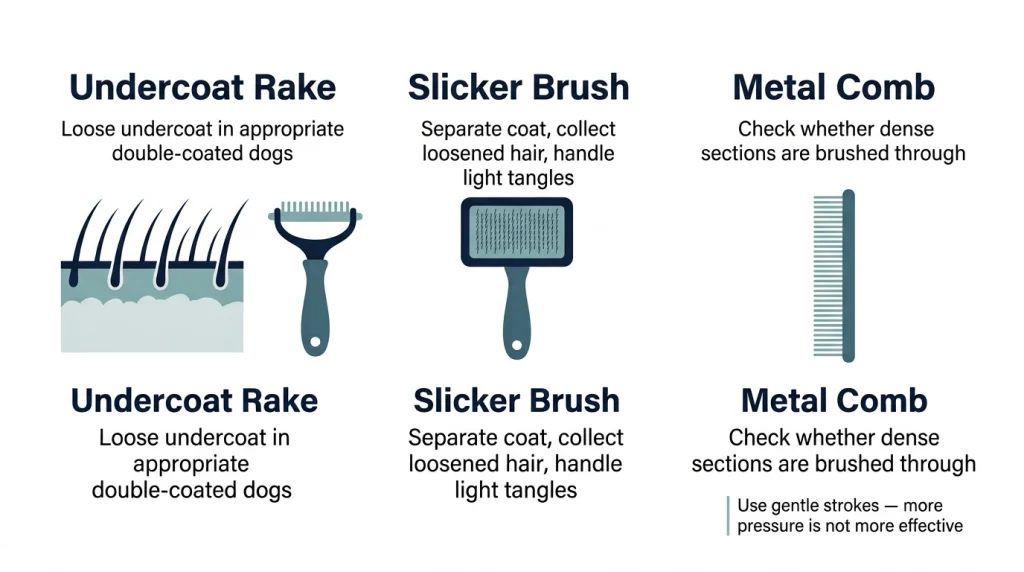
SaveOften, but not automatically. An undercoat rake is most useful when a dog has a real undercoat containing loose hair that a surface brush cannot reach comfortably.
Double-coated dogs have an outer layer plus softer hair underneath. During heavy shedding, that lower layer can loosen faster than an ordinary surface brush can collect it.
- Use an undercoat rake for: Loose undercoat in appropriate double-coated dogs.
- Use a slicker for: Separating coat, collecting loosened hair, and handling light tangles.
- Use a metal comb for: Checking whether dense sections are brushed through.
- Use gentle strokes: More pressure does not make an undercoat rake more effective.
If seasonal shedding is your main problem, my guide to managing shedding in a Siberian Husky shows how I combine deeper and surface tools without repeatedly scraping the same area.
VCA Animal Hospitals also notes that different brush styles suit different hair coats. Its veterinary guidance includes slickers, combs, stiff bristles, flexible grooming tools, and long-toothed combs for different coat structures.
What About Dense Curly or Long Coats?
Dense curly coats create a different problem from shedding double coats. Loose hairs may stay trapped within curls instead of falling freely onto the floor.
A suitable slicker helps separate the coat, while a metal comb gives you a useful final check. If the comb stops, that area still needs attention rather than harder pulling.
- Long straight dense coats: Look for enough pin length to reach through the full section.
- Curly dense coats: Combine careful slicker brushing with a comb check.
- Feathered areas: Use smaller controlled strokes around ears, legs, tails, and furnishings.
- Existing mats: Avoid forcing a brush through tight matting against the skin.
According to VCA’s grooming guidance, long, silky, and curly coats often need more frequent attention to prevent tangles. That matters because greater density can hide tangles until they become uncomfortable.
Can a Brush Be Too Aggressive for a Dense Coat?
Yes. Dense fur may tempt you to push harder, but pressure is not a substitute for proper tool depth.
If the pins are too short, pressing them into the coat mainly increases pressure near the skin. I would rather choose a longer appropriate tool and use lighter strokes.
- Stop for redness: Pink or irritated skin means the session needs reassessment.
- Stop for repeated snagging: Find the source instead of pulling through it.
- Watch body language: Flinching, turning, sitting, or trying to leave can signal discomfort.
- Use smaller sections: Dense coats are easier to brush in controlled layers.
- Check the tool: Bent, rough, or damaged pins should not be dragged through the coat.
Regular brushing also gives you a chance to inspect the skin. The ASPCA’s general dog-care guidance recommends frequent brushing and routine checks for fleas and ticks.
How Does Shedding Change Brush Choice?
Shedding can temporarily change what your grooming session needs to accomplish. A coat that feels manageable most of the year may suddenly fill with loose hair during a seasonal change.
As of 2026, my rule remains simple: match the tool to the coat you are seeing today. Do not assume the same brush must handle every stage of the shedding cycle.
- Normal maintenance: Use the gentlest tool that reaches the necessary layer.
- Heavy loose undercoat: Add an appropriate undercoat tool where needed.
- Surface shedding: Rubber brushes or bristle brushes may be enough on shorter coats.
- Tangle-prone shedding: Use a slicker or comb in small sections.
One of my most useful practical checks is simple. When a brush passes easily but a comb immediately finds resistance underneath, the brush is not reaching deeply enough.
Common Coat-Density Brush Selection Mistakes
Most brush mistakes happen when owners buy according to coat length or marketing labels alone. Density, undercoat, skin sensitivity, and the actual grooming task matter just as much.
- Choosing only by breed: Individual dogs can have noticeably different coat density.
- Choosing only by hair length: Short hair can still be exceptionally dense.
- Using short pins on thick fur: The brush may polish the surface without reaching loose hair below.
- Using an undercoat tool on every dog: Not every coat contains an undercoat that needs raking.
- Applying more pressure: Better reach should come from the tool design, not harder brushing.
- Skipping the comb check: A smooth-looking coat can still hide tangles underneath.
I would rather own two well-matched grooming tools than five that all perform the same surface job. Coat density usually determines which missing function becomes obvious first.
Dog Brushes I Would Consider for Different Coat Densities
 Save
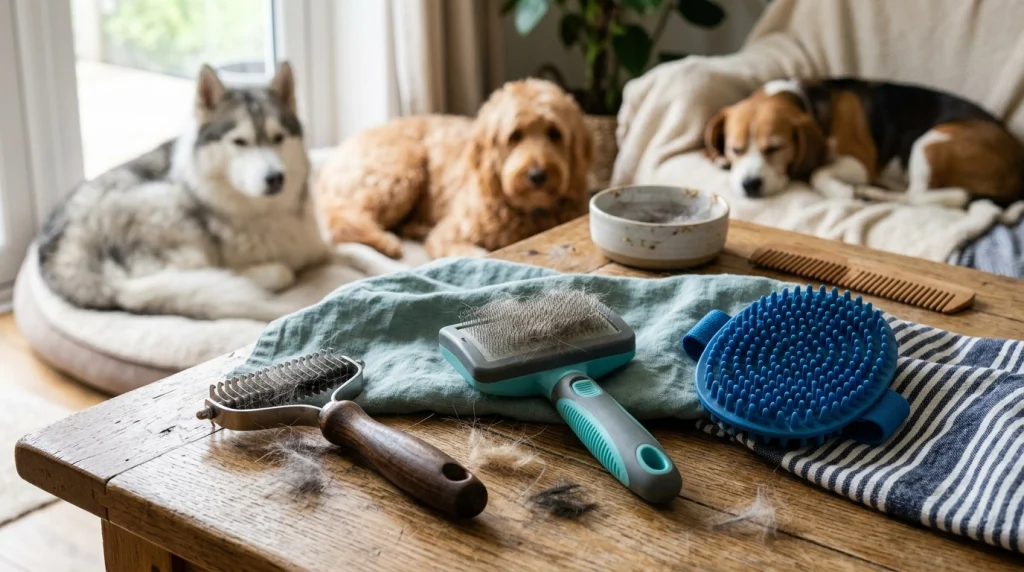
SaveIf you’re ready to pick a tool, I would focus on three different grooming jobs rather than buying several nearly identical brushes.
🏆 Best for dense undercoat
Maxpower Planet Double-Sided Undercoat Rake
★★★★½
Its two-sided tooth layout gives you options for working through loose undercoat and denser sections. I would consider it when a normal surface brush keeps leaving loose undercoat behind.
✨ Best everyday slicker option
Hertzko Self-Cleaning Slicker Brush
★★★★☆
This familiar slicker format can collect loose hair and work through many medium-density coats. I like a slicker as a general-purpose option when surface brushing alone is no longer enough.
🐾 Best for short light coats
KONG ZoomGroom Dog Brush
★★★★½
The flexible rubber design focuses on loose surface hair and massage rather than deep coat penetration. I would reach for this style first on many smooth, lower-density coats.
Frequently Asked Questions
Does a thicker dog coat always need a slicker brush?
No. A thicker coat may benefit from a slicker, but the correct tool depends on coat structure and the job you need to do. Double coats may need an undercoat rake, while long dense coats may benefit from a long-toothed comb alongside a slicker.
How do I know if my dog’s brush reaches deep enough?
Part the coat and brush a small section gently, then check it with your fingers or a metal comb. If loose hair or tangles remain beneath an apparently smooth surface, the brush may need longer pins or a different design.
Can I use an undercoat rake on a short-haired dog?
Only when the dog genuinely has an undercoat suited to that tool. Some short-coated dogs have dense undercoats, while others have simple smooth coats where rubber or bristle brushes make far more sense.
Are long pins dangerous on low-density coats?
Long pins are not automatically dangerous, but they may be unnecessary when little hair separates the tool from the skin. Use light pressure and choose a brush whose depth matches the coat rather than assuming longer pins are always better.
Does coat density change during the year?
It can, especially in dogs that develop or shed substantial seasonal undercoat. Pay attention to how the coat feels during each grooming session and adjust tools or frequency when loose undercoat becomes more noticeable.
Choose Brush Depth, Not Just Brush Type
Coat density changes how far a grooming tool must travel before it reaches the hair that needs attention. That makes pin length, tooth spacing, and coat penetration just as important as choosing between a slicker, rake, comb, or rubber brush.
Part your dog’s coat today and look at what is happening underneath. Once you judge density first, choosing a comfortable and effective brush becomes much easier.

Thomas Cutter is a lifelong dog owner and the founder of FindOutAboutDogs.com. With over 10 years of hands-on experience owning multiple breeds, Thomas created this site to provide honest, research-based dog advice that real owners can actually trust.
