What Type of Coat Does a Golden Retriever Have?
Quick Answer
A Golden Retriever has a medium-length double coat made of a dense undercoat and a firm, water-repellent outer coat. The outer coat can be straight or wavy, while longer feathering grows around the neck, legs, underside, thighs, and tail, as described in the official Golden Retriever breed standard.
What that means for coat care
- Two coat layers: Soft undercoat sits beneath stronger protective guard hairs.
- Regular shedding: Expect loose hair throughout the year and heavier seasonal shedding.
- Feathered areas: Hair behind the ears, legs, chest, thighs, and tail can tangle faster.
- Multiple tools help: A brush, undercoat rake, and metal comb do different jobs.
- Don’t shave routinely: The natural double coat has protective functions and should normally remain intact.
Easy way to confirm it
- Part the body coat gently and you’ll usually see softer, shorter undercoat beneath the longer outer hairs.
That flowing golden coat looks simple until you start brushing it. Underneath the visible hair is another layer that explains the shedding, tangles, and seasonal coat changes Golden owners deal with.
The good news is that the coat becomes much easier to manage once you understand its structure. Here’s exactly what is growing on your Golden and which grooming tools make sense for it.


What Kind of Coat Does a Golden Retriever Have?
A Golden Retriever has a double coat. That means two distinct layers of hair grow together and perform different jobs.
As of 2026, the official breed standard describes the Golden’s coat as dense and water repellent with a good undercoat. It also calls for an outer coat that is firm, resilient, and either straight or wavy.
A double coat is a coat with a softer insulating underlayer beneath longer protective outer hairs. Those outer hairs are often called guard hairs.
The AKC’s explanation of double-coated dogs describes the same basic two-layer structure.
- Undercoat: Shorter, softer, denser hair close to the skin.
- Outer coat: Longer, firmer hairs forming the visible protective jacket.
- Feathering: Longer hair around selected areas rather than evenly across the whole body.
- Texture: Straight or wavy is normal for the breed.
If you’re comparing the Golden with other relaxed family breeds, coat maintenance is an important difference. Our guide to easy-going dog breeds shows how grooming demands vary between breeds with very different coat types.
What Does Each Layer of a Golden Retriever’s Coat Do?
 Save
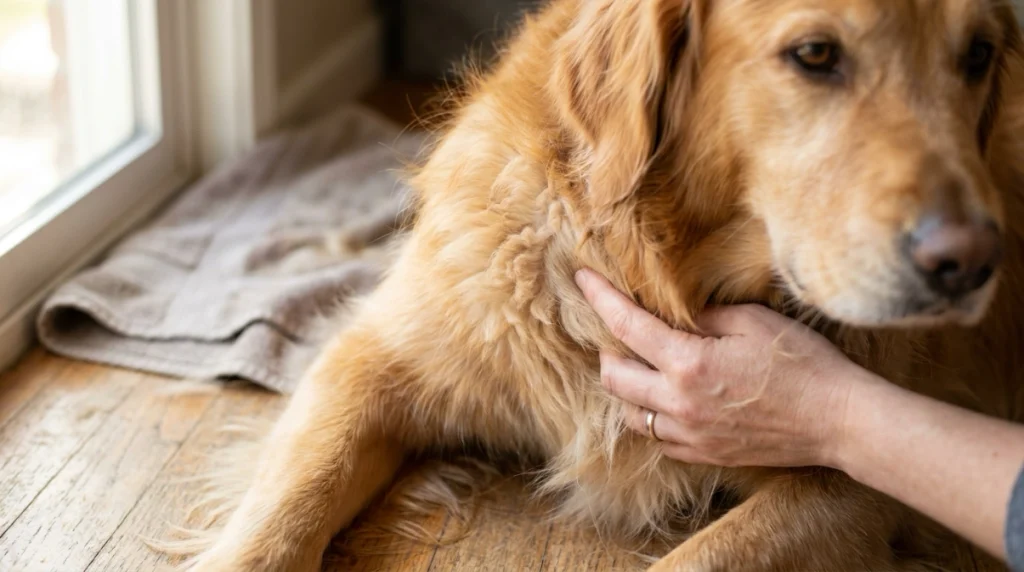
SaveThe two layers work together rather than acting like two unrelated coats. The outer hair takes the first contact with weather and debris, while the undercoat adds insulation close to the body.
This coat developed around the breed’s working role as a retriever. It is functional hair, not just decoration.
| Coat Feature | What It Feels Like | Main Role | Grooming Need |
|---|---|---|---|
| Outer coat | Firm and resilient | Protects the body from moisture, vegetation, and debris | Brush out loose hair and debris |
| Undercoat | Soft and dense | Provides insulation beneath the outer coat | Remove loose undercoat during shedding |
| Feathering | Longer and flowing | Adds protection around exposed areas and creates the breed’s outline | Comb carefully for knots and mats |
The Golden Retriever Club of America emphasizes that the coat should follow the body’s natural outline. A correct Golden should not look like its entire coat has been fluffed outward.
Is a Golden Retriever’s Coat Straight or Wavy?
Both are normal. The breed standard specifically permits a Golden Retriever’s outer coat to be straight or wavy.
One Golden may have a fairly flat body coat, while another develops obvious waves across the back or shoulders. Neither automatically indicates a problem.
The important feature is the texture and overall structure. The coat should still have a functional outer layer and a proper undercoat.
- Some Goldens have relatively straight body hair.
- Others have gentle waves through the back and sides.
- Feathering often looks softer than the main body coat.
- Puppies may look much fluffier before their adult coat develops.
That recognizable feathered appearance is one reason Goldens stand out among family dogs. You can see how their grooming needs compare with other popular choices in our guide to friendly dog breeds for families.
Where Does a Golden Retriever Have Feathering?
Golden Retriever feathering is concentrated in specific areas. It isn’t simply extra-long hair covering the entire dog.
The breed standard calls for moderate feathering behind the forelegs and beneath the body. Heavier feathering appears on the front of the neck, back of the thighs, and underside of the tail.
- Front of the neck: Creates the fuller ruff many owners notice first.
- Back of the front legs: Longer hair forms visible fringes.
- Underbody: Moderate feathering extends beneath the torso.
- Back of the thighs: Dense feathering can collect tangles and debris.
- Underside of the tail: Long feathering creates the Golden’s characteristic flowing tail.
These are the areas I would check first after a walk through weeds, woodland, or wet grass. Behind the ears is another practical trouble spot because friction can encourage tangles.
Do Golden Retrievers Shed a Lot?
Yes. Golden Retrievers shed throughout the year and usually shed more heavily during seasonal coat changes.
The amount you see can vary between individual dogs and living conditions. A Golden kept mostly indoors may appear to drop hair steadily instead of following a perfectly neat seasonal schedule.
The American Kennel Club’s Golden Retriever profile recommends regular brushing and notes that grooming often needs to become more frequent during heavy shedding.
Think of loose undercoat as hair you can collect with a grooming tool or collect later from the sofa. Regular coat maintenance usually makes the first option easier.
- Brush routinely when shedding is moderate.
- Increase grooming frequency when undercoat starts releasing heavily.
- Pay close attention to feathering where loose hair can become trapped.
- Work gently rather than repeatedly scraping the same skin area.
Families considering a Golden should factor shedding into the decision alongside temperament. That’s especially useful when comparing breeds for homes with children, as covered in our guide to dog breeds for families with babies.
What Brush Should You Use on a Golden Retriever?
 Save
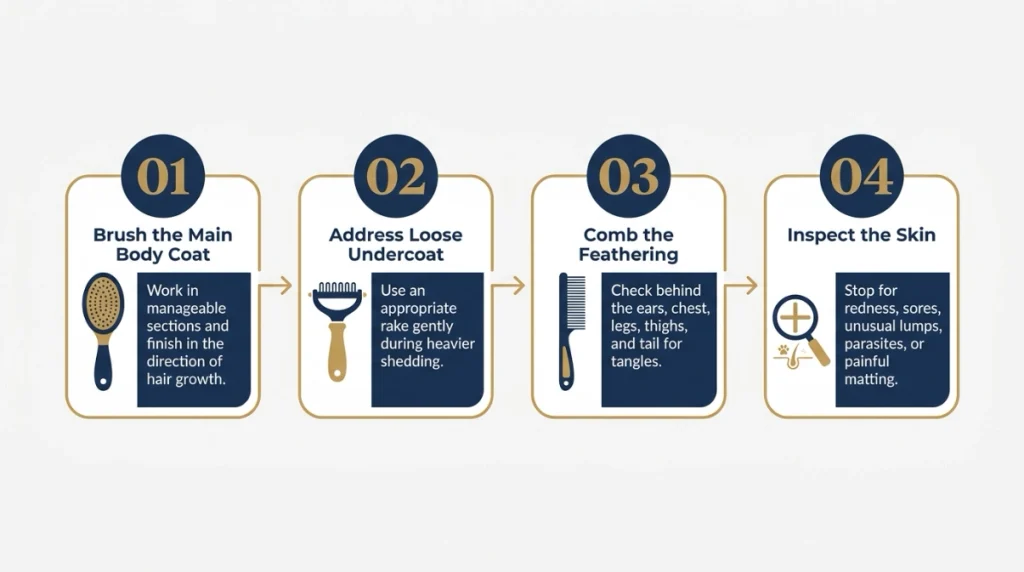
SaveNo single brush does every job perfectly on a Golden’s double coat. I prefer thinking in terms of three jobs: routine brushing, undercoat removal, and finishing.
A useful home grooming kit usually combines a quality brush with an undercoat tool and metal comb.
- Brush the main body coat. Work in manageable sections and follow the direction of hair growth for the finishing passes.
- Address loose undercoat. Use an appropriate rake gently during heavier shedding rather than digging aggressively at the skin.
- Comb the feathering. Check behind the ears, chest, legs, thighs, and tail for small tangles.
- Inspect the skin. Stop if you find redness, sores, unusual lumps, parasites, or painful matting.
The AKC’s Golden Retriever grooming guidance recommends regular brushing and paying special attention to the feathered coat. It also advises brushing before bathing.
Veterinary guidance from VCA Animal Hospitals likewise recommends regular brushing to remove loose hair, debris, and tangles while giving owners a chance to inspect the skin.
How do you know whether you’ve brushed deeply enough?
A simple finishing check is more useful than counting brush strokes. After brushing, gently work a metal comb through the coat in sections.
If the comb repeatedly catches before reaching through the coat, loose undercoat or tangles may still be hiding underneath. Never force the comb through a painful knot.
Should You Shave a Golden Retriever’s Double Coat?
Routine shaving is generally not the right way to manage normal Golden Retriever shedding. Brushing and removing loose undercoat preserves the natural coat while dealing with the hair that is ready to come out.
The Golden Retriever Club of America’s coat guidance stresses maintaining the breed’s natural coat and explains its protective working function.
There are situations where clipping may be necessary for veterinary treatment or severe matting. Those decisions are different from shaving a healthy Golden simply because the weather is warm.
- Don’t shave merely to stop normal shedding.
- Don’t cut tightly against skin you cannot clearly see beneath a mat.
- Ask a groomer or veterinarian for help with extensive painful matting.
- Use routine brushing to prevent small tangles becoming serious mats.
Does a Golden Retriever Puppy’s Coat Change?
Yes. Golden Retriever puppies begin with a softer, fluffier coat and gradually develop the more recognizable adult double coat.
The transition does not happen in one dramatic moment. Adult-textured hair and feathering become more obvious as the puppy matures.
This is a good time to build calm grooming habits. A puppy that learns to accept gentle handling around the feet, ears, tail, and body is usually easier to groom later.
If children will help with grooming, adults should supervise and teach gentle brush pressure. Our guide to dog breeds for 9 to 12 year olds also covers the everyday care responsibilities families should consider.
How Often Should You Check a Golden Retriever’s Coat?
I would separate a quick coat check from a full grooming session. Looking over high-risk areas takes much less time than completely brushing the dog.
- After outdoor adventures: Check for burrs, seeds, twigs, mud, and tangles.
- During normal weeks: Brush often enough that the coat stays loose and easy to comb.
- During heavy shedding: Increase brushing as loose undercoat starts collecting quickly.
- After swimming: Make sure the dense coat dries properly and check for developing tangles.
Watch your dog’s coat rather than treating a fixed calendar as a rule. A Golden releasing handfuls of undercoat needs more attention than the same dog during a quieter shedding period.
Golden Retriever Grooming Tools I Would Choose
 Save
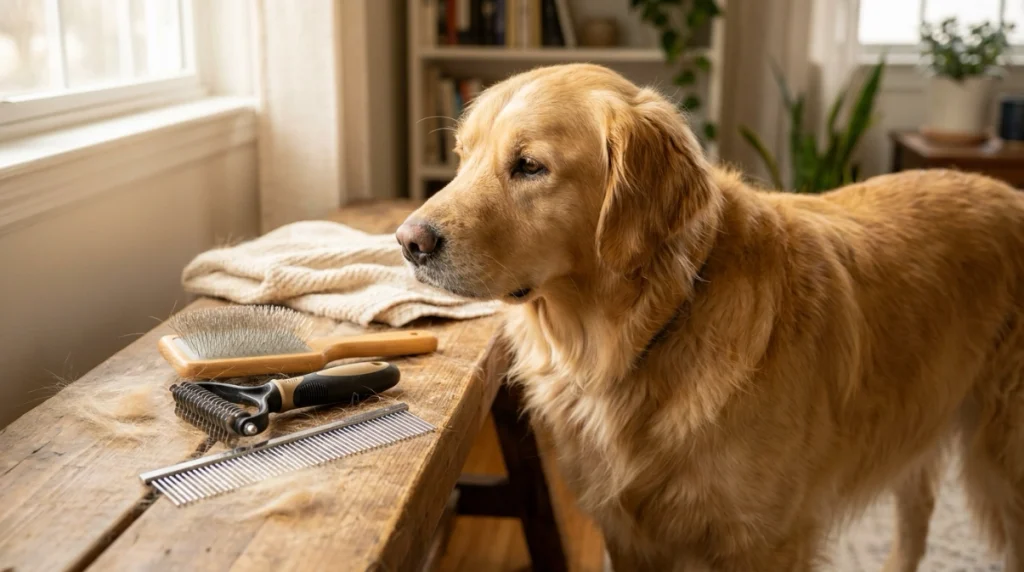
SaveIf you’re ready to build a simple grooming kit, I’d choose tools that handle the different layers instead of expecting one brush to do everything.
🏆 Premium Brush Pick
Chris Christensen Big G Slicker Brush
Editorial fit: ★★★★★
The Big G uses long 27 mm pins designed to reach through longer, dense coats and remove thick undercoat. I like it for owners who want a premium brush for thorough body work without choosing the cheapest tool first.
🍂 Heavy-Shedding Pick
Safari Double Row Undercoat Rake With Rotating Pins
Editorial fit: ★★★★☆
Its double rows are intended for thick undercoats, while rotating rounded pins help move through dense hair. I would bring this out mainly when a Golden is releasing substantial undercoat rather than treating it as an aggressive everyday scraper.
✨ Finishing Pick
Safari Dog Grooming Comb
Editorial fit: ★★★★☆
A metal grooming comb is useful for checking feathering and finding small tangles your brush missed. I consider the comb the final test because it quickly reveals whether you’ve only smoothed the surface or worked through the coat.
Frequently Asked Questions
Do Golden Retrievers have hair or fur?
Golden Retrievers are commonly described as having fur because they grow a shedding double coat with a dense undercoat and longer outer hairs. In everyday conversation, however, people often use the words hair and fur interchangeably when talking about dogs.
Are Golden Retrievers single-coated or double-coated?
Golden Retrievers are double-coated dogs. They have a soft, dense undercoat beneath a firmer outer coat, and this two-layer structure is one reason they shed noticeably and need regular grooming.
Do all Golden Retrievers have long coats?
Golden Retrievers have a medium-length coat rather than uniformly long hair across the entire body. The head, paws, and front of the legs have shorter hair, while the neck, legs, underside, thighs, and tail carry more feathering.
How often should I brush a Golden Retriever?
Most Goldens benefit from regular weekly brushing, with more frequent sessions during periods of heavy shedding. The right schedule depends on how quickly your individual dog’s undercoat is releasing and whether feathered areas are beginning to tangle.
Can a Golden Retriever have a curly coat?
The normal Golden Retriever coat may be straight or wavy. Tight curls or ringlets are not the typical breed-standard coat, although individual dogs can vary in how pronounced their waves appear.
The Bottom Line
A Golden Retriever has a dense, medium-length double coat consisting of a soft undercoat beneath a firm, water-repellent outer layer. That coat can be straight or wavy and includes distinctive feathering around several parts of the body.
Once you understand those layers, grooming choices become simpler. Brush the body, manage loose undercoat when shedding increases, comb the feathering, and preserve the natural coat instead of trying to eliminate it.
Start with gentle, consistent grooming before knots develop. Your Golden will be more comfortable, and you’ll spend far less time chasing loose fur and stubborn tangles later.

Thomas Cutter is a lifelong dog owner and the founder of FindOutAboutDogs.com. With over 10 years of hands-on experience owning multiple breeds, Thomas created this site to provide honest, research-based dog advice that real owners can actually trust.
