How Often Should You Brush a Golden Retriever?
Quick Answer
Most Golden Retrievers should be brushed at least once or twice a week. During heavy seasonal shedding, daily brushing is often worthwhile because Goldens have a dense double coat that releases much more loose undercoat at once. If you’re still deciding whether this breed’s coat fits your routine, compare the grooming needs in our guide to easy-going dog breeds.
A simple Golden Retriever brushing schedule
- Normal weeks: Brush thoroughly once or twice each week.
- Heavy shedding: Brush daily, or as close to daily as your schedule allows.
- Feathered areas: Check the ears, tail, legs, and armpits between full sessions.
- After swimming: Let the coat dry, then check for tangles and trapped debris.
- For puppies: Keep sessions short and positive so grooming becomes normal.
The practical rule
- Increase the frequency whenever you can feel loose undercoat, developing tangles, or small knots behind the ears and legs.
Golden Retrievers look wonderfully effortless until shedding season arrives. Then one relaxed brushing schedule can suddenly become a daily battle with loose hair.
I prefer using the coat itself as the final guide. A calendar gives you a starting point, but your dog’s shedding, lifestyle, and feathering tell you when extra brushing is needed.


How Often Should You Brush a Golden Retriever Normally?
For most adult Golden Retrievers, one or two thorough brushing sessions each week is a sensible minimum. The American Kennel Club says most Goldens benefit from brushing once or twice weekly, with more frequent grooming during heavier shedding.
VCA Animal Hospitals gives similar guidance, stating that brushing twice weekly is normally adequate. It also recommends increasing frequency during shedding seasons.
- Low-shedding weeks: One thorough session may be enough for some dogs.
- Typical weeks: Two sessions make it easier to catch tangles before they tighten.
- Hair-heavy households: Three lighter sessions can control loose hair better than one long session.
- Seasonal coat blow: Move toward daily brushing until shedding settles.
The American Kennel Club’s Golden Retriever guidance is a useful baseline. Your individual dog may need more attention around heavily feathered areas.
Definition: Brushing a Golden Retriever means working through both the longer outer coat and loose hair around the dense undercoat. A quick pass over the back alone isn’t the same as a complete grooming session.
Should You Brush a Golden Retriever Every Day?
You don’t normally need to brush a Golden Retriever every day all year. Daily brushing becomes most useful during a major shedding period or when tangles form unusually quickly.
The Golden Retriever Club of America says weekly brushing can be sufficient through much of the year. During major shedding, it describes daily brushing as almost essential.
- Brush daily when handfuls of loose undercoat appear with each pass.
- Brush more often if your Golden swims frequently or runs through brush and vegetation.
- Check daily behind the ears if your dog develops knots there easily.
- Reduce frequency once shedding settles and the comb passes cleanly through the coat.
You can read the breed club’s broader Golden Retriever grooming advice for more context on seasonal coat loss. Their guidance also makes an important point: shedding is a normal part of the Golden coat cycle.
Golden Retriever Brushing Schedule by Situation
The right schedule changes with the coat. I wouldn’t treat a lightly shedding January coat exactly like a Golden dropping large amounts of undercoat during a major seasonal shed.
| Situation | Brushing Frequency | Main Goal | Useful Tool |
|---|---|---|---|
| Normal adult coat | 1–2 times weekly | Loose hair and tangle control | Slicker brush + comb |
| Heavy seasonal shedding | Daily when needed | Remove released undercoat | Undercoat rake + slicker |
| Long or tangle-prone feathering | Spot-check between full sessions | Prevent small knots becoming mats | Steel comb |
| After swimming or muddy outings | Check once coat is clean and dry | Remove debris and new tangles | Comb + slicker |
| Puppy learning grooming | Several brief sessions weekly | Build calm grooming habits | Gentle brush + comb |
Why Do Golden Retrievers Need Regular Brushing?
 Save
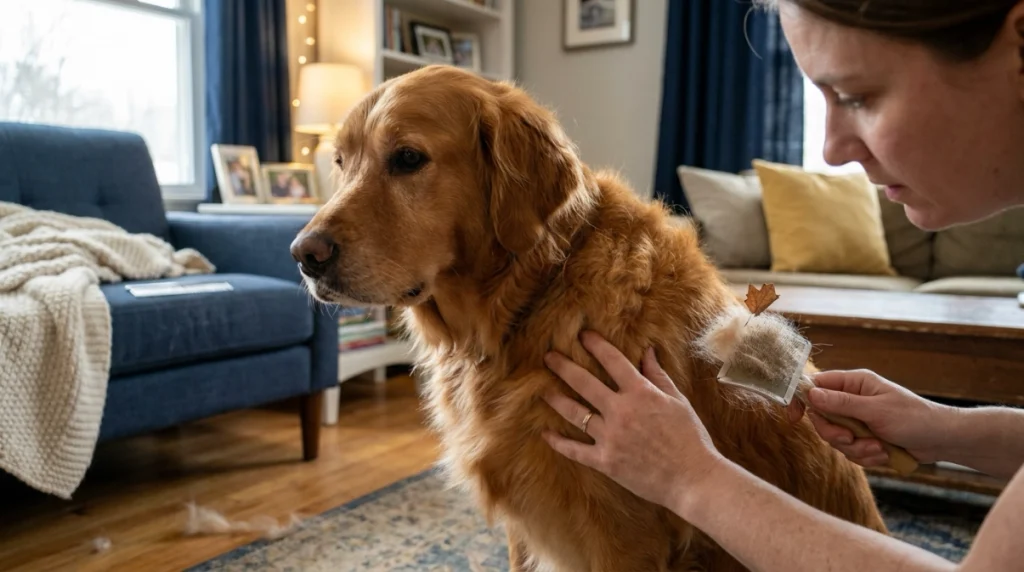
SaveRegular brushing removes loose hair, separates tangles, and lets you inspect the skin beneath a thick coat. It also helps keep loose fur in your brush instead of spreading all over your floors and furniture.
The ASPCA notes that brushing helps remove dirt, distribute natural oils, prevent tangles, and gives owners a chance to inspect the coat. That inspection matters with a dense retriever coat.
- Loose hair: Catching shed hair early reduces what drops around your home.
- Tangles: Small knots are much easier to remove before they tighten.
- Skin checks: Brushing lets you notice bumps, irritation, ticks, or sore areas.
- Debris: Seeds, leaves, and dirt can hide in long feathering.
- Comfort: A clean, separated coat is easier to maintain than a neglected one.
The ASPCA’s dog grooming tips also stress that coat type affects brushing frequency. That’s especially relevant for retrievers.
Where Do Golden Retrievers Mat Most Often?
Golden Retrievers often need extra attention around the ears, armpits, tail, chest, and feathering on the legs. These areas experience friction and can hide small tangles beneath the outer hair.
My practical rule is simple: don’t finish a brushing session until a metal comb can move through the vulnerable areas without snagging. That final comb check catches knots a brush can glide over.
- Behind the ears: Fine hair can knot close to the skin.
- Under the front legs: Movement creates friction in the armpit area.
- Chest feathering: Moisture and outdoor debris can create tangles.
- Back legs: Longer furnishings need more careful separation.
- Tail: Brush in manageable sections rather than dragging through the entire plume.
If you’re choosing a Golden for family life, grooming time belongs in the decision alongside exercise and training. Our friendly family dog comparison shows how Golden Retriever care compares with other popular breeds.
What Is the Best Way to Brush a Golden Retriever?
 Save
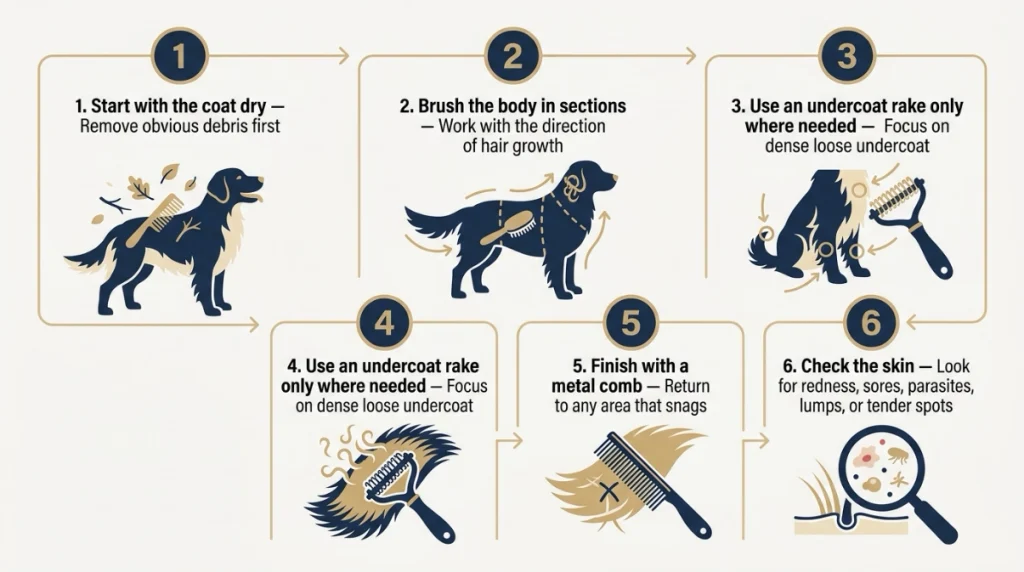
SaveWork in sections, use light pressure, and make sure you’re reaching through the coat rather than polishing only the surface. A slicker brush followed by a metal comb works well for routine maintenance.
- Start with the coat dry. Remove obvious leaves, burrs, or debris with your fingers first.
- Brush the body in sections. Work with the direction of hair growth and avoid scraping the skin.
- Separate longer feathering. Pay extra attention behind the ears, chest, legs, and tail.
- Use an undercoat rake only where needed. During heavy shedding, work gently through dense loose undercoat.
- Finish with a metal comb. If the comb catches, return to that area with the brush instead of pulling hard.
- Check the skin. Look for redness, sores, parasites, unusual lumps, or tender spots.
Don’t attack a stubborn mat with repeated hard strokes. Hold the hair near the skin to reduce pulling, work from the outer edge, and stop if your dog becomes uncomfortable.
Can You Brush a Golden Retriever Too Much?
Yes, poor technique can irritate the skin even when the brushing schedule itself looks reasonable. The biggest problem is usually excessive pressure, repeated scraping, or aggressive use of a de-shedding tool.
More brushing isn’t automatically better. Gentle daily brushing during a shed is different from repeatedly dragging sharp or tightly spaced teeth over the same patch.
- Stop for redness: The skin shouldn’t look scratched after grooming.
- Use light pressure: Let the tool do the work.
- Don’t force mats: Pain teaches dogs to resist future sessions.
- Inspect your tools: Bent or damaged pins can scratch.
- Ask for help: Dense mats close to the skin are safer in experienced hands.
VCA’s Golden Retriever breed-care guidance supports increasing brushing during shedding periods rather than treating one frequency as permanent. Adjusting to the coat is the safer approach.
Should You Shave a Golden Retriever to Reduce Brushing?
Routine shaving isn’t a substitute for brushing a Golden Retriever’s double coat. Removing the coat doesn’t fix the underlying need to manage shedding, tangles, skin checks, and regrowth.
Instead, keep the coat clean and brushed while trimming only areas that genuinely need tidying. Ask a veterinarian or experienced Golden Retriever groomer before making a major coat change.
Grooming tip: If you can see a mat but can’t clearly tell where the skin ends and the mat begins, don’t cut into it with scissors. Folded skin can be pulled into a mat and accidentally cut.
How Often Should You Brush a Golden Retriever Puppy?
A Golden Retriever puppy benefits from several short, easy grooming sessions each week. At this stage, teaching calm handling matters more than removing large amounts of hair.
Touch the paws, ears, tail, chest, and legs during these sessions. Reward calm behavior before your puppy gets bored or starts fighting the brush.
- Keep early sessions brief.
- Use gentle tools and minimal pressure.
- Pair brushing with praise or a small reward.
- Practice standing still for a few seconds.
- End before the puppy becomes frustrated.
Children can eventually help with calm grooming under adult supervision. If that matches your household, our guide to dog breeds for 9- to 12-year-olds explains why Golden Retrievers often suit families willing to share daily care.
What Brush Is Best for a Golden Retriever?
 Save
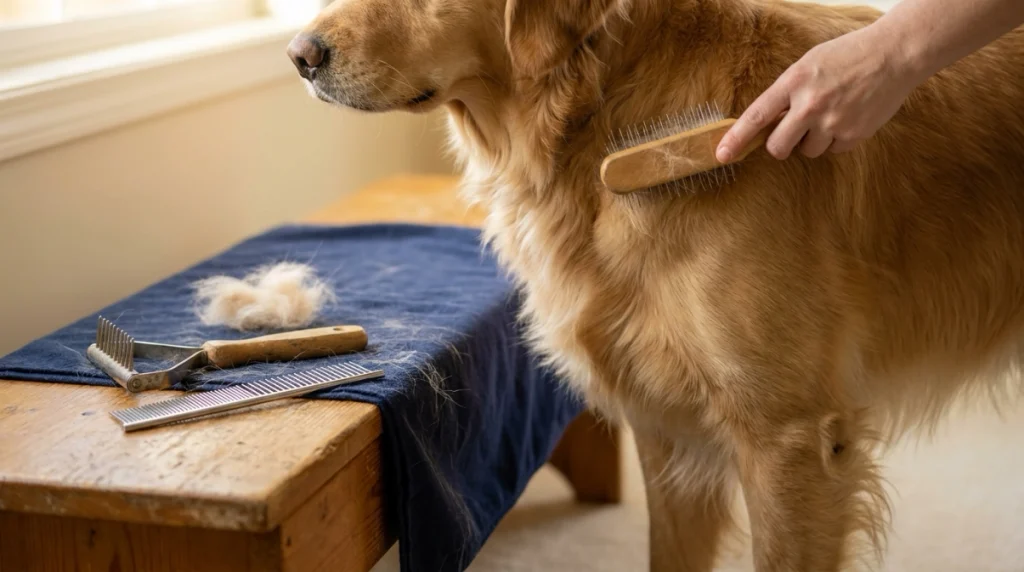
SaveNo single brush handles every part of a Golden Retriever’s coat perfectly. I prefer a simple three-tool setup: a slicker brush, an undercoat rake, and a steel finishing comb.
| Tool | Best Use | When to Use It |
|---|---|---|
| Long-pin slicker brush | Routine detangling and loose coat | Most full brushing sessions |
| Undercoat rake | Dense loose undercoat | Heavy seasonal shedding |
| Steel comb | Finding hidden tangles | At the end of every thorough session |
Families considering their first Golden should budget for both grooming time and tools. The same practical trade-offs matter when choosing among the best dog breeds for families with babies.
Golden Retriever Brushes I’d Recommend
If you’re ready to build a simple grooming kit, these are the types of tools I’d put at the top of the list. Each serves a different job, so you don’t need to force one brush to do everything.
🏆 Best Overall
Chris Christensen Big G Slicker Brush
★★★★☆ 4/5 editorial fit
The Big G uses long stainless-steel pins designed for longer, dense coats. I like this style for routine body brushing because the longer pins can work beyond the surface coat when used gently.
🍂 Best for Heavy Shedding
Safari by Coastal Double Row Undercoat Rake
★★★★☆ 4/5 editorial fit
Its two rows of tapered pins are designed for thick, heavy coats, with rounded tips for comfort. I’d reach for an undercoat rake during a major shed rather than using it aggressively every day of the year.
🔍 Best Finishing Tool
Andis 7-1/2″ Steel Comb
★★★★☆ 4/5 editorial fit
This steel comb has both coarse and fine tooth spacing for detangling and finishing. I consider a comb the final test because it can reveal small knots hidden beneath apparently smooth feathering.
Frequently Asked Questions
Is brushing a Golden Retriever once a week enough?
Once-weekly brushing can be enough during lighter shedding periods if the coat stays free from tangles. Many Goldens benefit from twice-weekly grooming, while heavy seasonal shedding can justify daily brushing until the loose undercoat decreases.
How often should you brush a Golden Retriever during shedding season?
Brush a heavily shedding Golden Retriever daily when practical. Frequent gentle sessions remove released undercoat before it tangles into the surrounding coat and can make seasonal shedding easier to manage around your home.
Do Golden Retrievers need an undercoat rake?
An undercoat rake can be useful when a Golden Retriever is releasing large amounts of dense undercoat. It isn’t required for every session, so use it gently during heavier shedding and rely on a slicker brush and comb for routine maintenance.
Should I brush my Golden Retriever before or after a bath?
Brush before bathing to remove loose hair and obvious tangles. After the coat is completely clean and dry, comb through it again because drying can reveal loose undercoat and knots that were difficult to detect beforehand.
What happens if you don’t brush a Golden Retriever?
Loose hair and tangles can accumulate, especially around feathered areas such as the ears, legs, chest, and tail. Skipping regular grooming also means fewer opportunities to notice skin irritation, parasites, debris, or small mats before they become harder to manage.
Final Takeaway
For most Golden Retrievers, start with one or two complete brushing sessions each week and increase to daily brushing during major shedding. Check vulnerable feathered areas between sessions rather than waiting for visible mats.
The best schedule is the one that keeps a comb moving easily through the coat without irritating your dog. Keep the routine gentle and consistent, and brushing becomes far easier for both of you.

Thomas Cutter is a lifelong dog owner and the founder of FindOutAboutDogs.com. With over 10 years of hands-on experience owning multiple breeds, Thomas created this site to provide honest, research-based dog advice that real owners can actually trust.
