How to Brush a Pomeranian: Step-by-Step Guide
Quick Answer
To brush a Pomeranian correctly, work through the coat in small sections from near the skin toward the ends. Use a soft or long-pin slicker brush gently, then finish with a metal comb to find hidden tangles. Because a Pomeranian has a dense double coat, surface brushing alone isn’t enough. The American Kennel Club’s Pomeranian guide also recommends regular brushing to help prevent matting.
How to brush a Pomeranian quickly
- Prepare the coat: Check for mats and lightly mist with a dog-safe grooming spray if needed.
- Divide the fur: Separate the coat into small sections so you can reach the dense undercoat.
- Brush gently: Start near the skin and brush outward without scraping or pressing hard.
- Work systematically: Brush the legs, sides, chest, back, rear coat, neck, and tail in sections.
- Check trouble spots: Pay extra attention behind the ears, under the front legs, and around the rear coat.
- Finish with a comb: A metal comb should pass through the coat without repeatedly catching.
Best routine
- For many adult Pomeranians, plan on two or three thorough brushing sessions each week, with extra attention during heavy shedding.
Pomeranian coats look fluffy and simple from a distance, but brushing one properly takes more than running a brush over the surface. The dense undercoat is where loose hair and hidden tangles can stay unnoticed.
My approach is simple: brush in sections, keep the pressure light, and let a metal comb tell you whether you’ve finished the job.


Why Does a Pomeranian Need a Special Brushing Technique?
A Pomeranian has a double coat, meaning there are two different layers of hair that need attention. The outer guard hairs create the familiar fluffy outline, while a softer, denser undercoat sits closer to the skin.
If you only brush the visible top layer, the coat may look neat while knots continue developing underneath.
Definition: Line brushing is a grooming method where you separate a thick coat into narrow sections and brush each section from near the skin toward the hair ends before moving upward.
- Outer coat: Longer guard hairs that create shape and help protect the body.
- Undercoat: Shorter, softer hair that can hold loose fur and become compacted.
- High-friction zones: Areas such as behind the ears and under the legs where tangles can develop faster.
The AKC’s guide to dog brushes notes that double-coated dogs need grooming that reaches both the topcoat and undercoat.
What Tools Do You Need to Brush a Pomeranian?
You don’t need a drawer full of grooming equipment. For routine coat care, a suitable slicker brush and metal comb can handle most of the important work.
A pin brush can also be useful for gentle finishing and fluffing.
| Tool | Best Use | When to Use It | Important Tip |
|---|---|---|---|
| Soft/long-pin slicker brush | Separating dense coat and lifting loose undercoat | Main brushing sessions | Use light pressure and controlled strokes |
| Metal comb | Finding remaining knots near the skin | After every thorough brush-out | Don’t force the comb through resistance |
| Pin brush | Fluffing and smoothing the outer coat | Finishing or light maintenance | Don’t rely on it alone for dense undercoat |
| Dog grooming spray | Adding slip and controlling static | Lightly before or during section brushing | Choose a product made specifically for dogs |
Whatever tool you choose, avoid digging the pins into the skin. VCA’s coat-care guidance also emphasizes gentle brushing and avoiding excessive pulling on tangles.
How Do You Brush a Pomeranian Step by Step?
 Save
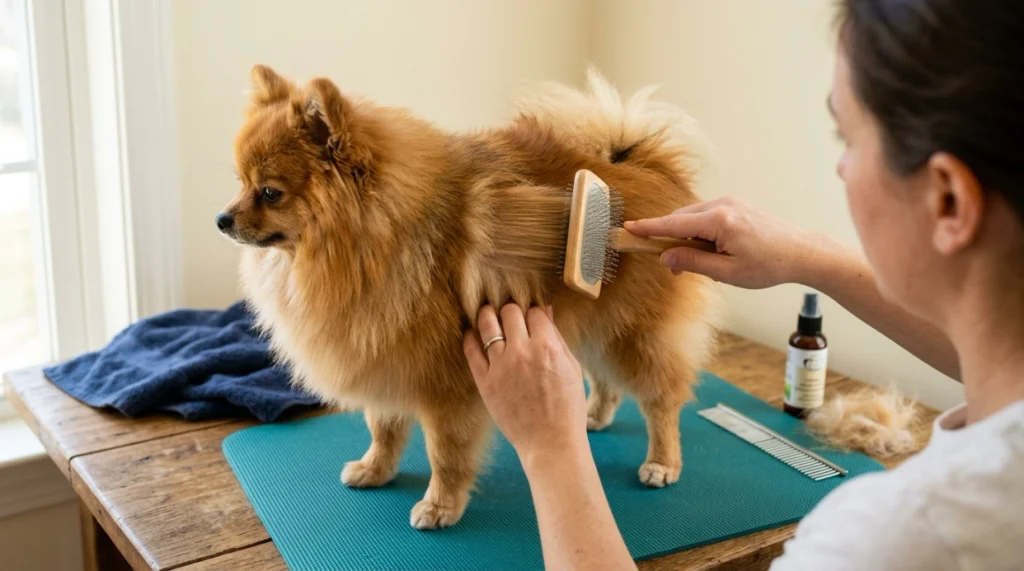
SaveThe easiest way to get consistent results is to follow the same order every time. I prefer working from the lower body upward because finished sections stay easier to track.
1. Make Your Pomeranian Comfortable
Put your dog somewhere stable and non-slip. A grooming table is useful, but a secure floor-level area also works if you can comfortably reach the coat.
Let a nervous dog sniff the brush first. Keep early sessions short rather than turning brushing into a wrestling match.
2. Check the Coat Before Brushing
Run your fingers through the coat and look for tight tangles, debris, irritated skin, or unusual lumps. Don’t drag a brush through a hard mat without checking it first.
- Look behind both ears.
- Check the armpits.
- Feel through the chest coat.
- Inspect the rear legs and trousers.
- Check around the tail base.
3. Lightly Prepare the Coat
If you use a grooming spray, apply only a light mist rather than soaking the fur. The goal is a manageable coat, not wet hair.
Use products formulated for dogs, especially if your Pom has sensitive or dry skin.
4. Separate a Small Line of Hair
Use one hand to lift the coat and expose a narrow row underneath. You should be able to see where the hair begins near the skin.
This is what prevents surface-only brushing.
5. Brush From the Base Toward the Ends
Use short, controlled strokes while keeping the brush nearly parallel with the body. Don’t jab the slicker downward into the skin.
Start at the hair base and move outward toward the ends. When that section feels free, expose the next small line.
6. Work Around the Entire Body
Follow a predictable sequence so you don’t skip hidden areas.
- Rear legs and trousers
- Front legs and armpits
- Sides and belly
- Chest
- Back and shoulders
- Neck and mane
- Behind the ears
- Tail and rear coat
Be especially gentle around thin-skinned areas and joints. Your dog should not be flinching each time the brush moves.
7. Finish With the Metal Comb Test
This is the step I consider the best quality check. Run the comb through each finished area from near the skin toward the ends.
If the comb repeatedly catches, return to that small section with the brush instead of pulling harder on the comb.
How Often Should You Brush a Pomeranian?
For many adult pet Pomeranians, two to three thorough sessions per week is a useful routine. During periods of heavier shedding, more frequent coat checks and brushing may be needed.
PetMD also advises brushing Pomeranians at least two or three times weekly between professional grooming visits.
- Normal weeks: Aim for two or three complete brushing sessions.
- Heavy shedding: Check the coat daily and remove loose undercoat as needed.
- Puppies: Use brief, gentle sessions to teach calm grooming behavior.
- Mat-prone dogs: Check friction areas more often than the rest of the body.
You can read the broader coat-care recommendations in PetMD’s Pomeranian care guide.
Where Do Pomeranians Usually Get Mats?
 Save
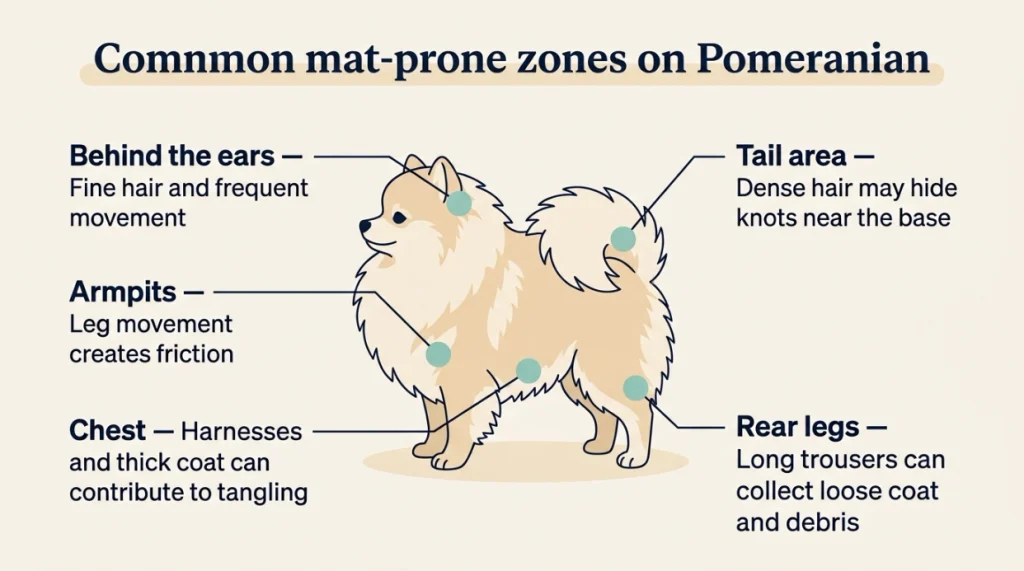
SaveMats tend to appear where hair rubs against hair or where owners miss the undercoat during surface brushing. Catching small tangles early makes grooming much easier.
- Behind the ears: Fine hair and frequent movement make this a common problem area.
- Armpits: Leg movement produces constant friction.
- Chest: Harnesses and thick coat can contribute to tangling.
- Rear legs: The long trousers can collect loose coat and debris.
- Tail area: Dense hair may hide knots close to the base.
Severe mats deserve extra caution. Don’t slide scissors under a tight mat because folded skin can be pulled into the hair where you can’t clearly see it.
Should You Use a Slicker Brush or Pin Brush on a Pomeranian?
A slicker brush and pin brush perform different jobs. For a thick adult Pomeranian coat, I would not depend on a pin brush alone for a complete brush-out.
The slicker does more of the deeper separation work, while a pin brush works well for smoothing and finishing.
- Slicker brush: Better for separating dense coat, loose undercoat, and light tangles.
- Pin brush: Useful for gentle maintenance, fluffing, and finishing the outer coat.
- Metal comb: Best used as the final test for remaining tangles.
A good routine doesn’t depend on one magic brush. Technique and the final comb check matter just as much.
What Brushing Mistakes Should You Avoid?
Most brushing problems come from going too fast, using too much pressure, or only grooming the visible layer. A calmer, section-by-section approach usually works better.
- Surface brushing only: The top looks fluffy while hidden undercoat remains tangled.
- Pressing too hard: Slicker pins can become uncomfortable when pushed into the skin.
- Pulling through mats: Repeated tugging can make grooming painful.
- Skipping the comb: Small knots can remain even after the coat looks finished.
- Brushing too much at once: Long sessions can make puppies or nervous dogs resist future grooming.
- Ignoring skin changes: Redness, sores, hair loss, or unusual sensitivity should not simply be brushed over.
If you find extensive matting or irritated skin, a professional groomer or veterinarian is the safer option. The AKC’s double-coat grooming guidance also recommends combining appropriate brushing with combing rather than relying on surface grooming.
How Do You Brush a Pomeranian That Hates Being Brushed?
Don’t begin with a full-body grooming session. Build tolerance in short stages while your dog is still relaxed.
- Let your dog investigate the grooming tool.
- Touch the coat with the back of the brush.
- Give one or two gentle strokes.
- Reward calm behavior.
- Stop before your dog becomes frustrated.
- Gradually lengthen future sessions.
I would rather finish half the coat calmly and continue later than force a nervous dog through 30 stressful minutes.
Consistent handling also makes future professional grooming much easier.
My Simple Pomeranian Brushing Routine
If you’re overwhelmed by grooming advice, keep the routine basic. The goal isn’t maximum hair removal in one session.
The goal is a coat that stays separated, comfortable, and easy to comb.
- Step 1: Check the coat with your hands.
- Step 2: Work in narrow sections with a gentle slicker brush.
- Step 3: Slow down around friction zones.
- Step 4: Use a metal comb as your final check.
- Step 5: End the session while your dog is still comfortable.
My rule is easy to remember: if the comb catches, the section isn’t finished yet.
Grooming Tools I’d Consider for a Pomeranian
 Save
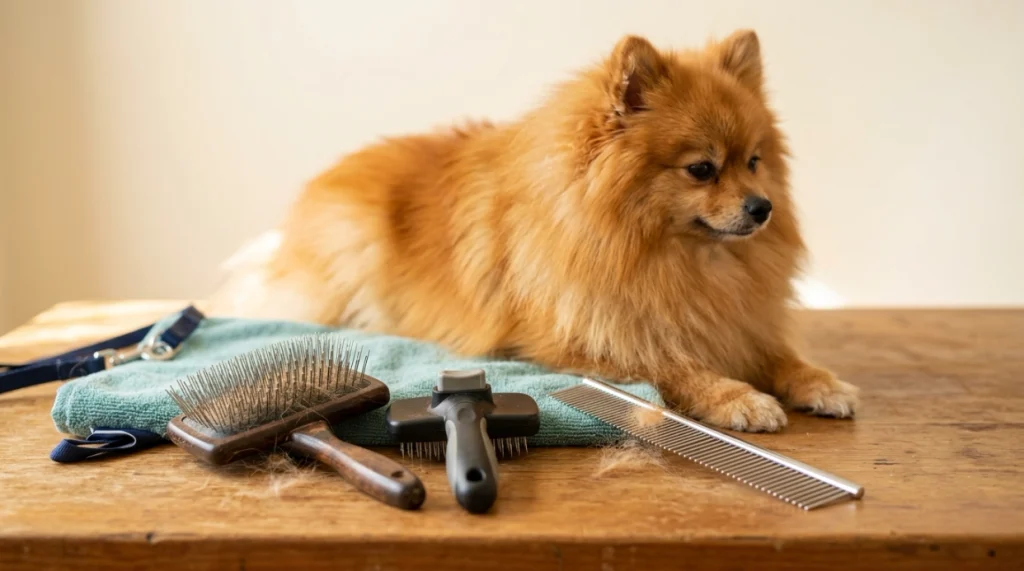
SaveIf you’re ready to put together a simple grooming kit, these are three practical types of tools I’d consider for maintaining a Pomeranian’s double coat.
🏆 Best Overall
Chris Christensen Big G Slicker Brush
My rating: ★★★★★
Its long, flexible pins are designed for working through dense coats and lifting loose undercoat. I like this style when the priority is reaching deeper than a basic surface brush while still keeping the strokes controlled.
💰 Easy-Clean Pick
Hertzko Self-Cleaning Slicker Brush
My rating: ★★★★☆
The retracting-pin design makes collected hair easier to remove from the brush. I’d consider it for owners who want straightforward maintenance, although coat depth and individual Pom density still determine how well any slicker reaches the undercoat.
🪮 Best Finishing Check
Chris Christensen #003 Buttercomb
My rating: ★★★★☆
This 7.5-inch combination comb has fine and extra-coarse tooth spacing, making it useful for checking different parts of a thick coat. I see a metal comb as the finishing tool that tells you where another few brush strokes are still needed.
Frequently Asked Questions
Should you brush a Pomeranian every day?
You don’t necessarily need a complete line-brushing session every day. For many adult Pomeranians, two or three thorough sessions each week are a practical baseline, while quick daily checks can help during heavy shedding or if your dog tangles easily.
Can you use a slicker brush on a Pomeranian?
Yes. A soft, appropriately sized slicker brush can help separate a Pomeranian’s dense double coat and remove loose hair. Use light pressure, work in sections, and avoid repeatedly scraping the pins against the skin.
What is the best way to brush a Pomeranian’s undercoat?
Use line brushing. Lift the outer coat, expose a narrow section near the skin, and gently brush outward through that section before moving upward. Finish with a metal comb to check whether hidden tangles remain.
Should you brush a Pomeranian before or after a bath?
Remove obvious tangles and mats before bathing whenever possible. Water can tighten existing tangles and make them more difficult to manage, so starting with a reasonably separated coat usually makes the rest of the grooming process easier.
What should I do if my Pomeranian has a severe mat?
Don’t force a brush through a tight mat or blindly cut underneath it with scissors. Severe matting can sit close to folded skin, so a professional groomer is usually the safer choice. Contact a veterinarian if you also notice redness, sores, swelling, or pain.
Final Takeaway
Learning how to brush a Pomeranian comes down to reaching the entire double coat without turning grooming into a painful experience. Work in small sections, use light pressure, and pay extra attention to areas where friction creates tangles.
Most importantly, finish with a metal comb. If it moves comfortably through the coat, you’ve done much more than make your Pom look fluffy—you’ve checked the coat from the surface down.

Thomas Cutter is a lifelong dog owner and the founder of FindOutAboutDogs.com. With over 10 years of hands-on experience owning multiple breeds, Thomas created this site to provide honest, research-based dog advice that real owners can actually trust.
