Soft Pins vs Firm Pins for Dog Brushes: Which Should You Choose?
Quick Answer
Soft pins are generally the better starting point for fine coats, delicate areas, and dogs that need a gentler brushing approach. Firm pins provide more resistance and control when working through dense coats, but they can cause discomfort if you press too hard. Choose based on coat density, pin length, brush-head flexibility, and your dog’s skin sensitivity rather than stiffness alone. For more guidance, consult the American Kennel Club’s dog brush guide.
How to choose the right pin stiffness
- Soft pins: Consider these for delicate coats, lighter brushing, and sensitive areas where a forgiving touch matters.
- Firm pins: Consider these when a dense coat needs more brush resistance and controlled separation.
- Coat depth: Select pins long enough to work through the coat without forcing the brush against the skin.
- Pin tips: Look for smooth, well-finished tips and inspect the brush regularly for damage.
- Brush technique: Use short, light strokes instead of pushing harder when you encounter resistance.
- Skin response: Stop if your dog shows pain or you notice redness, irritation, or broken skin.
One important distinction
- Soft and firm pins describe stiffness, while slicker and pin brushes describe different brush designs. A soft-pin slicker is not the same tool as a conventional pin brush.
Choosing a dog brush sounds simple until you encounter terms such as soft pins, firm pins, flexible heads, and long-pin slickers. These differences affect how a brush moves through the coat and how much pressure reaches your dog’s skin.
In this guide, I’ll explain what pin stiffness changes, which coat types may benefit from each option, and how to make a sensible choice without buying several brushes unnecessarily. The goal is comfortable, effective grooming—not the firmest brush you can find.


What Is the Difference Between Soft Pins and Firm Pins on Dog Brushes?
Soft pins bend more readily under pressure, while firm pins resist bending and provide a more rigid brushing feel. Neither option is automatically superior; the best choice depends on the coat, brush design, and amount of pressure applied.
Pin stiffness matters most when the brush meets resistance. A softer pin may flex around loose hair and coat contours, while a firmer pin may maintain its position more effectively as it separates a denser coat.
How soft pins work
Soft pins offer a more forgiving feel during brushing. Depending on their construction, they can accommodate small changes in pressure and movement rather than remaining completely rigid.
They may be worth considering for:
- Dogs with fine or delicate coats.
- Light maintenance brushing between more thorough grooming sessions.
- Owners learning how to use a slicker brush with a light touch.
- Areas where careful handling and control are especially important.
- Dogs that tolerate gentler brushing better than a rigid brush.
However, soft pins are not automatically safe for every sensitive dog. A poorly designed brush, excessive pressure, or repeated strokes over one spot can still irritate the skin.
How firm pins work
Firm pins resist bending and can provide a more controlled feel when moving through a coat with substantial density. This can help the brush maintain contact with the hair rather than flexing excessively.
They may suit:
- Dense coats that need controlled section-by-section brushing.
- Long coats that require careful separation of the hair.
- Grooming situations where a more supportive brush head improves control.
- Experienced owners who can maintain light pressure and monitor skin contact.
Firm pins do not automatically penetrate deeper or remove more loose hair. Pin length, spacing, angle, brush-head design, and grooming technique also determine how effectively a brush works.
Soft Pins vs Firm Pins: Side-by-Side Comparison
 Save
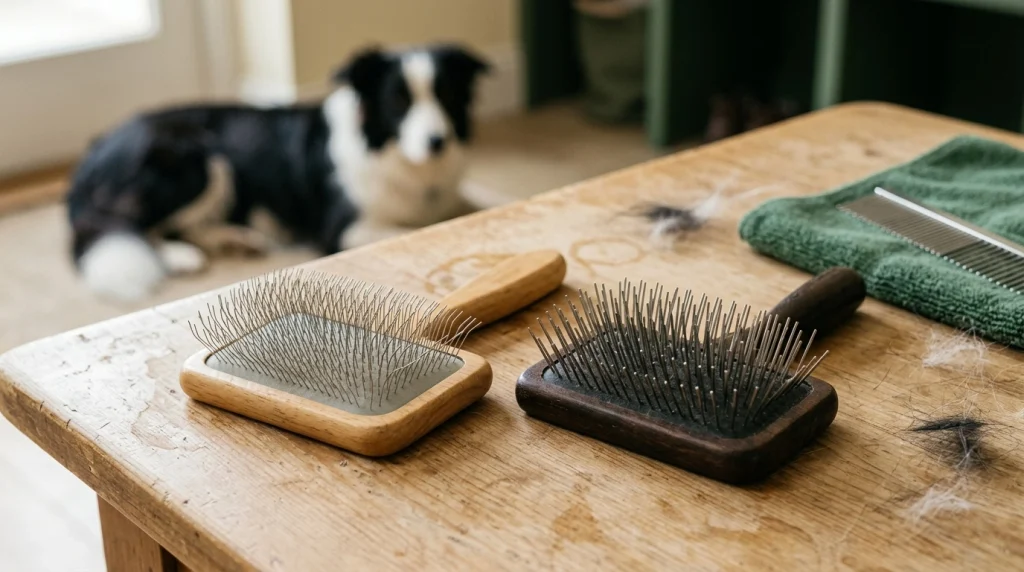
The easiest way to compare these options is to consider how each responds to the coat. Use the table below as a starting point, not as a guarantee that every brush labeled soft or firm will perform identically.
| Feature | Soft Pins | Firm Pins |
|---|---|---|
| Flexibility | Bend more readily | Resist bending more strongly |
| Brushing feel | More forgiving under light pressure | More rigid and supportive |
| Possible use | Gentle maintenance and delicate coats | Controlled work through denser coats |
| Main limitation | May flex too much for some grooming tasks | May feel harsh when pressure is excessive |
| Tangle removal | Depends on pin design and coat condition | Depends on pin design and coat condition |
| Best selection criteria | Comfort, coat texture, and controlled flex | Coat density, suitable length, and gentle technique |
Notice what the comparison does not say: firm pins are not inherently better for shedding, and soft pins are not guaranteed to prevent skin irritation. Both claims overlook the brush’s construction and how the owner uses it.
Which Dogs Benefit Most From Soft-Pin Brushes?
Soft pins are worth considering when gentle handling is a priority, particularly if a dog’s coat is relatively fine or the brush will be used for routine maintenance rather than heavy detangling.
Fine and silky coats
Dogs with fine, flowing hair may benefit from a brush that moves smoothly without unnecessary pulling. A suitable soft-pin brush can help maintain the coat, although pin length and spacing still need to match the hair.
For breeds such as Maltese and Yorkshire Terriers, a conventional pin brush with smooth, rounded tips may also be suitable. The right choice depends on whether you need to smooth the hair, separate strands, or address tangles.
Puppies and dogs new to grooming
A gentle brush can help introduce a puppy to the sensation of grooming. Keep early sessions short, reward calm behavior, and allow the puppy to become comfortable with handling before increasing the duration.
Choose a brush appropriate for the puppy’s actual coat rather than assuming that every puppy needs the same tool. A soft brush designed for a short coat may not be suitable for a long, dense coat.
Sensitive areas
The face, ears, belly, armpits, and areas around the legs require particular care because the skin and coat can behave differently from those on the body. Use a suitable small brush, work slowly, and avoid dragging pins across the skin.
If your dog has painful skin, inflammation, open sores, or persistent sensitivity, address the underlying problem before brushing the affected area. A softer brush cannot make painful skin safe to groom.
When Are Firm-Pin Dog Brushes a Better Choice?
Firm pins may be useful when a coat requires more support from the brush and the owner needs to maintain controlled contact while working through individual sections. They are most useful when their stiffness, length, and layout suit the coat.
Dense and double coats
Double-coated dogs have a topcoat and an insulating undercoat. Breeds such as German Shepherds, Golden Retrievers, and Border Collies can retain loose undercoat, especially during seasonal shedding.
A suitable slicker brush can help separate hair and collect loose material. An undercoat rake may be more appropriate when the main task is removing loose undercoat, so a firmer brush should not be treated as a universal replacement.
Long coats that tangle easily
Long hair can develop tangles behind the ears, under the legs, and around areas where movement creates friction. A brush with appropriate pin length can help you work through manageable tangles in small sections.
Firmness alone will not solve compacted knots. If the brush pulls at the skin or cannot move through a section without force, stop and reassess the technique or use a suitable detangling method.
Curly and dense coats
Poodles and many Poodle mixes need careful brushing because their coats can mat close to the skin. A suitable slicker brush and a metal comb are often more useful than choosing a brush simply because its pins feel firm.
Work in small layers and check that the coat is clear down to the skin. If a mat sits tightly against the skin, professional grooming is safer than repeatedly pulling on it.
Does Pin Stiffness Matter More Than Pin Length?
No. Pin stiffness and pin length solve different problems, and both must suit the dog’s coat. A firm pin that is too short may skim the surface, while a long pin used with excessive pressure may irritate the skin.
Before buying a brush, consider these factors together:
- Pin length: The pins must reach the intended layer of the coat without being forced into the skin.
- Pin spacing: Closely spaced pins and widely spaced pins interact differently with loose hair and tangles.
- Pin angle: Angled slicker wires work differently from straight pins on a conventional pin brush.
- Head flexibility: A flexible cushion can change how pressure is distributed during brushing.
- Brush size: A smaller head may offer better control around narrow or delicate areas.
- Tip finish: Inspect the pins for sharp edges, burrs, broken tips, or other damage.
For example, a long-coated dog may need longer pins to reach through the coat, but that does not mean the pins must also be extremely firm. A well-matched brush should move through the coat with minimal pulling.
How Can You Tell Whether Your Dog Needs Softer or Firmer Pins?
 Save
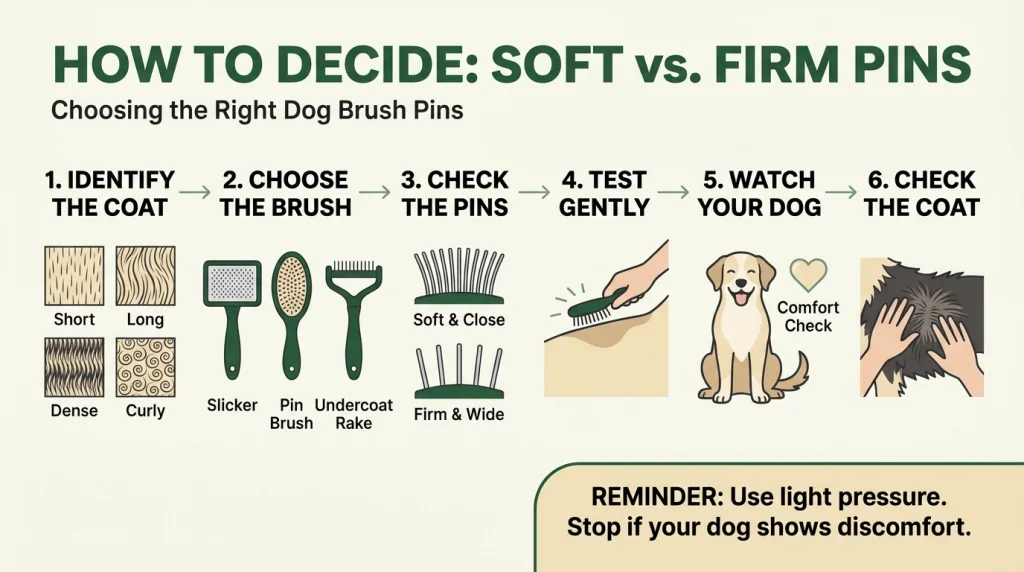
Start with your dog’s coat and grooming goal, then evaluate how the brush feels during a short, gentle trial. You do not need to buy both stiffness options before learning which type works better.
- Identify the coat: Decide whether it is short and smooth, long and silky, dense and double-coated, or curly and mat-prone.
- Choose the brush type: Consider a bristle brush for short, smooth coats, a pin brush for suitable long coats, or a slicker for coats prone to tangles.
- Check the pins: Compare stiffness, length, spacing, and tip quality rather than relying only on the product label.
- Test your pressure: Follow the manufacturer’s instructions and begin with light strokes on an appropriate area.
- Watch your dog: Look for relaxed behavior and easy brush movement; stop if your dog flinches, pulls away repeatedly, or shows discomfort.
- Check the coat: Part the hair to see whether the brush has reached the intended layer instead of merely smoothing the surface.
A useful rule is to increase control, not force, when the coat resists the brush. If a stroke catches, reduce the section size and work carefully rather than pushing through the knot.
How to Use Soft and Firm Pins Without Irritating Your Dog’s Skin
Correct technique matters with both types. Even a brush marketed as gentle can cause irritation when you repeatedly scrape the same area or press its pins into the skin.
Use short, controlled strokes
Hold the brush comfortably and let the pins work through the hair without bearing down. Start with small sections and adjust your angle instead of forcing a difficult stroke.
Brush long coats in layers
Separate the hair into manageable sections so you can reach the coat underneath. This technique, often called line brushing, helps reveal tangles that a quick pass over the surface might miss.
Handle tangles carefully
Work on small, loose tangles only when you can separate them without pulling the skin. Holding the hair above the tangle can reduce tugging, but tight mats close to the skin may require a professional groomer.
Inspect the skin and brush
Check for redness, scratches, tenderness, and damaged pins during grooming. Stop if the skin becomes irritated, and replace a brush with bent, broken, or rough pins.
For broader coat-care guidance, the American Kennel Club offers information about grooming and breed-specific coat needs. Veterinary guidance is appropriate when brushing reveals persistent skin problems or pain.
Common Mistakes When Choosing Dog Brush Pins
Several buying mistakes can lead to an ineffective brush or an uncomfortable grooming session. Avoid these common assumptions before deciding between soft and firm pins.
- Assuming firm means effective: A firmer pin does not automatically remove more hair or detangle more safely.
- Choosing only by breed: Coat length, density, condition, and grooming style can vary within the same breed.
- Ignoring pin length: Pins that are too short may fail to reach the intended layer of a thick coat.
- Brushing harder when resistance increases: Resistance may signal a tangle or unsuitable tool, not a need for greater pressure.
- Using one brush for every task: Surface finishing, undercoat removal, and dematting are different jobs.
- Overlooking skin condition: A dog with irritated or painful skin may need veterinary advice before routine brushing continues.
As of 2026, the most useful selection principle remains straightforward: match the tool to the coat and use it with appropriate technique. Product names and stiffness labels cannot replace those decisions.
Which Dog Brushes Are Worth Considering?
 Save
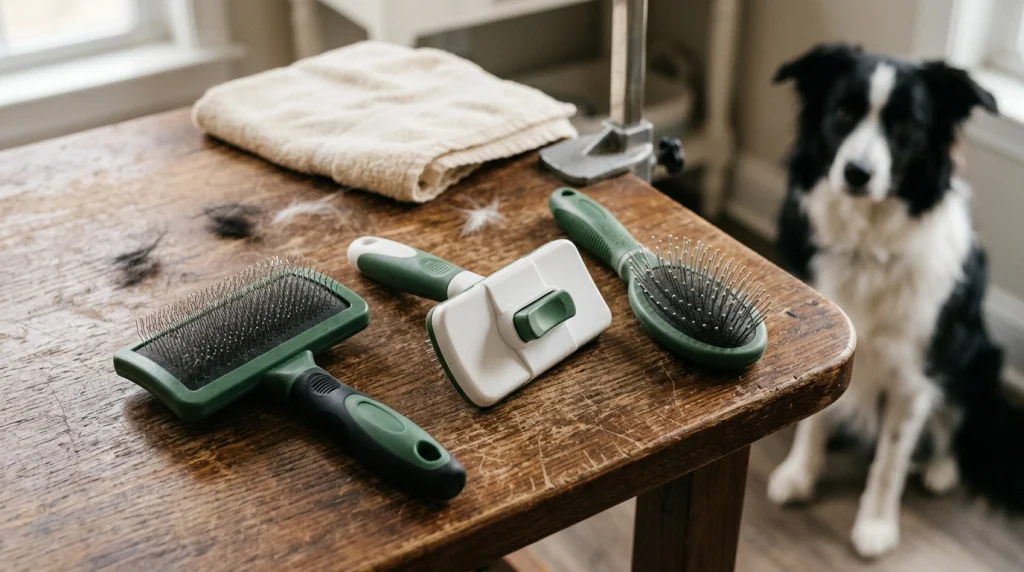
If you’re ready to choose a brush, start with the grooming task rather than the marketing label. These options provide different brush designs to compare; verify the current product description, pin construction, and intended coat type before ordering.
Gentle grooming option
Chris Christensen Big G Slicker Brush
★★★★☆
Consider this professional-style slicker when comparing brushes for long, dense, or curly coats. Check the specific model’s pin length and firmness, and use light strokes rather than relying on pressure to remove tangles.
Easy-clean design
Hertzko Self-Cleaning Slicker Brush
★★★★☆
Consider this style if convenient hair removal from the brush head matters to you. Before buying, check the pin design and whether the particular version suits your dog’s coat and comfort needs.
Long-coat maintenance
Chris Christensen Original Series Pin Brush
★★★★☆
A conventional pin brush is worth comparing when the goal is separating and maintaining suitable long coats. Confirm the exact model, pin length, and tip design because pin brushes serve a different purpose from slickers.
The star symbols above represent general editorial fit, not verified customer ratings or controlled product-test results. Product availability, specifications, and model variations should be checked before purchase.
Frequently Asked Questions
Are soft-pin brushes better for dogs with sensitive skin?
Soft pins can offer a more forgiving brushing feel, but they do not guarantee protection against irritation. Pin tips, brush-head design, coat condition, and pressure all matter. If your dog has inflamed skin, open sores, or pain during grooming, stop brushing the affected area and seek veterinary advice.
Do firm pins remove more shedding hair?
Not necessarily. Shedding-hair removal depends on the brush design, pin arrangement, coat type, and grooming technique. A suitable slicker or undercoat rake may remove loose hair more effectively than a conventional pin brush on a dense double coat, regardless of pin stiffness.
Can I use a soft-pin slicker on a double-coated dog?
Possibly, if the brush has suitable pin length and design for the coat and you can use it comfortably without excessive pressure. Some double-coated dogs benefit from a slicker for coat separation and an undercoat rake for loose undercoat. Choose the tools according to the task and monitor the skin throughout grooming.
Are firm pins safe for puppies?
Firm pins are not automatically appropriate or inappropriate for every puppy. A puppy’s coat, size, skin sensitivity, and familiarity with grooming should guide the choice. Start with brief, gentle sessions and a suitable brush, reward calm behavior, and stop if the puppy shows discomfort.
Should I choose soft pins or firm pins for a Poodle?
Choose a slicker brush with suitable pin length and construction for the Poodle’s coat, then consider stiffness according to your handling technique and the dog’s comfort. Regular layered brushing and checking with a metal comb can help reveal tangles near the skin. Tight mats may require professional grooming.
Final Takeaway: Choose the Pins That Suit Your Dog
Soft pins are a sensible starting point when you want a more forgiving brush feel, while firm pins may offer useful support when working through a suitable dense coat. Neither option replaces the need to choose the correct brush type and pin length.
Before buying, identify your dog’s coat type, decide whether you need maintenance brushing or tangle removal, and inspect the pin construction. Most importantly, use gentle technique and let your dog’s comfort guide the decision.
When a brush repeatedly catches, pulls, or irritates the skin, don’t solve the problem by pressing harder. Reassess the tool, adjust your technique, and seek professional help for tight mats or persistent skin concerns.

Thomas Cutter is a lifelong dog owner and the founder of FindOutAboutDogs.com. With over 10 years of hands-on experience owning multiple breeds, Thomas created this site to provide honest, research-based dog advice that real owners can actually trust.
