What Brush Is Best for a Goldendoodle? 2026 Grooming Guide
Quick Answer
The best brush for most Goldendoodles is a long-pin slicker brush that can reach through a thick, wavy, or curly coat without requiring heavy pressure. I recommend pairing it with a steel comb, since the comb tells you whether hidden tangles remain near the skin; the American Kennel Club’s dog brush guidance also recommends slicker brushes for curly and mat-prone coats.
What I look for in a Goldendoodle brush
- Long pins: They reach farther into a medium or long Doodle coat than shallow pins.
- Flexible cushion: Some give in the brush head helps make light, controlled strokes easier.
- Angled wires: Bent slicker pins can work through loose hair while you use minimal pressure.
- Comfortable handle: Goldendoodle grooming takes time, so hand comfort matters.
- Correct size: Large heads suit the body, while smaller brushes give better control around legs and tight areas.
My quick pick
- For a full, medium-to-long Goldendoodle coat, start with a quality long-pin slicker and finish every section with a steel comb.
Goldendoodle coats can fool you. The surface may look fluffy and smooth while small tangles are forming underneath.
That is why I don’t choose a brush based on how soft the top of the coat looks afterward. I want a tool that helps me work through the coat in controlled sections and then lets me verify the result.


Why Is a Long-Pin Slicker Brush Best for Most Goldendoodles?
A long-pin slicker brush is usually the best primary Goldendoodle brush because its fine wire pins can work through thick, curly, and wavy hair more effectively than a surface-only brush. The goal isn’t aggressive detangling.
The goal is reaching deeper layers using light strokes. VCA Animal Hospitals specifically lists slicker brushes as useful for curly, non-shedding-type coats such as Poodles.
A slicker brush is a grooming brush covered with many thin wire pins, usually angled or bent. Those pins separate hair, lift loose coat, and help stop small tangles from tightening into mats.
- Curly coat: Prioritize longer pins and careful line brushing.
- Wavy fleece coat: A medium or long-pin slicker normally gives good everyday control.
- Short clipped coat: You may not need the deepest professional slicker available.
- Straighter coat: A pin brush can help with finishing, but I still prefer a slicker where tangles develop.
Coat type varies considerably between individual Goldendoodles. Don’t assume a brush works for your dog just because another Goldendoodle owner likes it.
Pin length, coat length, density, grooming frequency, and technique all affect the result.
What Should You Look for When Choosing a Goldendoodle Slicker Brush?
Choose the brush according to coat depth first, then consider head size, pin flexibility, and handle comfort. A beautiful brush that never reaches the deeper coat won’t solve your matting problem.
Long enough pins for the coat
Long pins are especially useful when your Goldendoodle carries several inches of fluffy coat. Current Doodle-oriented professional brushes commonly use pins around 20 to 27 mm long.
That doesn’t mean longer is automatically safer. Technique still matters more than brute force.
A flexible, forgiving brush head
A cushioned slicker head gives the pins some movement. I prefer that over a tool that feels rigid when working around curved body areas.
Keep your pressure light. If you’re pushing hard enough to scrape the skin, changing technique is more important than buying a stronger brush.
A brush size that matches the area
- Large slicker: Best for the back, sides, chest, and other broad areas.
- Medium slicker: Easier around legs, shoulders, and smaller Goldendoodles.
- Small slicker: Useful for controlled work around tight areas, although extra care is needed near sensitive skin.
One large brush can handle most home grooming. Owners maintaining a long coat may eventually appreciate both large and medium sizes.
Which Goldendoodle Brushes Are Worth Considering in 2026?
 Save
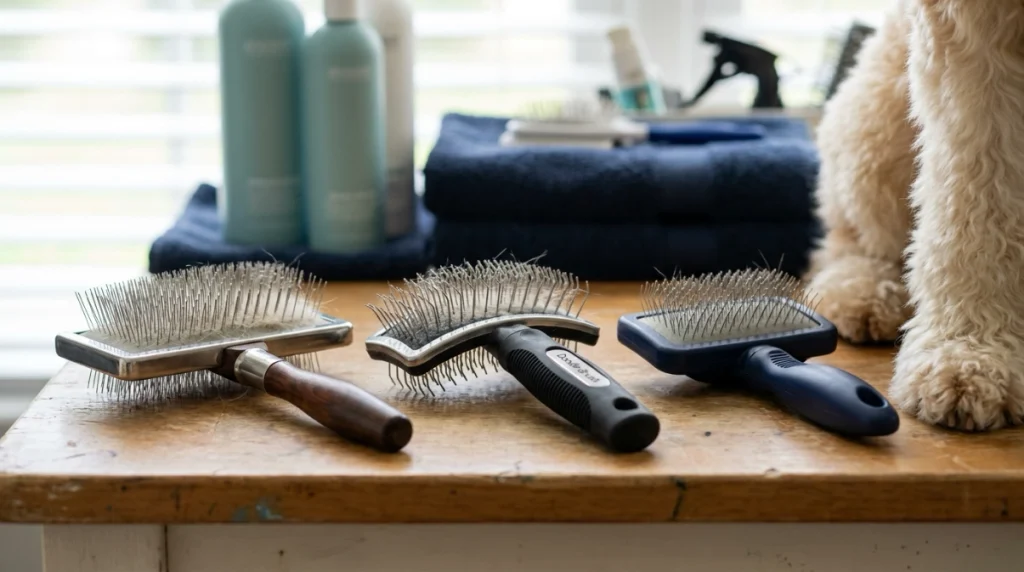
SaveThe Chris Christensen Big G stands out for dense, longer coats, while We Love Doodles offers a lower-priced long-pin alternative and Show Tech offers a more compact professional-style option. The specifications below matter more to me than marketing claims.
| Brush | Pin Length | Notable Design | Best Fit |
|---|---|---|---|
| Chris Christensen Big G | 27 mm | Long bent stainless-steel pins, flexible cushion, curved back | Dense, curly, medium-to-long coats |
| We Love Doodles Slicker Brush | About 1 inch | Dense angled stainless-steel pins | Owners wanting a long-pin Doodle-focused brush |
| Show Tech Tuffer Than Tangles Long Pin | 20 mm | Angled pins, flexible padded cushion, shaped handle | Curly coats and controlled section work |
The Chris Christensen Big G currently uses 27 mm pins and comes in several head sizes. Its large version is designed for body work, while smaller versions give more control on legs and tighter areas.
We Love Doodles lists approximately one-inch pins on its large slicker. Show Tech’s long-pin Tuffer Than Tangles version uses 20 mm pins.
How Do You Brush a Goldendoodle Without Missing Hidden Mats?
 Save
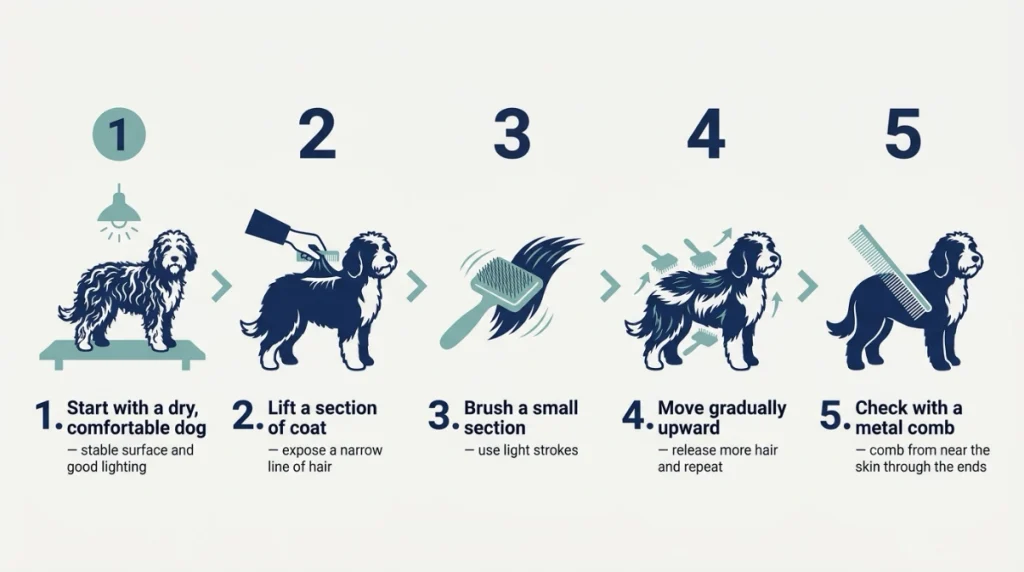
SaveUse line brushing instead of making long strokes over the top of the coat. Line brushing exposes one small layer at a time so your brush can work from near the roots toward the ends.
This is the difference between a coat that looks brushed and one that has been checked thoroughly.
- Start with a dry, comfortable dog. Place your Goldendoodle somewhere stable with good lighting.
- Lift a section of coat. Use your free hand to expose a narrow line of hair beneath it.
- Brush a small section. Use light strokes rather than dragging hard through resistance.
- Move gradually upward. Release a little more hair and repeat the process.
- Check with a metal comb. Run the comb from near the skin through the ends before moving on.
My favorite test is simple: the coat isn’t finished just because the slicker moves smoothly. The steel comb should also pass through the section without repeatedly catching.
The Goldendoodle Association of North America recommends using a slicker followed by a metal comb for puppy coat maintenance. That second step helps expose mats hiding beneath the surface.
Where should you check for mats first?
Don’t spend all your time on the easy part of the back. High-friction areas deserve more attention.
- Behind the ears: Fine hair can knot quickly here.
- Under the collar: Constant rubbing encourages tangles.
- Armpits: Movement creates friction in a difficult-to-see area.
- Chest and belly: Long coat can hide tangles underneath.
- Legs: Fluffy leg hair often needs small, careful sections.
- Harness areas: Straps rubbing against longer coat can encourage matting.
- Tail and rear: Check the dense base rather than brushing only the visible ends.
How Often Should You Brush a Goldendoodle?
Longer Goldendoodle coats may need brushing several times a week or even daily, while shorter clipped coats can often go longer between complete sessions. The correct schedule depends on coat length, curl, activity, and how quickly your individual dog’s coat tangles.
I would rather do short maintenance sessions before knots tighten than turn grooming into one exhausting weekly battle.
| Coat Situation | Practical Home Routine |
|---|---|
| Long, curly, mat-prone coat | Check high-friction areas daily and perform thorough brushing frequently. |
| Medium-length wavy coat | Brush several times weekly and use the comb check. |
| Short professionally clipped coat | Brush as needed while monitoring ears, collar areas, legs, and tail. |
Season, swimming, rain, clothing, and outdoor play can change that schedule. Check the coat with your hands rather than relying only on the calendar.
Should You Use a Slicker Brush, Pin Brush, or Bristle Brush?
For preventing tangles in a typical medium-to-long Goldendoodle coat, I would choose the slicker first. A pin brush and bristle brush serve different purposes.
- Long-pin slicker brush: Best primary option for dense, curly, wavy, and tangle-prone coats.
- Pin brush: Useful for gentle finishing and maintaining straighter or loosely wavy hair.
- Bristle brush: Better suited to surface smoothing and many shorter coats than deep Doodle detangling.
- Steel comb: Not a replacement for the slicker, but excellent for checking whether your brushing reached deeper layers.
- Dematting tools: Specialized tools that require more care and shouldn’t replace routine maintenance.
A common mistake is buying a brush that feels gentle in your hand but only skims the coat. The surface becomes fluffy while tangles remain underneath.
Can You Brush Out a Severely Matted Goldendoodle?
Small loose tangles may be worked apart carefully, but tight or extensive mats shouldn’t be attacked with repeated hard brushing. Tugging can pull the skin and make grooming painful.
If a mat sits tightly against the skin, let a professional groomer assess it. Using scissors close to hidden skin folds can also cause an accidental cut.
Before bathing, check the coat carefully. The ASPCA recommends brushing out dead hair and mats before a bath.
Prevention is much easier. Frequent short sessions also help your dog learn that the brush doesn’t always predict a long grooming ordeal.
How Can You Make Goldendoodle Brushing More Comfortable?
 Save
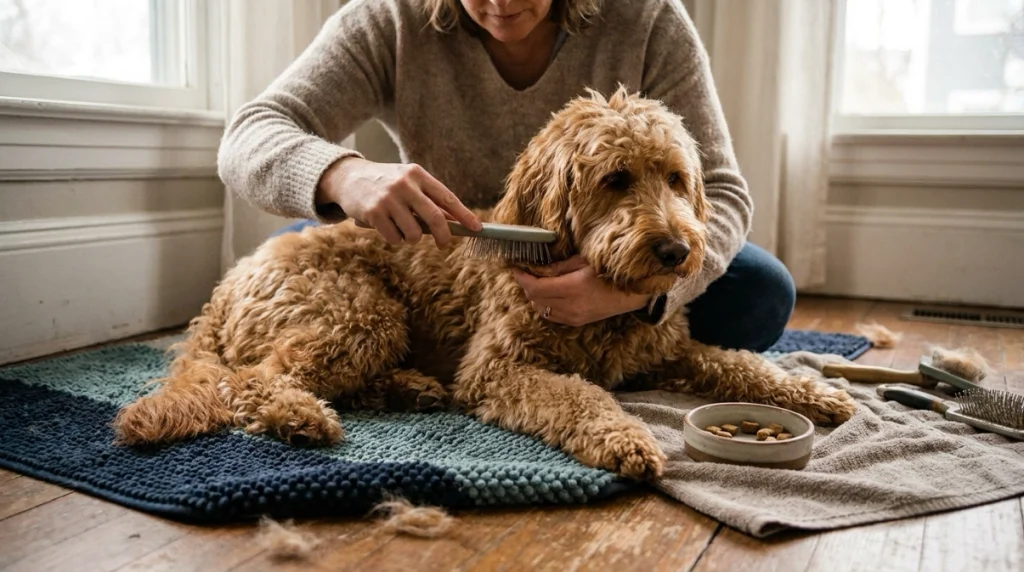
SaveUse lighter pressure, smaller sections, and shorter grooming sessions. More force rarely solves a tool or technique problem.
- Start calmly: Let puppies investigate the brush before expecting a full grooming session.
- Use small sections: Thick Doodle hair becomes easier to manage when divided into narrow lines.
- Support tangled hair: Hold hair near the base when working on a loose knot to reduce pulling.
- Reward cooperation: Treats and calm praise can build positive grooming associations.
- Stop for skin irritation: Redness, sores, or obvious pain deserve professional attention.
Watch your dog’s body language. Repeated flinching, turning, sitting down, or trying to escape tells you something about the session needs to change.
If you’re ready to pick one, these are the three slicker brushes I’d put on my shortlist for a Goldendoodle in 2026:
🏆 Best Overall
Chris Christensen Big G Slicker Brush
★★★★★ 4.9/5 editorial fit
The Big G uses 27 mm stainless-steel pins, a flexible cushion, and a deeply curved head designed for dense coats. It’s my strongest all-around choice when maintaining a full, curly or wavy Goldendoodle coat at home.
💰 Best Value
We Love Doodles Slicker Brush
★★★★☆ 4.6/5 editorial fit
This Doodle-focused slicker uses approximately one-inch stainless-steel pins with an angled design for longer coats. I like it as a value-minded alternative for owners who still want more reach than a shallow everyday slicker.
🐕 Best Compact Pro-Style Pick
Show Tech Tuffer Than Tangles Long Pin Slicker
★★★★☆ 4.5/5 editorial fit
The long-pin version uses 20 mm angled pins and a flexible padded cushion. I would consider it when you want a smaller professional-style slicker for curly coat work without jumping straight to the Big G.
Frequently Asked Questions
What is the best type of brush for a Goldendoodle?
A long-pin slicker brush is the best primary brush for most Goldendoodles with medium-to-long wavy or curly coats. The longer pins help reach deeper layers where tangles can hide, while a metal comb should be used afterward to check your work.
Do Goldendoodles need a slicker brush and a comb?
Yes, the combination works better than relying on either tool alone. Use the slicker to separate and detangle the coat, then pass a steel comb from near the skin through the ends to find sections that still need attention.
Is a pin brush good for a Goldendoodle?
A pin brush can be useful for finishing, fluffing, and maintaining straighter or loosely wavy hair. For a thick, curly, mat-prone Goldendoodle coat, however, I would normally make a long-pin slicker the primary grooming brush.
How often should I brush my Goldendoodle?
Long or curly Goldendoodle coats often need attention several times per week, with mat-prone areas checked even more frequently. Short clipped coats may need less brushing, so adjust the schedule according to coat length, activity, and how quickly tangles appear.
Why does my Goldendoodle still get mats after brushing?
You may be brushing only the surface instead of reaching deeper layers. Divide the coat into narrow sections, line brush each section carefully, and finish with a metal comb; if the comb repeatedly catches near the roots, that area needs more work.
My Final Takeaway
If you’re wondering what brush is best for a Goldendoodle, start with a long-pin slicker brush. For a full, dense coat, the Chris Christensen Big G is my strongest overall choice, while other long-pin slickers can work well at different budgets.
Don’t stop with the brush. Add a steel comb, learn line brushing, and check high-friction areas before tiny tangles become painful mats.
Your best next step is simple: examine your Goldendoodle’s coat length today, choose a slicker with enough pin depth for that coat, and start with one short, gentle grooming session.

Thomas Cutter is a lifelong dog owner and the founder of FindOutAboutDogs.com. With over 10 years of hands-on experience owning multiple breeds, Thomas created this site to provide honest, research-based dog advice that real owners can actually trust.
