What Brush Should You Use on a Goldendoodle?
Quick Answer
For most Goldendoodles, use a long-pin slicker brush as your main grooming brush, then check the coat with a stainless-steel comb. The slicker separates dense, curly, or wavy hair, while the comb reveals tangles the brush may have missed; this Goldendoodle brushing guide shows the full section-by-section technique.
What to look for in the brush
- Long wire pins: They should reach into the coat instead of polishing only the fluffy surface.
- Flexible cushion: A little movement in the brush head helps you work with lighter pressure.
- Angled pins: Bent pins help separate curly or wavy hair during controlled strokes.
- Correct head size: Larger heads suit the body, while smaller heads give better control around legs.
- Comfortable handle: Good grip matters when a full-coat grooming session takes time.
One important check
- Finish with a comb: If a metal comb still catches near the roots, that section is not fully detangled.
Goldendoodle coats can look soft and perfectly brushed while small tangles remain underneath. That is why I pay more attention to how deeply a brush works than how fluffy the coat looks afterward.
As of 2026, my basic setup is still simple: one suitable long-pin slicker, one metal comb, and a gentle line-brushing routine.


What brush should you use on a Goldendoodle?
A long-pin slicker brush is the best primary brush for most medium-to-long Goldendoodle coats. Pair it with a metal grooming comb rather than expecting one brush to do every job.
Goldendoodles can inherit curly, wavy, or straighter coat traits, so the ideal pin depth and brush size can vary. The goal is to reach through the coat without scraping the skin.
Definition: A long-pin slicker brush is a grooming brush with many fine, angled wire pins set into a padded head. Longer pins help the brush work through deeper layers of a full curly or wavy coat instead of touching only the outer ends.
- Primary tool: Long-pin slicker brush for separating the coat and removing loose hair.
- Checking tool: Stainless-steel comb for finding remaining knots near the skin.
- Optional finishing tool: Pin brush for fluffing or light work on looser coats.
- Usually unnecessary: Aggressive de-shedding blades for routine Goldendoodle maintenance.
Why does a slicker brush work so well on a Goldendoodle?
Slicker brushes are designed to work through longer, curly, and mat-prone coats using many fine wire pins. The American Kennel Club’s brush guide specifically lists slickers for curly and longer coats and recommends using a light touch.
That combination fits many Goldendoodles well. Their coat often holds loose hair inside the surrounding curls or waves instead of dropping every strand onto the floor.
- Reaches deeper: Longer pins can separate more of a full coat than a shallow surface brush.
- Finds early tangles: Small knots become easier to notice before they tighten.
- Works section by section: Slickers suit the line-brushing method particularly well.
- Lifts dense hair: This makes it easier to see which areas you have already covered.
I use one simple rule when judging a brush: the coat should become easier to comb, not merely bigger and fluffier. A smooth-looking surface means little if the comb immediately stops underneath it.
Should you use a slicker, pin brush, bristle brush, or rake?
 Save
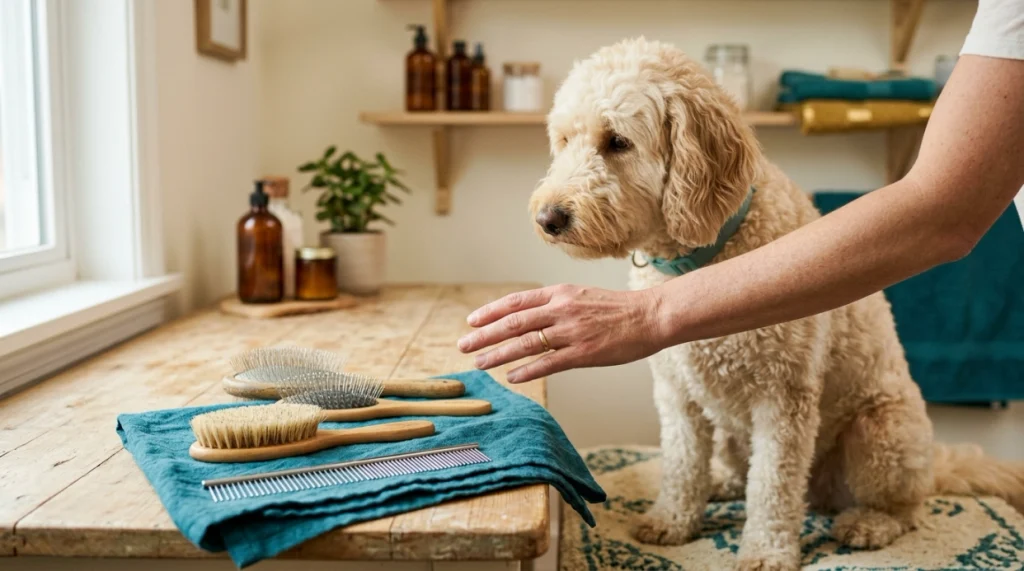
SaveFor a typical full Goldendoodle coat, start with the slicker. The other tools have useful roles, but they are not interchangeable.
| Tool | Best Role | Goldendoodle Use | Main Limitation |
|---|---|---|---|
| Long-pin slicker | Separating dense hair | Best primary choice for many curly and wavy coats | Can irritate skin if pressed too hard |
| Pin brush | Finishing and light maintenance | Useful on looser or straighter coats | May pass over deeper tangles |
| Bristle brush | Surface smoothing | Limited finishing use | Usually lacks reach for a full Doodle coat |
| Metal comb | Checking for hidden tangles | Essential finishing check | Should never be forced through a mat |
How long should Goldendoodle slicker-brush pins be?
A fuller Goldendoodle coat generally benefits from longer pins because they can reach farther into the hair. Current professional and Doodle-focused brushes commonly offer roughly one-inch or 27 mm pins.
Longer is not automatically better. The brush must still match your dog’s coat length, body size, skin sensitivity, and your ability to control it.
| Brush | Published Pin Length | Design | Best Fit |
|---|---|---|---|
| Chris Christensen Big G | 27 mm | Dense bent stainless-steel pins, curved head, flexible cushion | Full, long, curly or cottony coats |
| We Love Doodles Slicker | 1 inch | Angled stainless-steel pins with Doodle-focused sizing | Owners wanting a long-pin everyday option |
| Show Tech Tuffer Than Tangles LongReach | 27 mm | Flexible long pins, soft pad, curved head | Dense coats and controlled section work |
Do curly, wavy, and shorter Goldendoodle coats need different brushes?
Yes, coat texture and haircut should influence the brush you choose. “Goldendoodle” describes a mix, not one completely uniform coat.
- Dense curly coat: Prioritize a long-pin slicker with enough reach to separate small sections.
- Wavy fleece coat: A medium or long-pin slicker usually works well for routine maintenance.
- Looser or straighter coat: A pin brush may be useful for finishing, with a slicker kept for tangle-prone areas.
- Short clipped coat: You may not need the deepest professional brush, but ears, tail, and friction areas still require checks.
- Puppy coat: Choose a controllable, gentle brush and build positive grooming habits before the adult coat becomes harder to maintain.
Coat length also changes quickly between grooming appointments. A brush that feels excessive immediately after a short trim may become much more useful several weeks later.
How should you brush a Goldendoodle without hurting the skin?
 Save
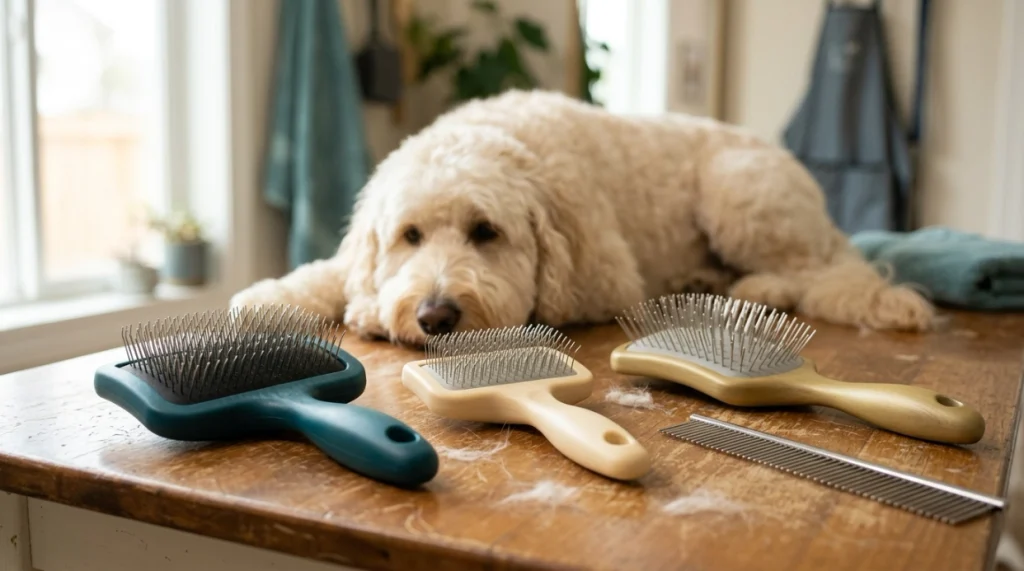
SaveBrush in narrow sections using short, light strokes instead of dragging the slicker across the entire surface. This technique is often called line brushing.
The brush should move through hair, not repeatedly scrape bare skin. If you need heavy force, stop and inspect the area rather than pushing harder.
- Start with a calm, dry dog. Remove the collar or harness so you can reach friction areas.
- Lift a thin layer of hair. Expose a narrow section instead of brushing a large fluffy patch.
- Begin near the ends. Use light strokes to free minor resistance before moving deeper.
- Work toward the roots. Keep the brush moving through hair without scraping the same skin repeatedly.
- Release another layer. Continue methodically so sections do not get skipped.
- Finish with a metal comb. Pass it from near the skin through the ends without forcing resistance.
- Stop at painful tangles. Tight mats need assessment rather than stronger brushing.
How often should you brush a Goldendoodle?
Most Goldendoodles need brushing at least several times each week, while long or curly coats may need daily attention. PetMD’s Goldendoodle care guide recommends brushing at least a few times weekly.
The right schedule depends on length, curl, activity, moisture, clothing, and how quickly your individual dog develops tangles. My preference is short maintenance sessions before knots become difficult.
- Long curly coat: Check daily and perform thorough brushing frequently.
- Medium wavy coat: Start with several sessions each week.
- Short trim: Brush less extensively, but keep checking longer ears, legs, and tail hair.
- After swimming or rain: Inspect the coat once it is properly managed and dried.
- After harness use: Check the chest, shoulders, and underarm areas for friction tangles.
If you are unsure why that schedule matters, this guide explains why Goldendoodles need regular brushing even when little loose hair appears around the house.
Why should you use a metal comb after the slicker brush?
The comb tells you whether the slicker reached the deeper coat. A brush can glide over the top while a small knot remains closer to the skin.
The Goldendoodle Association of North America recommends a slicker brush followed by a metal comb for puppy grooming. I use the same principle as a practical quality check on longer coats.
- Slicker first: Separate hair and work through minor tangles.
- Comb second: Test whether the full section is clear.
- Snag found: Stop and inspect rather than pulling the comb through it.
- Comb glides freely: Move to the next section.
For more detail, see why a dog brush and comb work better together than either tool used alone.
How can you tell your brush is not reaching deeply enough?
The clearest sign is a coat that looks brushed while a comb still catches underneath. Repeated knots in the same friction zones are another warning.
- Comb resistance: Teeth stop before moving from root to tip.
- Fluffy surface only: The top looks polished but deeper hair still feels packed.
- Recurring ear knots: Fine hair behind the ears tangles again quickly.
- Harness-area tangles: Chest or shoulder hair forms small clumps beneath straps.
- Armpit matting: Leg movement creates knots that surface brushing misses.
- Groomer finds mats: Hidden matting appears despite frequent home brushing.
You can use this hidden-mat checking method to inspect problem areas with your fingers and comb before they become severe.
When should you stop brushing and call a groomer?
Stop when a mat is tight against the skin, pulling causes pain, or the skin underneath appears irritated. Stronger brushing is not a safe solution to severe matting.
VCA Animal Hospitals advises gentle detangling for minor problems and professional care when mats are severe or extensive. Its coat-care guidance also warns against using scissors to remove mats because skin can be accidentally cut.
- Call a groomer: Tight or widespread mats on otherwise healthy-looking skin.
- Call a veterinarian: Redness, swelling, bleeding, odor, sores, or marked tenderness.
- Do not force it: Stop if your dog cries, freezes, snaps, or repeatedly tries to escape.
- Avoid household scissors: Skin can become pulled into a mat and hidden from view.
A shorter haircut can also make home maintenance easier. Tell your groomer how often you can realistically brush rather than choosing a style that demands more upkeep than your routine allows.
Goldendoodle slicker brushes I would consider in 2026
 Save
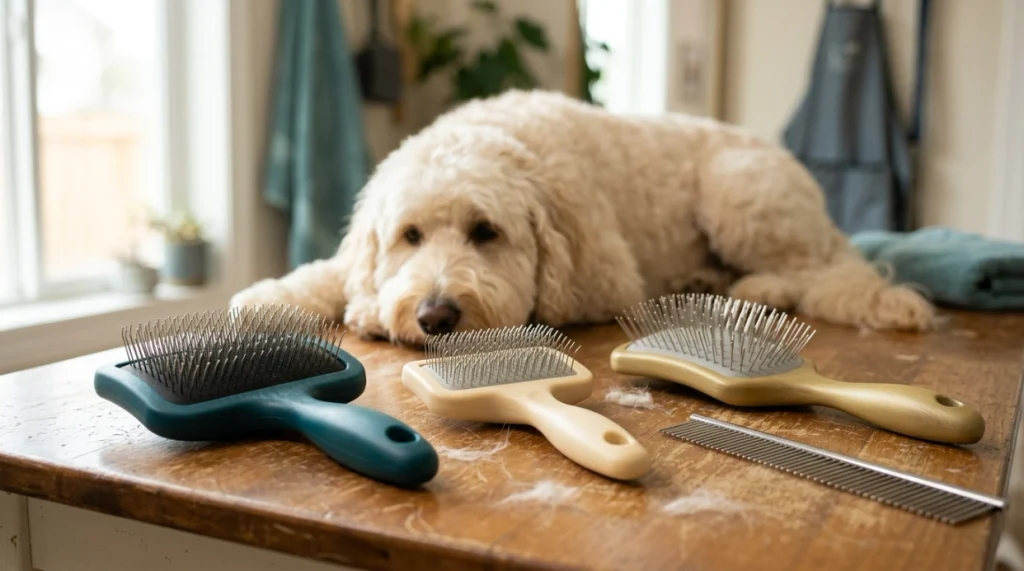
SaveIf you are ready to choose one, I would match the brush to coat depth, body size, and budget. The ratings below are editorial fit scores based on published design and specifications, not Amazon customer ratings or a claim of hands-on laboratory testing.
🏆 Best Overall
Chris Christensen Big G Slicker Brush
★★★★★ 4.9/5 editorial fit
The Big G uses 27 mm stainless-steel pins, a flexible cushion, and a curved head for long, dense coats. I would make it my first choice for a full curly or wavy Goldendoodle when deep coat reach matters more than price.
💰 Best Value
We Love Doodles Slicker Brush
★★★★☆ 4.6/5 editorial fit
This Doodle-focused brush uses one-inch angled stainless-steel pins for curly and wavy coats. I like it for owners who want long-pin reach without immediately moving to the higher-priced professional option.
🐕 Best Pro-Style Alternative
Show Tech Tuffer Than Tangles LongReach
★★★★☆ 4.5/5 editorial fit
The LongReach version uses 27 mm flexible pins, a soft pad, and a curved head intended for deeper grooming. I would consider it for controlled section work on thick or curly coats when you want a professional-style alternative.
Frequently Asked Questions
What type of brush is best for a Goldendoodle?
A long-pin slicker brush is the best primary option for most Goldendoodles with medium-to-long curly or wavy coats. Its fine pins can reach deeper than many surface brushes, but you should follow it with a stainless-steel comb to check for hidden tangles.
Do Goldendoodles need both a slicker brush and a comb?
Yes, the two tools perform different jobs. The slicker separates hair and works through minor tangles, while the metal comb checks whether the section is clear from near the roots through the ends and exposes knots the brush may have missed.
Is a pin brush good for a Goldendoodle?
A pin brush can be useful for light maintenance, finishing, or a looser Goldendoodle coat. However, I would not rely on it as the only tool for a thick, long, curly, or mat-prone coat because deeper tangles can remain underneath.
Can you use a regular human hairbrush on a Goldendoodle?
A typical human hairbrush usually does not have the pin length or design needed to work through a dense Goldendoodle coat. A dog-specific slicker and grooming comb give you more control and make it easier to check whether you reached the deeper hair safely.
How do I know if I am brushing my Goldendoodle correctly?
Work through small sections with light pressure, then pass a metal comb from near the skin through the ends. If the comb moves comfortably without repeated snags and your dog shows no skin irritation or pain, the section has been brushed more thoroughly.
Final Takeaway
If you are asking what brush you should use on a Goldendoodle, start with a long-pin slicker brush and add a sturdy metal comb. That simple pair covers the most important home-maintenance jobs for many curly and wavy Goldendoodle coats.
Choose enough pin depth for the coat, work in small sections, and keep your pressure light. The best test is not how fluffy your Goldendoodle looks afterward—it is whether the comb can pass through the coat comfortably without finding hidden knots.
Your next step: check your Goldendoodle’s current coat length today, inspect the areas behind the ears and under the harness, then choose a slicker that can reach that depth without requiring heavy pressure.

Thomas Cutter is a lifelong dog owner and the founder of FindOutAboutDogs.com. With over 10 years of hands-on experience owning multiple breeds, Thomas created this site to provide honest, research-based dog advice that real owners can actually trust.
