What Is a Curly Dog Coat? Types, Breeds, and Grooming Tips
Quick Answer
A curly dog coat is a type of coat with hair that grows in visible curls, coils, or tight ringlets instead of lying straight. Common examples include Poodles, Bichon Frises, and Lagotto Romagnolos. Curly coats often trap loose hair, making regular brushing essential to prevent mats and maintain healthy skin. The curl pattern is largely inherited, as explained by the canine coat genetics research from UC Davis.
Five characteristics of a curly dog coat
- Visible curls: Hair forms defined loops, spirals, or tight waves.
- Variable shedding: Many curly breeds shed lightly, but some shed noticeably.
- Matting tendency: Loose hairs can become trapped among surrounding curls.
- Regular grooming: Dense coats often need daily brushing and routine trimming.
- Different textures: Curls may feel soft, woolly, springy, or relatively coarse.
How to check your dog’s coat
- Look beneath the surface: Gently separate the curls and check for hidden tangles near the skin.
- Check with a comb: A suitable metal comb should move through a well-maintained coat without snagging.
Those adorable curls can make a dog look like a living teddy bear. However, the coat underneath that fluffy appearance needs more attention than many owners expect.
I believe the best grooming routine starts with understanding the coat itself. This guide explains curly dog coat types, common breeds, brushing techniques, and the tools worth considering.


What Exactly Makes a Dog Coat Curly?
A curly dog coat develops when individual hair shafts grow with a curved or spiral shape. Those hairs combine to create the ringlets, coils, and textured appearance associated with curly-coated breeds.
Genetics plays an important role in determining this pattern. Variations involving the KRT71 gene are associated with wavy and curly coats in many dogs.
Understanding the structure of curly hair
Curly hair behaves differently from straight hair because adjacent strands bend and overlap. Loose hairs may remain caught within the surrounding coat rather than falling directly onto furniture.
Several characteristics influence how the finished coat looks and feels:
- Curl tightness: Some dogs develop small, compact ringlets, while others have larger, looser curls.
- Hair density: Closely packed strands create a fuller coat and increase the need for thorough brushing.
- Hair length: Longer curls have more opportunity to become tangled.
- Undercoat: Some curly breeds have a double coat, while others have little undercoat.
- Coat texture: Hair may be woolly, soft, wiry, or springy, depending on the breed.
These differences explain why two curly-haired dogs may need different brushes. The visible curl pattern tells only part of the story.
How Can You Tell if Your Dog Has a Curly Coat?
A curly-coated dog usually has naturally curved hair that forms recognizable curls after drying. However, a fluffy coat does not automatically mean the dog has a genetically curly coat.
Start by examining the hair around the shoulders, chest, back, and legs. Look for consistent curl patterns rather than isolated bends caused by moisture or grooming.
Simple coat identification checklist
- Examine individual strands. Gently separate a small section and look for naturally curved hairs.
- Check different body areas. Some breeds have tighter curls on their bodies than on their faces.
- Compare dry and damp hair. Moisture can temporarily change how curls appear.
- Look near the roots. The coat may be curlier beneath a brushed or blow-dried surface.
- Consider breed background. Breed standards and parent coat types provide useful clues.
Be particularly patient when identifying a puppy’s coat. Puppy hair can change considerably as the adult coat develops.
Can a puppy’s straight coat become curly?
Yes, some puppies develop stronger waves or curls as their adult coats grow. This is particularly relevant in Poodle mixes, where inherited coat traits can vary.
A puppy’s current appearance cannot reliably predict every adult grooming need. Watch how the hair texture changes during growth and adjust brushing accordingly.
Curly vs. Wavy vs. Straight Dog Coats: What’s the Difference?
 Save
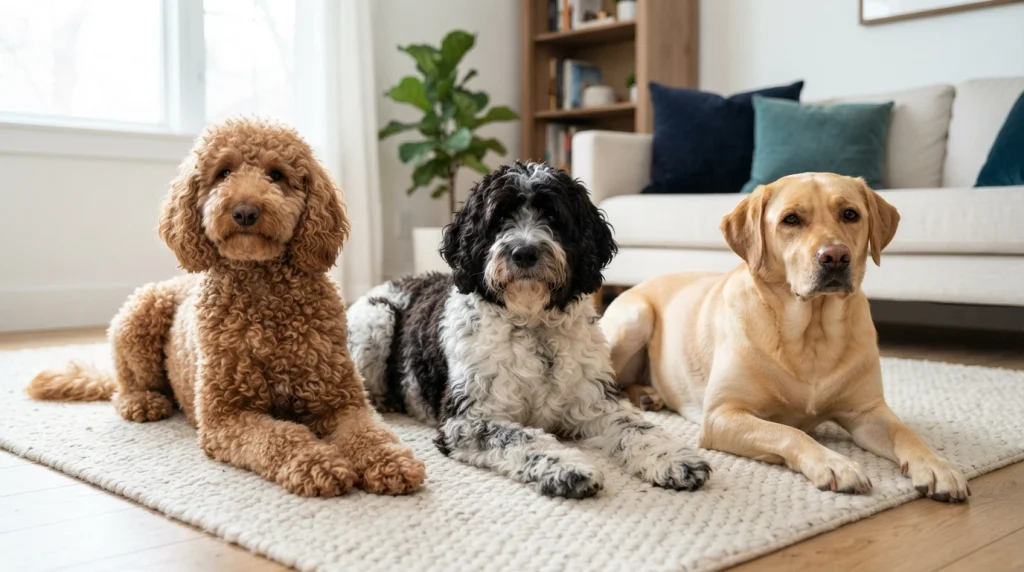
SaveThe main difference is the shape of the individual hair strands. However, shedding, undercoat density, and grooming requirements depend on more than curl shape alone.
| Feature | Curly coat | Wavy coat | Straight coat |
|---|---|---|---|
| Hair shape | Defined loops or spirals | Gentle curves or S-shaped waves | Mostly straight strands |
| Example breeds | Poodle, Lagotto Romagnolo | Some Portuguese Water Dogs | Beagle, Labrador Retriever |
| Matting risk | Often high when long or dense | Variable; increases with length | Usually lower in short coats |
| Shedding | Varies by breed | Varies by breed | Varies by breed |
| Typical care | Thorough brushing and comb checks | Regular detangling | Coat-specific brushing |
One important distinction is that a curly coat is not necessarily a single coat. For example, the Bichon Frise has a curly double coat.
The American Kennel Club also recognizes curly coats as a grooming category. Its coat type guidance includes Poodles, Bichons, Irish Water Spaniels, and Lagotto Romagnolos.
Which Dog Breeds Naturally Have Curly Coats?
Several purebred dogs are known for their curly coats. Their hair can look similar, but coat density, shedding, and maintenance vary considerably.
- Poodle: Has a dense, naturally curly coat with relatively low shedding. Long styles require consistent brushing and professional trimming.
- Bichon Frise: Features a soft, curly double coat that creates its familiar rounded appearance. Trapped loose hair makes regular combing essential.
- Lagotto Romagnolo: Has a dense, woolly, curly coat traditionally maintained in a natural-looking style. Grooming should respect its distinctive texture.
- Irish Water Spaniel: Displays tight curls across much of the body, with smoother hair in certain areas. The coat benefits from regular maintenance.
- Portuguese Water Dog: May have either curly or wavy hair. Both varieties require grooming suited to their length and density.
- Curly-Coated Retriever: Has a distinctive coat of small, tight curls and sheds. Its grooming approach differs from a continuously growing Poodle coat.
What about Goldendoodles and Labradoodles?
Doodle mixes can inherit curly, wavy, or straighter coats. Even puppies from the same litter may develop different textures and shedding patterns.
I would never choose grooming tools based on the word “Doodle” alone. A better approach is to evaluate the individual dog’s coat density, length, and tendency to tangle.
Do Curly-Haired Dogs Shed or Cause Allergies?
Yes, curly-haired dogs can shed, although some breeds shed noticeably less than others. Curls often hold loose hairs within the coat instead of allowing them to fall freely.
That trapped hair still needs to be removed through brushing. Otherwise, it can contribute to dense tangles and uncomfortable mats.
Are curly dog coats hypoallergenic?
No dog coat guarantees an allergy-free home. Dog allergens occur in dander, saliva, and other biological materials, not simply in visible fur.
Some people tolerate certain low-shedding breeds better than others. However, the American Kennel Club’s allergy guidance explains why no breed is completely hypoallergenic.
Before choosing a curly-coated dog for allergy reasons, consider these factors:
- Individual sensitivity: Allergy reactions differ from person to person.
- Coat maintenance: Regular grooming removes loose hair and accumulated debris.
- Household cleaning: Washing bedding and cleaning frequently used surfaces may help manage allergens.
- Professional advice: An allergist can help assess the risks before adopting a dog.
How Often Should You Brush a Curly-Coated Dog?
Daily brushing is a sensible starting point for many long or dense curly coats. Shorter trims may need less work, but regular checks remain important.
Veterinary guidance from VCA Animal Hospitals recommends daily brushing for long, silky, or curly coats to reduce tangling and matting.
A practical grooming schedule
- Every day: Inspect friction areas and brush dense or longer curls thoroughly.
- After outdoor activity: Remove leaves, burrs, and debris trapped in the coat.
- After swimming: Check for knots, clean when needed, and dry the coat thoroughly.
- Before bathing: Remove manageable tangles and identify any serious mats.
- Every four to six weeks: Consider professional grooming for many Poodle-style trims, adjusted to the dog’s needs.
The schedule should respond to the coat’s condition rather than the calendar alone. A dog developing tangles between sessions needs more frequent attention or a shorter trim.
How Do You Brush a Curly Dog Coat Correctly?
 Save
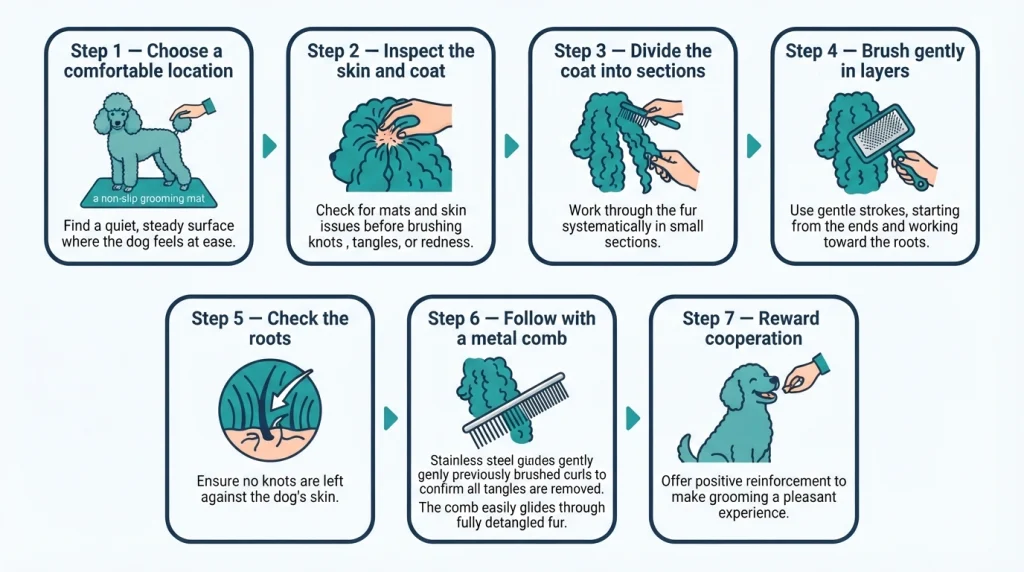
SaveThe safest routine combines gentle brushing, small sections, and a final comb check. Your goal is to separate the curls without pulling painfully against the skin.
Step-by-step curly coat brushing
- Choose a comfortable location. Use a secure, non-slip surface where your dog can stand or sit calmly.
- Inspect the skin and coat. Look for knots, sore areas, redness, or attached debris before starting.
- Divide the coat into sections. Begin near a lower leg and lift the hair above the area you are working on.
- Brush gently in layers. Use short, controlled strokes with an appropriate slicker brush, working from the lower layers outward.
- Check the roots. Avoid brushing only the fluffy outer surface while leaving hidden knots underneath.
- Follow with a metal comb. Move through the brushed section gently to locate remaining tangles.
- Reward cooperation. Offer praise, treats, and breaks before your dog becomes uncomfortable.
What is line brushing?
Line brushing means separating a coat into visible layers and grooming one narrow section at a time. It helps reach deeper hair that surface brushing may miss.
For thick Poodle or Doodle coats, this technique can be particularly useful. However, brushing should never involve scraping the skin or forcing a tool through tight knots.
Grooming safety tip: If a comb catches repeatedly or your dog shows pain, stop pulling. Tight mats close to the skin should be assessed by a professional groomer, and irritated skin may need veterinary attention.
Which Brush Is Best for a Curly Dog Coat?
For many curly-coated dogs, a suitable slicker brush and a stainless steel comb make a useful combination. The brush separates hair, while the comb checks whether tangles remain.
The AKC dog brush guide identifies slicker brushes as useful for curly coats. It also emphasizes using light pressure to avoid discomfort.
Essential curly coat grooming tools
- Slicker brush: Helps separate curls and remove loose hair from suitable coat types.
- Stainless steel comb: Detects remaining tangles and checks whether brushing reached deeper layers.
- Dog-safe detangling spray: May help with minor knots when used according to its instructions.
- Dog-specific shampoo: Cleans the coat without relying on products formulated for human hair.
- Absorbent towel: Helps remove excess water before careful drying.
Choose brush pin length according to coat depth, not simply dog size. Dense, longer coats may benefit from longer pins, while smaller tools offer better control around tight spaces.
How Should You Bathe and Trim a Curly Dog Coat?
Curly-coated dogs need occasional bathing, thorough drying, and trimming when their coat type requires it. The right schedule depends on lifestyle, skin health, coat length, and breed.
Bathing a curly-coated dog
- Check the coat for mats and remove manageable tangles before bathing.
- Use lukewarm water and shampoo designed for dogs.
- Rinse thoroughly so cleaning products do not remain trapped in dense hair.
- Blot gently with a towel instead of vigorously rubbing curls together.
- Dry the coat completely using a safe method suited to the dog’s comfort and coat.
- Inspect and comb the coat as appropriate once it is properly dried.
Avoid bathing over severe mats without professional advice. Water and drying can make existing tangles harder to manage.
How frequently should curly-haired dogs get haircuts?
Many pet Poodles and Bichons visit groomers approximately every four to six weeks. Longer styles, fast coat growth, and individual needs can change that schedule.
Other breeds, such as the Lagotto Romagnolo, may need a different grooming approach. Not every curly coat should be styled into a fluffy Poodle-like finish.
I generally favor manageable coat length over elaborate styling for busy households. A comfortable, maintainable haircut is more valuable than curls that become painful between appointments.
What Common Mistakes Damage Curly Dog Coats?
Most curly coat problems begin when everyday maintenance becomes inconsistent. Small tangles can grow into difficult mats when overlooked.
- Brushing only the surface: A fluffy outer layer can hide compacted hair near the roots.
- Using excessive pressure: Aggressive slicker brushing can irritate or scrape the skin.
- Ignoring friction areas: Collars, harnesses, armpits, and areas behind the ears are common trouble spots.
- Bathing over mats: Wetting already tangled hair can make later grooming more difficult.
- Cutting mats with scissors: Tight mats can pull skin into the hair, creating a serious cutting risk.
- Assuming low shedding means no grooming: Hair trapped inside curls still needs attention.
- Using the same routine for every breed: A curly retriever and a Poodle do not necessarily need identical care.
When Does a Curly Dog Need Professional Grooming?
 Save
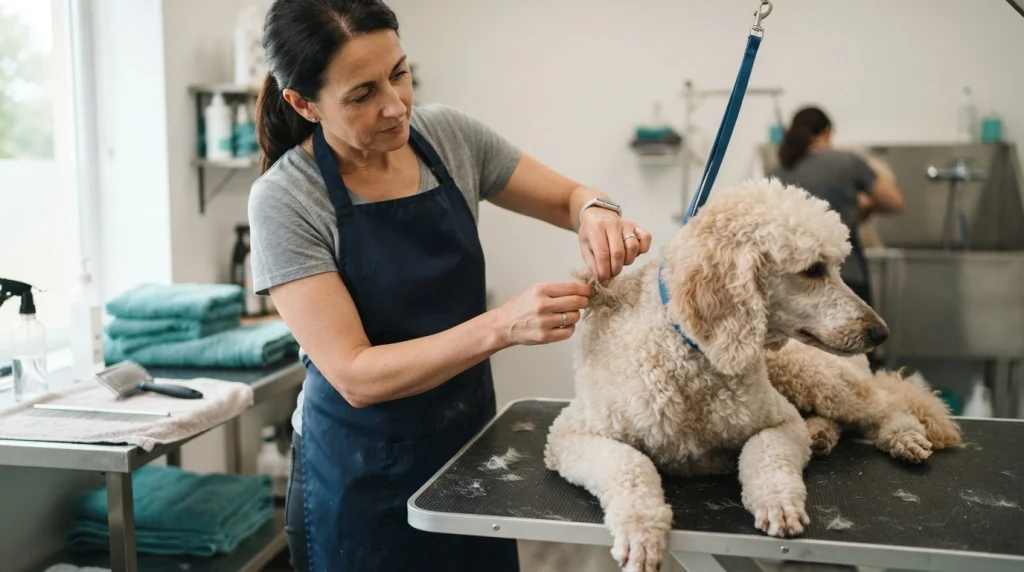
SaveA professional groomer can help when the coat becomes difficult to manage safely. Severe matting should not become an exhausting or painful home grooming project.
Watch for these warning signs:
- A metal comb cannot move through substantial areas of the coat.
- Large mats sit tightly against the skin.
- Your dog flinches, cries, or resists when a tangled area is touched.
- The coat develops persistent moisture, unpleasant odor, or trapped debris.
- Home brushing takes increasingly long without preventing new tangles.
Seek veterinary care for inflamed skin, sores, unusual hair loss, or persistent itching. These symptoms may indicate more than an ordinary grooming problem.
Recommended Grooming Tools for Curly-Coated Dogs
Once you understand your dog’s coat, selecting tools becomes easier. These three products cover different grooming needs without assuming that every curly-coated dog needs an expensive kit.
Disclosure: Some product links are affiliate links. Qualifying purchases may earn a commission at no additional cost to you. Ratings below are editorial suitability assessments, not verified customer ratings or claims of hands-on testing.
🏆 Best for dense curls
Chris Christensen Big G Slicker Brush
★★★★☆ 4.5/5 editorial fit
This brush features 27 mm stainless steel pins, a flexible cushion pad, and multiple head sizes. I would prioritize it for owners maintaining longer, dense curly coats that need thorough, gentle section brushing.
Consideration: Premium pricing and careful technique required.
💰 Best for convenient maintenance
Hertzko Self-Cleaning Slicker Brush
★★★★☆ 4/5 editorial fit
The retractable-pin cleaning mechanism helps remove collected hair quickly. I would consider this an accessible maintenance option for lighter tangles, although very dense coats may need longer pins.
Consideration: Not intended to force apart severe mats.
🐾 Best for checking tangles
Andis 7-1/2-Inch Steel Comb
★★★★★ 5/5 editorial fit
This 7.5-inch steel comb features coarse and fine tooth spacing for grooming and finishing. I consider a good metal comb one of the most useful additions to a curly coat grooming kit.
Consideration: Works best after gentle brushing, not as a forceful dematting tool.
Frequently Asked Questions About Curly Dog Coats
Is a curly dog coat considered hair or fur?
Both words describe the hair covering a dog, but people often use “hair” for continuously growing, low-shedding coats. A curly coat’s growth cycle varies by breed, so curliness alone does not determine whether the coat grows continuously or sheds seasonally.
Can you brush a curly-haired dog every day?
Yes, daily brushing is appropriate for many curly-coated dogs, especially those with long or dense hair. Use a suitable brush, gentle pressure, and regular comb checks. If your dog’s skin becomes irritated, reconsider the technique and consult a groomer or veterinarian.
Should curly dog hair be brushed wet or dry?
For routine grooming, work with a dry or lightly conditioned coat using suitable tools. Avoid forcefully brushing wet, tangled hair because it can cause pulling and damage. Severe mats should be addressed before bathing, preferably with professional assistance when necessary.
Do curly dog coats need professional haircuts?
Many curly breeds, including Poodles and Bichon Frises, benefit from regular professional trimming. However, grooming styles and schedules vary by breed. Dogs with distinctive natural or corded coats may require specialized handling rather than standard clipping and fluffing.
Why does my dog’s curly coat keep getting matted?
Frequent matting usually results from loose hair becoming trapped, friction, moisture, or incomplete brushing. Mats often develop near the skin despite a fluffy surface. More thorough line brushing, regular comb checks, and a manageable coat length can help reduce recurring tangles.
Final Takeaway: Understanding Your Dog’s Curly Coat
A curly dog coat is more than an attractive collection of ringlets. Its structure, density, growth pattern, and tendency to trap loose hair determine how much maintenance your dog needs.
Start with regular coat inspections, a comfortable brushing routine, and tools suited to your dog’s actual texture. When grooming becomes difficult or painful, professional help is the safer choice.
Your next step: Check your dog’s coat behind the ears and beneath the front legs today. These small inspections can help you catch tangles before they become bigger problems.
Thomas Cutter is a lifelong dog owner and the founder of FindOutAboutDogs.com. With over 10 years of hands-on experience owning multiple breeds, Thomas created this site to provide honest, research-based dog advice that real owners can actually trust.
