What Is a Dog De-Shedding Tool? How It Works and When to Use One
Quick Answer
A dog de-shedding tool is a grooming tool designed to reach through the outer coat and remove loose, dead hair before it falls around your home. It is especially useful for dogs with shedding undercoats, but it should match the dog’s coat type and be used with light pressure. For general coat-care guidance, see VCA’s dog grooming and coat-care guide.
What a de-shedding tool does
- Removes loose hair: It lifts hair that has already detached or is ready to shed.
- Reaches the undercoat: Many models work below the visible topcoat where loose undercoat collects.
- Controls household fur: Removing hair during grooming means less loose coat reaches furniture and clothing.
- Does not stop shedding: Healthy shedding is natural, so the goal is management rather than prevention.
- Needs a coat match: A tool that suits a Labrador may be unnecessary or unsuitable for a continuously growing Poodle-type coat.
Before you start
- Check the skin for redness, sores, scabs, bumps, bald patches, and painful areas before using a de-shedding edge.
If your dog seems to produce another dog-sized pile of fur every week, a de-shedding tool can look like the obvious answer. The important part is understanding what the tool actually removes.
I treat de-shedding as a specific grooming job, not as another name for ordinary brushing. In this guide, I’ll explain the difference, which coats benefit, and how to avoid overworking the skin.


What Is a Dog De-Shedding Tool?
A dog de-shedding tool is a grooming tool made to remove loose coat, often including dead undercoat beneath the outer guard hairs. It does not need to cut healthy hair to work.
Definition: A de-shedding tool removes loose or dead shedding hair from a dog’s coat before that hair naturally drops away. Many designs use closely spaced metal teeth or a specialized edge that reaches through the topcoat.
Dogs grow several coat types, so the word “de-shedding” covers more than one tool design. Some products use fine stainless-steel edges, while others behave more like undercoat rakes.
The common goal is simple: collect loose coat efficiently while leaving healthy coat and skin alone.
- De-shedding edge: Fine teeth reach through the coat and collect loose hair.
- Undercoat rake: Longer pins or teeth move through dense coat and lift loose undercoat.
- Shedding blade: A toothed metal blade removes loose surface hair from suitable coats.
- Rubber grooming tool: Flexible rubber fingers loosen hair on short, smooth coats.
How Does a Dog De-Shedding Tool Work?
 Save
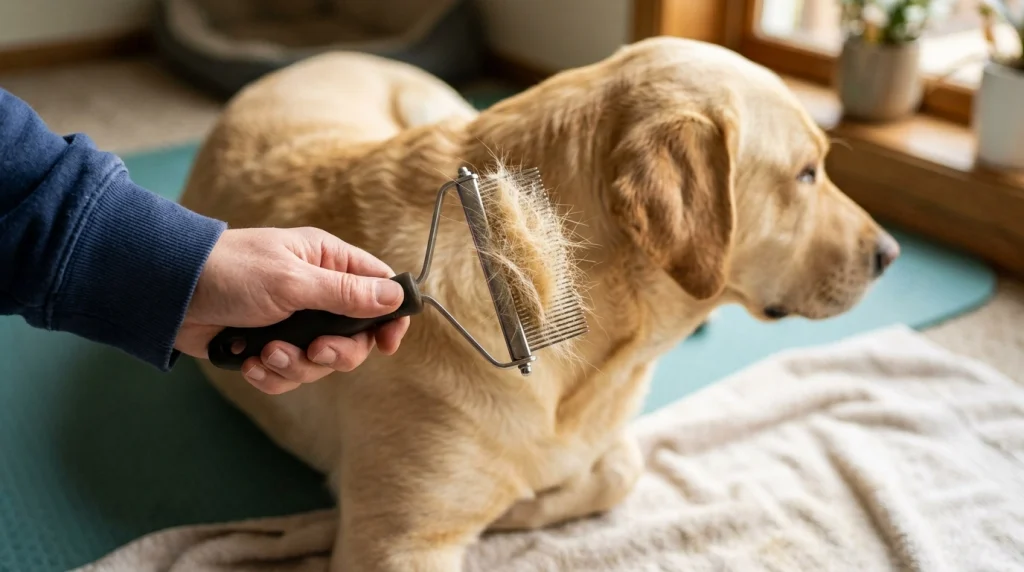
SaveA de-shedding tool works by catching hair that is already loose within the coat. The teeth pass through or below the outer layer and bring detached hair outward.
That distinction matters. You want the tool to collect dead coat, not scrape repeatedly through healthy hair until it breaks.
The American Kennel Club’s shedding guidance notes that long and double-coated dogs may need tools that reach loose undercoat during heavier shedding periods.
- Step 1: The teeth enter the coat with light pressure.
- Step 2: Loose hairs catch between or along the teeth.
- Step 3: A smooth stroke lifts that hair away from the body.
- Step 4: Collected fur is removed from the tool before the next section.
A large pile of removed fur does not automatically mean the session was better. My rule is to judge the skin and coat after grooming, not the size of the fur pile.
If the skin becomes pink, sore, warm, or irritated, the session has gone too far.
Which Dogs Should Use a De-Shedding Tool?
De-shedding tools are most useful for dogs that release significant amounts of dead coat, especially breeds with a dense undercoat. Labradors, German Shepherds, Golden Retrievers, Huskies, Corgis, and similar shedding breeds are common examples.
Short-haired dogs can shed heavily too. A short coat does not automatically mean a low-shedding coat.
- Double-coated dogs: Often benefit most because loose undercoat can remain trapped beneath guard hairs.
- Seasonal shedders: May need more coat removal when they “blow” their coat.
- Short dense coats: Can respond well to rubber tools or a correctly sized de-shedding edge.
- Long shedding coats: Often need detangling before deeper undercoat work.
Dogs with continuously growing or low-shedding coats need a different approach. Poodles and many Poodle-type coats, for example, depend more on routine brushing, combing, clipping, and mat prevention.
The ASPCA’s dog grooming guidance also recommends selecting brushes and combs according to coat type rather than treating every dog the same.
When should you avoid a de-shedding tool?
Do not run an aggressive de-shedding tool over damaged or painful skin. Grooming should stop if your dog shows discomfort or fresh irritation.
- Open sores or healing wounds
- Fresh rashes or inflamed skin
- Unexplained bald patches
- Severe tangles or tight mats
- Areas your dog finds painful when touched
- A coat type the manufacturer lists as unsuitable
Sudden or abnormal hair loss deserves more attention than a stronger brush. Ask a veterinarian about new bald spots, significant itching, skin lesions, or an unusual change in shedding.
De-Shedding Tool vs Brush vs Undercoat Rake: What Is the Difference?
A regular brush, an undercoat rake, and a de-shedding edge can overlap, but they are not interchangeable. Each one solves a different part of coat maintenance.
| Tool | Main Job | Good Coat Match | Main Limitation |
|---|---|---|---|
| De-shedding edge | Removes loose shedding hair and undercoat efficiently | Many short, medium, long, and double coats when correctly sized | Easy to overuse with excessive pressure or repeated strokes |
| Undercoat rake | Lifts loose undercoat from deeper, thicker coats | Huskies, Shepherds, Retrievers, Corgis and similar undercoats | Not a replacement for detangling severe mats |
| Slicker brush | Separates coat and removes loose hair and small tangles | Curly, medium, long, or dense coats depending on pin design | May not remove packed seasonal undercoat efficiently |
| Rubber curry brush | Loosens surface hair while massaging the coat | Short, smooth coats such as many Labs and Boxers | Cannot reach deeply into a heavy long undercoat |
I prefer thinking of these tools as a small grooming system. A gentle everyday brush handles routine coat care, while a deeper tool comes out when the coat condition calls for it.
How Do You Use a Dog De-Shedding Tool Safely?
 Save
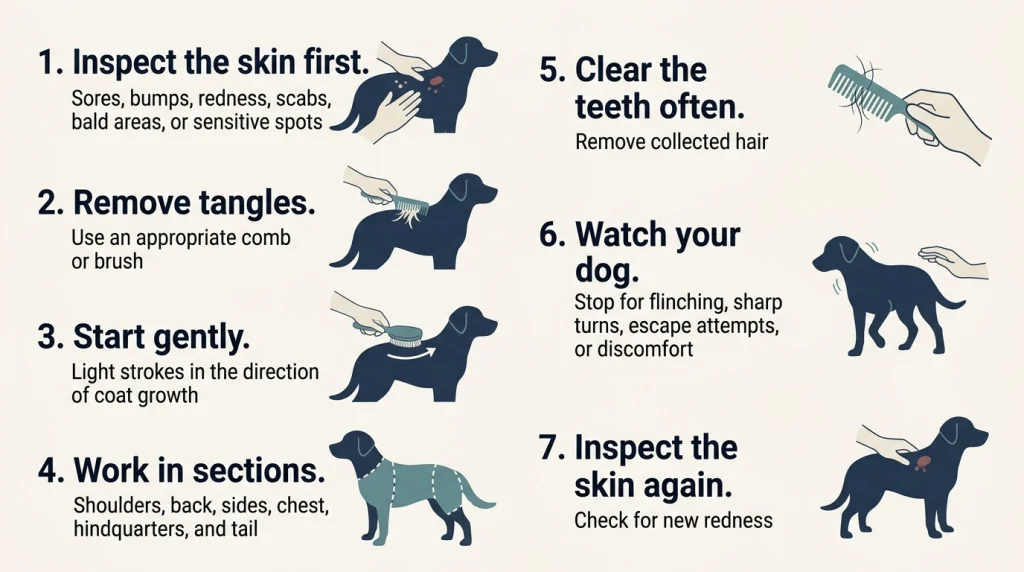
SaveUse a de-shedding tool on a dry, detangled coat unless the manufacturer gives different instructions. Start with light pressure and work in the natural direction of hair growth.
Before touching the coat, inspect the skin. That ten-second check can prevent a sore spot from becoming much worse.
- Inspect the skin first. Look for sores, bumps, redness, scabs, bald areas, or sensitive spots.
- Remove tangles. Work out manageable tangles with an appropriate comb or brush before de-shedding.
- Start gently. Make a light stroke in the direction of coat growth.
- Work in sections. Move across the shoulders, back, sides, chest, hindquarters, and tail instead of scraping one patch repeatedly.
- Clear the teeth often. A tool packed with hair becomes less effective.
- Watch your dog. Stop if your dog flinches, turns sharply, tries to escape, or shows increasing discomfort.
- Inspect the skin again. New redness tells you the pressure, repetition, or tool choice was too aggressive.
FURminator’s current instructions for its undercoat de-shedding tools also emphasize gentle strokes and avoiding excessive passes over one area. Its guidance says to stop if irritation or redness develops.
That is the part I would never ignore. Efficient grooming should leave the dog comfortable when the session ends.
Should you press hard to reach the undercoat?
No. A suitable tool should reach the coat through its tooth length and design, not through force from your hand.
Hard pressure increases friction against the skin. If the tool seems unable to reach the loose coat gently, reconsider the tool or coat preparation.
How Often Should You Use a De-Shedding Tool?
There is no single schedule for every dog because coat density, season, tool design, and individual skin sensitivity differ. Ordinary brushing can happen much more often than intensive de-shedding.
For one concrete example, FURminator currently recommends its undercoat de-shedding tool about one to two times weekly for roughly 10 to 20 minutes, adjusted for the individual animal.
- Routine weeks: Use ordinary coat-appropriate brushing as your foundation.
- Heavy shedding: Add deeper undercoat work when loose coat starts releasing heavily.
- After improvement: Reduce intensive de-shedding instead of continuing until little coat remains.
- Sensitive skin: Keep sessions shorter and stop at the first sign of irritation.
As of 2026, current veterinary grooming guidance still emphasizes matching grooming frequency to coat type. VCA notes that long, silky, and curly coats often need frequent brushing, while short coats may need less.
Can a De-Shedding Tool Damage a Dog’s Coat?
Yes, any grooming tool can cause problems when it is unsuitable or used aggressively. Repeated hard strokes can irritate skin and may pull or break coat that did not need removal.
A de-shedding tool should not become a contest to see how much hair you can collect.
- Do not scrape repeatedly over one small area.
- Do not force teeth through tight mats.
- Do not assume every breed needs an undercoat tool.
- Do not continue after redness appears.
- Do not mistake unusual hair loss for normal seasonal shedding.
The safest result is boring: loose coat comes away, the healthy coat remains intact, and the skin looks normal afterward.
What Are the Benefits of Using a De-Shedding Tool?
The biggest benefit is control. You collect a portion of loose coat during a planned grooming session instead of finding all of it later on your flooring, couch, clothing, and car seats.
- Less loose household hair: More shed coat ends up in the grooming area.
- Better undercoat access: Suitable tools reach hair an ordinary surface brush can miss.
- Easier coat monitoring: Regular grooming makes changes in skin and coat easier to notice.
- Improved routine: Short planned sessions can be easier than tackling a heavily packed coat later.
Regular grooming also gives you a reason to examine the dog’s skin closely. The goal is not just a cleaner floor.
Common De-Shedding Mistakes to Avoid
Most trouble comes from technique rather than the idea of de-shedding itself. The wrong pressure, frequency, or coat match can turn a useful grooming tool into an irritant.
- Using one tool for every breed: Coat structure should determine the tool.
- Pressing harder for more hair: Pressure does not make a mismatched tool correct.
- Working the same spot repeatedly: Move to fresh coat sections instead.
- Skipping detangling: De-shedding tools are not designed to rip through severe mats.
- Ignoring skin changes: Redness and soreness are reasons to stop.
- Trying to eliminate shedding: Normal shedding is part of the hair-growth cycle.
The AKC’s home grooming guide also stresses gentle brushing and checking the skin and coat for abnormalities while grooming.
How Do You Choose the Right De-Shedding Tool?
 Save
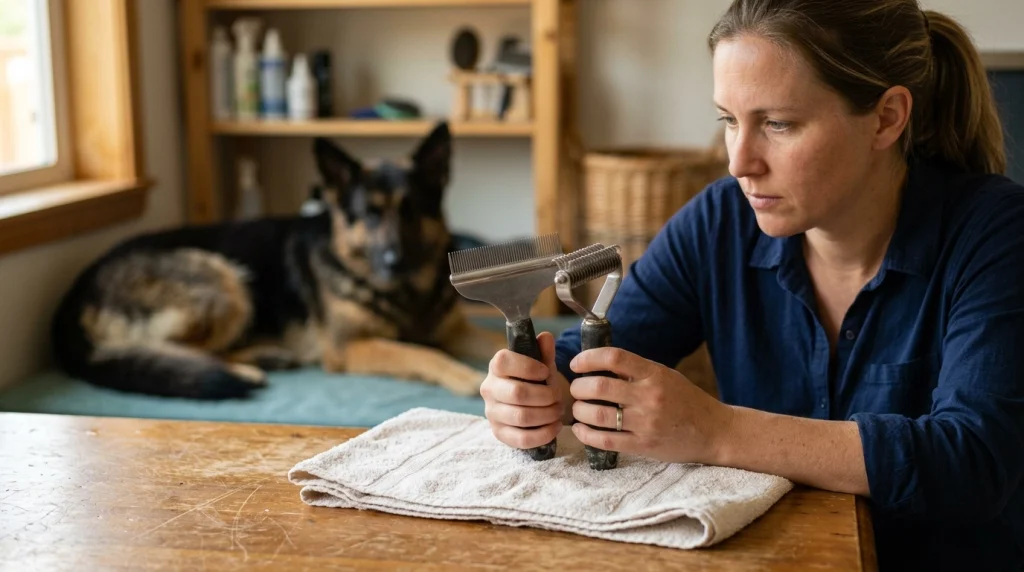
SaveStart with coat structure, not advertising claims. Decide whether you need surface hair removal, deep undercoat access, detangling, or a combination of separate tools.
- Coat length: Short and long coats can require different tooth lengths.
- Undercoat density: Thick double coats usually need deeper reach than smooth single coats.
- Dog size: A tool width that suits a German Shepherd may feel clumsy on a small dog.
- Skin sensitivity: Rounded pins or gentler tools may suit dogs that dislike aggressive edges.
- Handle control: A stable grip makes light, consistent pressure easier.
- Hair release: Easy cleaning matters when a dog is actively blowing coat.
If you’re ready to choose a tool, these are three practical styles I would compare first. Each one approaches loose undercoat a little differently.
🏆 Best dedicated de-shedder
FURminator Undercoat deShedding Tool
★★★★☆ 4.7/5
Its stainless-steel edge is designed to reach through the topcoat and collect loose undercoat, with versions matched to coat length and dog size. I would consider it when the main problem is significant loose coat rather than tangles or mats.
🐕 Best for controlled coverage
Andis Deshedding Tool
★★★★☆ 4.7/5
Andis uses a stainless-steel de-shedding design intended to lift loose undercoat while preserving healthy topcoat. Its balanced handle makes it an option worth comparing for larger grooming areas where hand control matters.
🪮 Best undercoat-rake alternative
JW Pet GripSoft Double Row Undercoat Rake
★★★★☆ 4.6/5
Two rows of round-tipped teeth are designed to lift shedding undercoat and work through light tangling. I would compare this style with an edged de-shedder when a thick double coat needs deeper but controlled undercoat access.
Frequently Asked Questions
Does a de-shedding tool cut a dog’s hair?
A properly designed de-shedding tool is intended to collect loose shedding hair rather than give the dog a haircut. Some designs use metal edges, so correct technique matters. Use light pressure and stop if the coat or skin shows signs of damage.
Can I use a de-shedding tool every day?
Daily ordinary brushing can suit some dogs, especially during heavy shedding, but intensive de-shedding tools may not need daily use. Follow the individual tool’s instructions and watch the dog’s skin. More frequent grooming is not automatically better.
Do de-shedding tools work on short-haired dogs?
Yes, they can work well on short-haired dogs that shed heavily. The tool still needs to suit the coat. Rubber grooming brushes are also useful for many short smooth coats and may be gentler for frequent routine grooming.
Are de-shedding tools good for double-coated dogs?
Many double-coated dogs benefit from undercoat removal because loose insulating hair can remain trapped beneath the outer coat. Choose a tool made for that coat length and density, and avoid harsh repeated strokes over the same skin area.
Should I use a de-shedding tool before or after a bath?
Loose tangles and obvious debris should be addressed before bathing. Some de-shedding tool makers recommend using their tool once the coat is completely dry after washing. Alway
“`

Thomas Cutter is a lifelong dog owner and the founder of FindOutAboutDogs.com. With over 10 years of hands-on experience owning multiple breeds, Thomas created this site to provide honest, research-based dog advice that real owners can actually trust.
