What Is a Dog Grooming Rake? Uses & Tips
Quick Answer
A dog grooming rake is a grooming tool with one or more rows of metal teeth designed to reach through a dog’s outer coat and remove loose undercoat, dead hair, and minor tangles. It is especially useful for thick or double-coated dogs, and choosing the right rake is an important part of brushing a dense double coat correctly.
What a grooming rake does
- Reaches the undercoat: Longer teeth can pass beneath the outer guard hairs on many double-coated dogs.
- Removes loose fur: It collects dead undercoat before much of that hair ends up around your home.
- Helps during shedding: A rake can be particularly useful when a dog releases large amounts of seasonal undercoat.
- Loosens minor tangles: Some rake designs help separate lightly packed coat, although tight mats need more careful treatment.
- Works below the surface: It performs a different job from brushes that mainly smooth or collect surface hair.
The most important rule
- Use light pressure and stop if the rake repeatedly catches, scratches the skin, or makes your dog uncomfortable.
I think grooming rakes are easy to misunderstand because they look like oversized combs. Their real value becomes obvious when an ordinary brush keeps sliding over a thick coat without reaching the loose hair underneath.
In this guide, I’ll explain what a rake does, which dogs benefit from one, and how I use one without turning grooming into a tug-of-war.


What Exactly Is a Dog Grooming Rake?
A dog grooming rake is a hand-held coat tool designed to reach deeper than many ordinary brushes. Its metal teeth or pins move through the outer coat so they can collect loose hair underneath.
Most grooming rakes resemble a small garden rake, but the teeth are shaped and spaced for animal coats rather than soil.
Definition: An undercoat rake is a grooming rake specifically designed to penetrate a dog’s outer coat and remove loose or dead undercoat while leaving healthy attached coat in place when used correctly.
- Handle: Gives you control and keeps your wrist away from the moving teeth.
- Metal teeth: Reach between hairs and collect loose coat.
- Single or double row: Changes how much coat the rake contacts in each pass.
- Tooth length: Determines how deeply the rake can reach into a dog’s coat.
- Rounded ends: Help reduce scratching when the tool is used with light pressure.
The American Kennel Club describes undercoat rakes as tools with one or two rows of metal pins that penetrate to the undercoat. They are commonly used to remove loose fur and help with mat prevention.
That deep reach is the key difference. A rake should work through the coat rather than simply polish its surface.
What Is a Dog Grooming Rake Used For?
A grooming rake is mainly used to remove loose undercoat from dogs with thick, dense, or double coats. It can also help separate lightly packed coat and make seasonal shedding easier to manage.
I reach for a rake when I can feel soft loose fur beneath the topcoat but a normal brush is barely collecting it.
- Seasonal shedding: Collects undercoat that has loosened during a coat change.
- Dense coats: Reaches beneath longer or thicker guard hairs.
- Lightly packed fur: Helps separate loose coat before it becomes more difficult to manage.
- Pre-bath grooming: Removes loose hair before washing a thick-coated dog.
- Routine coat maintenance: Helps keep loose undercoat from building up between grooming sessions.
VCA Animal Hospitals notes that dogs with long, thick coats can have an outer layer of guard hairs and a softer insulating undercoat. Those dogs may release substantial undercoat during seasonal shedding.
A rake doesn’t stop shedding. It simply helps you remove hair that has already loosened from the coat.
Which Dogs Need an Undercoat Rake?
 Save
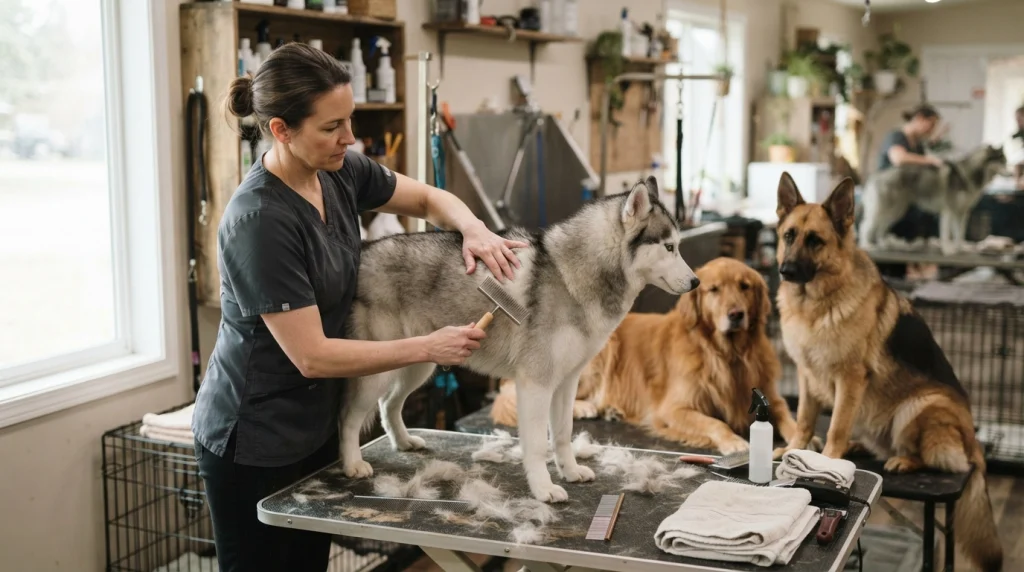
SaveUndercoat rakes are most useful for dogs whose coats contain a substantial undercoat. Huskies, German Shepherds, Malamutes, many retrievers, Collies, and other double-coated breeds are common examples.
Coat type matters more than the dog’s size. A huge smooth-coated dog may have less need for a deep rake than a much smaller dog with a dense double coat.
- Siberian Husky: Dense undercoat beneath protective guard hairs.
- Alaskan Malamute: Thick double coat that can release large amounts of undercoat.
- German Shepherd: Double coat with frequent loose hair and seasonal increases.
- Golden Retriever: Dense undercoat beneath a longer feathered outer coat.
- Collie: Longer outer coat that can hide considerable loose hair underneath.
- Newfoundland: Heavy coat that benefits from thorough section-by-section grooming.
For a practical example, my guide on managing Siberian Husky shedding shows why deep undercoat removal and surface brushing are separate jobs.
Dogs with thin, smooth, or sparse coats often need a different tool. A rubber brush or short bristle brush may make more sense for those coats.
Dog Grooming Rake vs Slicker Brush: What’s the Difference?
A grooming rake mainly targets loose hair deeper in the coat, while a slicker brush separates hair and collects loose fur nearer the surface. Neither tool automatically replaces the other.
I often think of the rake as the deep-cleaning tool and the slicker as the finishing tool.
| Tool | Main Job | Undercoat Reach | Best Coat Match | Main Caution |
|---|---|---|---|---|
| Undercoat rake | Loose undercoat removal | High | Dense and double coats | Excess pressure can irritate skin |
| Slicker brush | Loose hair, separation, light tangles | Low to medium, depending on pin length | Curly, long, or dense coats | Repeated scratching motion can irritate skin |
| Pin brush | Separating and smoothing longer hair | Medium | Long or flowing coats | May miss dense loose undercoat |
| Rubber brush | Surface hair and massage | Low | Short, smooth coats | Usually cannot reach deep undercoat |
The correct tool also changes with the individual dog. The American Kennel Club’s brush guidance stresses matching the grooming tool to coat type.
As of 2026, that is still the principle I use before considering brand, price, or complicated grooming-tool marketing.
How Do You Use a Grooming Rake on a Dog?
 Save
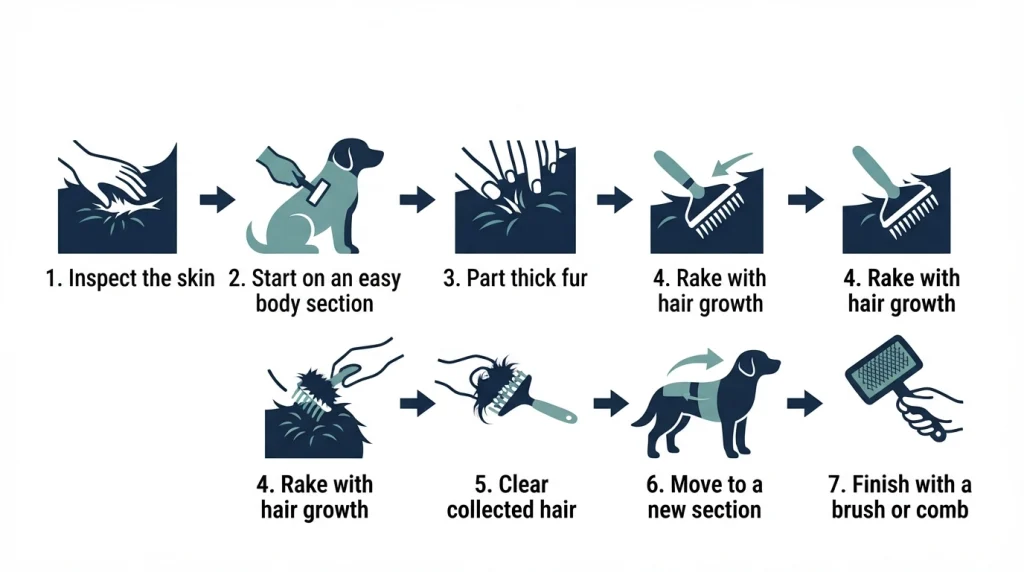
SaveUse a grooming rake with gentle, controlled strokes in the direction of hair growth. Work on small sections and let the teeth move through loose coat without forcing them through resistance.
My rule is simple: if I need significant muscle to move the rake, I stop and find out why.
- Inspect the skin first. Look for sores, redness, lumps, ticks, burrs, or painful areas.
- Start on an easy body section. The shoulder or side is often calmer than sensitive areas.
- Part thick fur with your free hand. This lets you see where the undercoat begins.
- Rake in the direction of hair growth. Use short, light strokes rather than long forceful pulls.
- Clear collected hair frequently. Packed teeth cannot travel through the coat properly.
- Move to a new section. Avoid repeatedly scraping the same patch of skin.
- Finish with another suitable brush or comb. This collects loosened hair and lets you check your work.
The AKC also advises working in the direction of hair growth and using gentle pressure with shedding tools. That matters even more when the tool contains firm metal teeth or cutting-style edges.
For general veterinary grooming guidance, VCA Animal Hospitals recommends being gentle and avoiding excessive pulling when working through a dog’s coat.
How Much Pressure Should You Use?
Use only enough pressure to guide the rake through the coat. You should not need to press the teeth firmly against the dog’s skin.
I occasionally test a new rake lightly against my own forearm first. It isn’t a perfect comparison, but rough edges become obvious quickly.
- Good sign: Loose fur gathers while the dog remains relaxed.
- Warning sign: The skin moves noticeably with every stroke.
- Stop sign: Redness, scratching, flinching, snapping, or repeated attempts to escape.
A grooming session shouldn’t become a contest over how much hair you can remove. Healthy attached coat is not the target.
Can a Grooming Rake Remove Mats?
A standard undercoat rake can help with loose or lightly packed hair, but it is not the right solution for every mat. Tight mats can pull painfully on skin and may require professional grooming.
Don’t force metal teeth through a knot that refuses to move. That transfers the pulling force straight to the dog’s skin.
- Loose undercoat: Appropriate job for an undercoat rake.
- Minor tangle: May respond to careful separation and combing.
- Compact mat: Needs a more cautious assessment.
- Mat tight against skin: Best handled by a professional groomer or veterinarian.
- Red or damaged skin: Stop grooming the area and seek veterinary advice.
VCA specifically warns that severe or extensive tangles may require professional help. It also advises against using scissors close to matted skin because accidental cuts can occur.
That is one reason I separate “undercoat removal” from “dematting.” They overlap sometimes, but they aren’t the same grooming task.
How Often Should You Use an Undercoat Rake?
There is no single schedule that fits every dog. Rake frequency depends on coat density, shedding level, season, skin condition, and how much loose undercoat is present.
During a heavy coat blow, short sessions can be more useful than waiting for the coat to become heavily packed.
- Light shedding: Use the rake only when you can detect loose undercoat.
- Heavy seasonal shedding: Short, gentle sessions may be useful several times during the week.
- After outdoor activity: Inspect the coat before raking if debris or burrs are present.
- Sensitive skin: Reduce frequency and pressure, and choose a gentler tool.
Regular brushing has wider benefits too. VCA explains that brushing removes loose hair, dead skin cells, dirt, and debris while helping distribute natural oils along the hair shafts.
Don’t use the amount of fur in the rake as your stopping rule. Some dogs can keep releasing hair even after a productive grooming session.
How Do You Choose the Right Grooming Rake?
Choose a rake according to coat length, density, tooth design, comfort, and the job you need it to perform. A rake that works beautifully on one dog can be awkward on another.
The most common mistake I see is buying the most aggressive-looking tool because it promises the biggest pile of hair.
- Match tooth length to coat: Teeth need enough reach to enter the undercoat without digging into skin.
- Check tooth finish: Smooth, well-finished teeth are preferable to rough metal edges.
- Consider spacing: Wider spacing can move more comfortably through thick coat.
- Choose a controllable width: Large heads cover the torso quickly, while smaller heads offer better control.
- Check the handle: A secure grip matters during repeated strokes.
- Know the design: A simple pin rake and a bladed dematting rake do not behave the same way.
Professional grooming standards published by the AKC also emphasize choosing tools according to their intended purpose and the dog’s coat type. That is a better buying rule than relying on “all breeds” packaging.
If you’re unsure, ask a groomer to show you which tooth length reaches your dog’s undercoat comfortably.
Common Grooming Rake Mistakes to Avoid
 Save
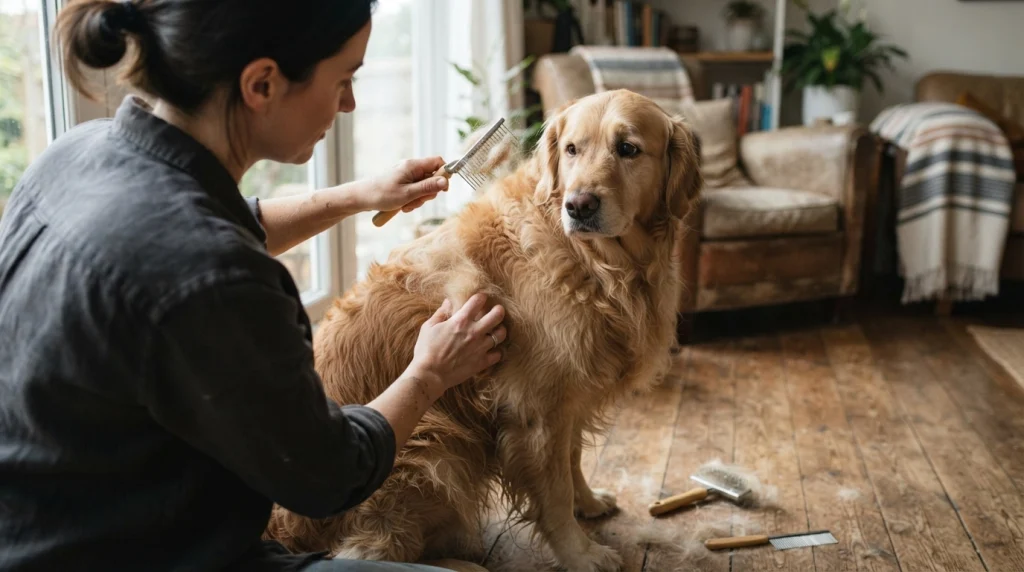
SaveMost problems come from excessive force, excessive repetition, or using the wrong rake for the coat. Good technique should feel controlled rather than aggressive.
- Pressing into the skin: A rake should travel through hair, not scrape the body.
- Raking one spot repeatedly: Friction can irritate skin even when the first passes felt comfortable.
- Forcing through tangles: Stop and investigate resistance instead of pulling harder.
- Using a deep rake on a thin coat: The teeth may contact skin more than hair.
- Ignoring body language: Turning away, sitting down, flinching, or licking repeatedly can signal discomfort.
- Trying to remove every hair: The goal is loose coat management, not stripping healthy fur.
Watch the skin while you groom. If you see bald patches, persistent redness, sores, or unusual hair loss, more brushing is not the answer.
Veterinary evaluation makes more sense when coat loss looks abnormal or comes with itching and inflammation.
Dog Grooming Rakes I Would Consider
If you’re ready to choose a rake, I would focus on designs that solve different grooming needs rather than buying three tools that do the same job.
🏆 Best Overall
Maxpower Planet Double-Sided Undercoat Rake
★★★★½
Its two-sided format gives you a wider 9-tooth side and a finer 17-tooth side. I like having two levels of separation in one tool when working through a dense shedding coat.
🐕 Best Simple Rake
Safari Double Row Undercoat Rake
★★★★☆
This traditional double-row design focuses on reaching and collecting loose undercoat without adding complicated features. I prefer this type when I want a straightforward tool for routine double-coat maintenance.
🧥 Best for Dense Coats
FURminator Grooming Rake
★★★★☆
This rake-style tool is aimed at thicker coats where surface brushing leaves loose fur underneath. I would use it slowly and section by section rather than trying to pull through the whole coat in long strokes.
Frequently Asked Questions
Is a grooming rake the same as an undercoat rake?
The terms are often used interchangeably, but “grooming rake” is broader. An undercoat rake specifically targets loose undercoat, while other rake-style tools may be designed for detangling or dematting. Always check the tooth design and intended purpose before using one.
Can I use an undercoat rake on a short-haired dog?
Only if the dog has enough undercoat for the tool to work without scraping the skin. Many smooth, short-coated dogs are better served by a rubber grooming brush or short-bristle tool that collects loose surface hair more comfortably.
Does an undercoat rake cut the dog’s hair?
A traditional pin-style undercoat rake is intended to collect loose hair rather than cut healthy coat. Some rake-shaped dematting or de-shedding tools contain sharpened edges, however, so check the product design instead of assuming every “rake” works the same way.
Should I use an undercoat rake before or after bathing?
I usually remove obvious loose hair and tangles before bathing. After the coat is completely dry, another gentle grooming session can collect additional hair loosened during washing and drying. Never rake aggressively through wet, tangled, or painful fur.
Can an undercoat rake hurt a dog?
Yes, if the teeth are inappropriate for the coat or you use too much pressure. Repeatedly scraping one area can irritate skin. Use short, controlled strokes, monitor your dog’s response, and stop if you notice redness, pulling, or discomfort.
Final Takeaway: A Grooming Rake Is a Deep-Coat Tool
A dog grooming rake is designed to reach where many ordinary brushes cannot. For the right dog, it can make loose undercoat and seasonal shedding much easier to manage.
The important part is matching the rake to the coat. Tooth length, spacing, pressure, and technique matter more than how much fur a tool promises to remove.
Start gently and work in small sections. When the rake moves comfortably and loose undercoat comes away without pulling the skin, you’re using the tool for the job it was meant to do.

Thomas Cutter is a lifelong dog owner and the founder of FindOutAboutDogs.com. With over 10 years of hands-on experience owning multiple breeds, Thomas created this site to provide honest, research-based dog advice that real owners can actually trust.
