What Is a Metal Dog Grooming Comb? Uses & Tips
Quick Answer
A metal dog grooming comb is a sturdy comb with smooth metal teeth used to find tangles, separate hair, remove loose coat, and check whether brushing has reached through the coat. I especially like it as a finishing tool after brushing, which is also useful when following a complete brushing routine for a dense coat.
What a metal grooming comb does
- Finds hidden tangles: Resistance tells you where knots or packed coat remain.
- Checks your brushing: A comb can reveal sections a brush passed over without fully separating.
- Separates longer hair: Metal teeth help straighten and organize furnishings, tails, ears, and longer body coat.
- Removes loose hair: The teeth can catch loose coat left behind after brushing.
- Handles repeated use: A well-made steel comb stays rigid while moving through thicker coats.
The important rule
- Never force a metal comb through a snag. Stop, loosen the tangle gently, then try the comb again.
A metal grooming comb looks simple, but it can tell you more about a dog’s coat than many larger tools. I think of it as both a grooming tool and a final inspection tool.
That distinction matters. A brush may make the surface look neat while small tangles remain underneath.


What exactly is a metal dog grooming comb?
A metal dog grooming comb is a hand-held grooming tool with rigid metal teeth arranged along a narrow spine. Many versions use stainless steel or metal teeth with a corrosion-resistant finish.
Unlike a slicker brush, it does not have dozens of flexible pins spread across a large pad. The teeth enter the coat in a straight row, which makes resistance much easier to feel.
Simple definition: A metal grooming comb is a dog-grooming tool designed to separate hair and identify remaining tangles by passing individual metal teeth through the coat.
- Coarse teeth: Wider spacing for thicker or longer hair.
- Fine teeth: Narrower spacing for finer hair, finishing, or detail work.
- Combination comb: Coarse spacing on one end and finer spacing on the other.
- Long-tooth comb: Deeper teeth for longer or denser coats.
- Face or finishing comb: Smaller versions for controlled detail work.
The American Kennel Club includes sturdy metal combs among useful grooming tools for longer coats. It also notes that grooming equipment should match the dog’s individual coat type.
You can review its broader dog grooming tool guidance when building a complete grooming kit.
What is a metal dog comb used for?
A metal dog comb is mainly used for detangling, coat checking, separating hair, and finishing. It works best when you use it deliberately rather than dragging it through knots.
I find its biggest advantage is feedback. You immediately feel when the teeth reach an area that needs more work.
- Checking for tangles: The comb catches where hair remains twisted or packed.
- Finishing after brushing: It collects loose hair and checks whether the brush reached deeply enough.
- Separating furnishings: It can organize longer hair on legs, tails, chests, and ears.
- Working through small knots: Loose tangles can often be separated gradually from their ends.
- Checking dense coats: Long teeth can expose areas where undercoat remains compacted.
The ASPCA notes that regular grooming with a brush or comb can remove dirt, distribute natural oils, prevent tangles, and help keep the skin clean. Coat type should determine the grooming method.
Its dog grooming guidance also recommends paying close attention to tangles in longer coats.
Metal dog grooming comb vs brush: what is the difference?
 Save
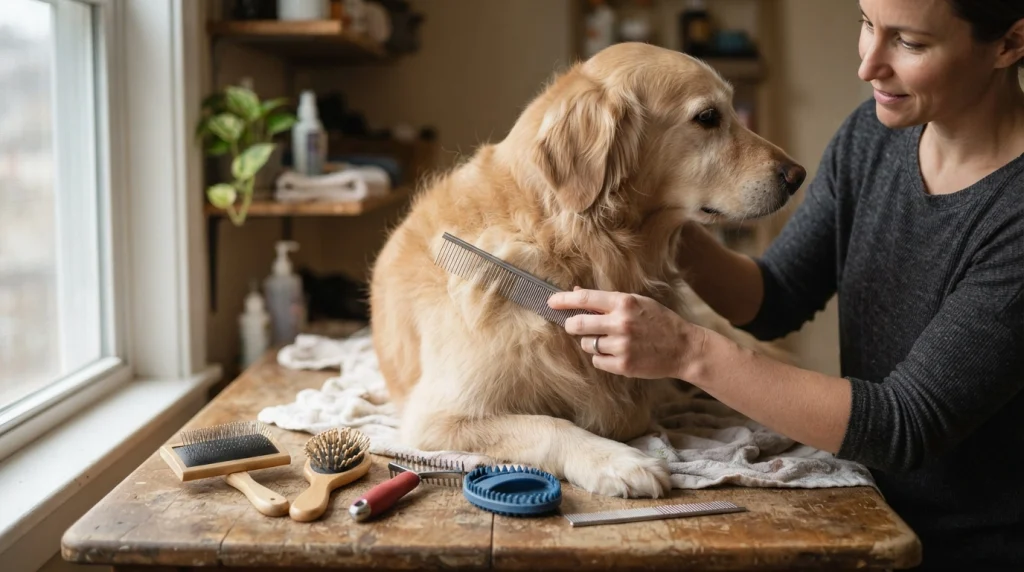
SaveA brush covers more coat with each stroke, while a metal comb gives you more precise feedback. That is why I rarely see them as competing tools.
They usually work better together.
| Tool | Best Use | Coat Reach | Main Limitation |
|---|---|---|---|
| Metal grooming comb | Checking, finishing, small tangles | Medium to high with long teeth | Slow for large areas |
| Slicker brush | Loose hair, tangles, general brushing | Medium to high | Can skim over dense coat if pins are too short |
| Pin brush | Long or flowing coats | Medium | Not ideal for packed undercoat |
| Undercoat rake | Loose undercoat in double coats | High | Not a detailed finishing tool |
| Rubber grooming tool | Loose surface hair on short coats | Low | Limited detangling ability |
For a double-coated dog, for example, I may use a rake or slicker first and the metal comb last. That same approach appears in our guide on managing heavy Husky shedding.
Which dogs benefit most from a metal grooming comb?
Metal combs are especially useful on medium, long, curly, wavy, and double coats. The ideal tooth length and spacing change with coat density.
VCA Animal Hospitals notes that combs can suit medium-length shedding coats, while long-toothed combs can help with long hair and loose undercoat.
- Poodles and Poodle mixes: Useful for checking curly hair after brushing.
- Golden Retrievers: Helpful around feathering, ears, tail, and longer body hair.
- Collies: Long teeth can help check dense areas and longer coat.
- Huskies: Useful as a final check after undercoat work.
- Spaniels: Helpful around ears, legs, chest, and feathering.
- Shih Tzus and similar long coats: Combination combs help locate small tangles.
You can read VCA’s coat and grooming guidance for more detail about matching tools to hair type.
Are metal combs useful for short-haired dogs?
Sometimes, but they are rarely my first choice. Short, smooth coats usually respond better to rubber grooming tools, short bristles, or grooming gloves.
A fine comb may still help with small areas or inspection. However, there may be little coat depth for a long metal comb to work through.
How do you use a metal grooming comb safely?
 Save
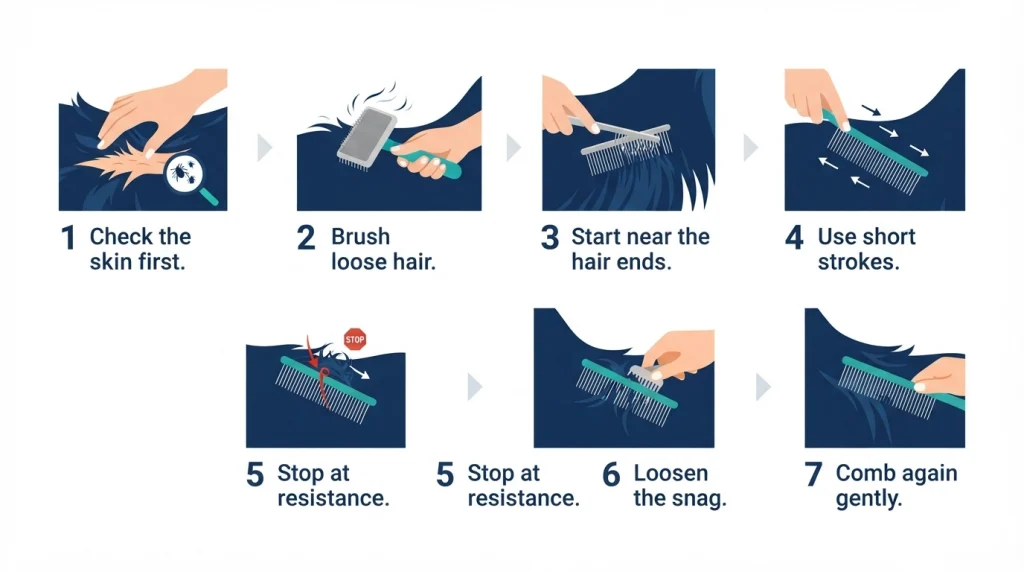
SaveUse a metal comb only after checking the coat with your fingers. Start where the hair moves freely and work toward tangled sections gradually.
The goal is smooth movement. Pulling harder is not better grooming.
- Check the skin first. Look for redness, sores, lumps, burrs, or sensitive areas.
- Brush loose hair. Use an appropriate brush before expecting the comb to handle the entire coat.
- Start near the hair ends. Do not begin by driving the teeth directly into a knot near the skin.
- Use short strokes. Work through one small section at a time.
- Stop at resistance. Hold the hair above the tangle to reduce pulling on the skin.
- Loosen the snag. Separate it with your fingers or an appropriate detangling tool.
- Comb again gently. Move closer to the skin only when the outer section passes freely.
One practical test I use is simple: don’t celebrate because the top inch looks smooth. The section is finished when the comb can travel through it without snagging or dragging the skin.
Should the comb touch the dog’s skin?
The teeth may reach close to the skin on many coat types, but you should not scrape the skin. Smooth rounded teeth and light pressure matter.
The AKC recommends gentle grooming and choosing tools designed for your dog’s coat. Repeated hard pressure with metal tools can make grooming uncomfortable.
Can a metal comb remove mats?
A metal grooming comb can help with small, loose tangles, but it should not be forced through a tight mat. Severe mats may sit very close to the skin.
That creates a safety problem. Pulling can hurt, while blindly cutting a mat can injure the skin underneath.
- Small loose knot: Work from the outside edge with your fingers and comb.
- Moderate tangle: Use an appropriate brush, detangler, or professional technique first.
- Tight mat against skin: Ask an experienced groomer or veterinarian for help.
- Red or painful skin: Stop grooming the area and seek veterinary advice.
VCA specifically advises against forcing tangles and recommends professional care for severe or extensive matting. Clippers are generally safer than scissors when a mat requires removal close to the skin.
What should you look for when buying a metal dog comb?
 Save
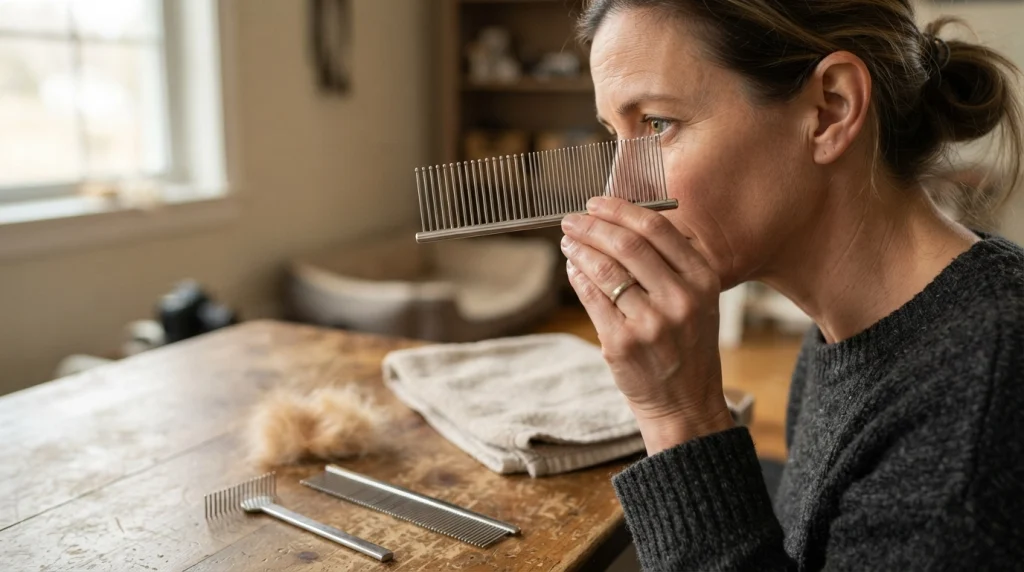
SaveLook closely at the teeth rather than buying based on packaging alone. Smoothness, spacing, length, and rigidity have more practical value than decorative features.
- Smooth rounded tips: Rough teeth can snag coat or scratch skin.
- Correct tooth length: Dense and longer coats generally need more reach.
- Useful spacing: Coarse spacing handles thicker hair, while fine spacing helps with finishing.
- Rigid construction: Teeth should not bend easily during normal grooming.
- Comfortable size: A full-size comb suits body work, while smaller combs provide control around details.
- Combination layout: Fine and coarse sections make one comb more versatile.
As of 2026, traditional steel “Greyhound-style” combination combs remain popular because one side can provide wider spacing while the other handles finer finishing.
My priority is always smooth teeth. An inexpensive comb with well-finished teeth is more useful than an expensive one that catches hair.
Metal grooming combs I would consider
If you’re ready to add one to your grooming kit, these three options cover different coat types and budgets.
🏆 BEST EVERYDAY PICK
Andis 7.5-Inch Steel Comb
★★★★½
This 7.5-inch steel comb uses coarse and finer tooth spacing for detangling and finishing. I like this traditional format because one tool can handle both general coat checking and smaller finishing work.
💰 BEST VALUE
Safari Dog Grooming Comb
★★★★☆
Safari offers versions intended for medium, coarse, and finer coats, with smooth rounded teeth. The 7.25-inch medium/coarse version is a practical choice when you want extra reach without moving into premium pricing.
✨ BEST PREMIUM OPTION
Chris Christensen Buttercomb
★★★★½
Buttercombs use highly finished metal teeth and are available in several tooth layouts and lengths. I would consider one for frequent grooming, show-style finishing, or curly and longer coats where smooth tooth finish matters.
Frequently Asked Questions
Is a metal comb good for dogs?
Yes. A smooth, properly sized metal grooming comb can be useful for detangling, coat checking, removing loose hair, and finishing. Choose the tooth length and spacing according to the dog’s coat, and never force the comb through resistance.
Can I use a human metal comb on my dog?
A dog-specific grooming comb is usually the better choice. Grooming combs are designed around canine coat depth, tooth spacing, strength, and repeated grooming use, while a normal human comb may be too short or poorly suited to dense dog hair.
Should I use a dog brush or a metal comb first?
For most medium, long, curly, or dense coats, I prefer brushing first and combing second. The brush handles larger areas and loose coat, while the comb checks your work and identifies remaining tangles that the brush may have missed.
Does a metal comb remove a dog’s undercoat?
It can collect loose undercoat, especially when the teeth are long enough to reach through the coat. However, an undercoat rake or suitable slicker is usually more efficient during heavy seasonal shedding, with the metal comb used afterward as a check.
How do I know when my dog’s coat is fully brushed?
Use a metal comb as your final check. Work through small sections from the hair ends toward the skin. When the comb passes smoothly without catching, dragging, or pulling the skin, that section is generally well separated.
Final Takeaway: A Metal Comb Is the Coat Check I Don’t Skip
A metal dog grooming comb isn’t meant to replace every brush. Its best job is showing you what the brush left behind.
Use the right tooth length, keep your pressure light, and stop whenever you hit resistance. That simple routine makes a metal comb one of the most useful finishing tools in a home grooming kit.
Start with a brush suited to your dog’s coat, then finish section by section with the comb. When it glides through comfortably, you know much more about what is happening beneath the surface.

Thomas Cutter is a lifelong dog owner and the founder of FindOutAboutDogs.com. With over 10 years of hands-on experience owning multiple breeds, Thomas created this site to provide honest, research-based dog advice that real owners can actually trust.
