What Type of Coat Does a Goldendoodle Have?
Quick Answer
A Goldendoodle can have a straight, wavy, or curly coat because it inherits coat traits from both Golden Retrievers and Poodles. Wavy coats are especially common, while curl, coat density, shedding, and facial furnishings can vary considerably between individual dogs. Once you identify the texture and length, you can choose a Goldendoodle brush that matches the coat.
Goldendoodle coat types at a glance
- Straight coat: Falls more loosely and may resemble the Golden Retriever side of the mix.
- Wavy coat: Has loose bends or waves and is often described informally as a fleece coat.
- Curly coat: Forms tighter curls and often needs the most careful detangling and comb checking.
- Furnishings: Longer eyebrow, beard, and muzzle hair create the classic shaggy Doodle face.
- Shedding: Amount varies, so curlier does not automatically mean completely non-shedding.
The practical takeaway
- Judge grooming needs by the coat your dog actually has rather than the generation label alone.
Goldendoodles can look surprisingly different from one another. One may have loose, shaggy waves, while another carries tight curls that look much closer to a Poodle.
That variation matters beyond appearance. Coat texture affects brushing, matting risk, shedding, drying time, and how often you may need professional grooming.
Definition: A Goldendoodle coat is the inherited hair covering of a Golden Retriever–Poodle cross. Its visible texture can range from straight to wavy to curly, while other genes influence facial furnishings, length, density, and shedding behavior.


What Are the Three Main Goldendoodle Coat Types?
 Save
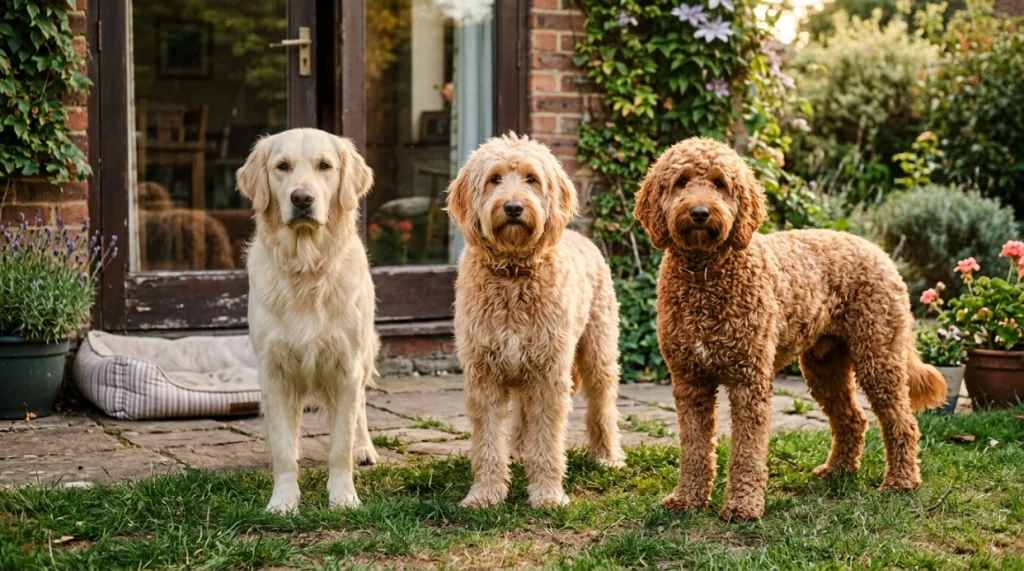
SaveThe three practical Goldendoodle coat types are straight, wavy, and curly. These labels describe the hair you can see and feel, not a guaranteed breed-standard classification.
You may also hear breeders use terms such as hair coat, fleece coat, and wool coat. I treat those as useful descriptions rather than rigid scientific categories.
- Straight or flat coat: Hair lies relatively straight with fewer visible curls. Some dogs may look more Retriever-like, especially around the body and tail.
- Wavy coat: Hair forms soft bends or loose waves without creating tight ringlets. This is the texture many people picture when they think of a shaggy Goldendoodle.
- Curly coat: Hair forms noticeable curls throughout much of the body. Loose hairs can remain trapped inside the coat, making thorough brushing especially important.
As of 2026, genetics gives us a better explanation than appearance labels alone. The UC Davis Veterinary Genetics Laboratory curl test identifies KRT71 variants associated with straight, wavy, and curly coat expression.
UC Davis reports that dogs with no tested curl allele are expected to have straight coats. One curl allele is associated with a wavy coat, while two copies are associated with a curly coat.
Why Do Goldendoodles Have Such Different Coats?
Goldendoodles inherit genes from two breeds with noticeably different coat characteristics. A puppy can receive combinations that produce more Retriever-like hair, more Poodle-like curl, or something between them.
The Golden Retriever contributes a medium-length shedding coat with an insulating undercoat. The Poodle side contributes dense curls and a different hair-growth pattern.
| Visible Coat | Typical Curl Genetics* | Common Appearance | Grooming Concern |
|---|---|---|---|
| Straight | N/N | Looser, flatter hair | Loose hair and lighter tangling |
| Wavy | N/C1 or N/C2 | Loose waves or shaggy bends | Hidden tangles beneath fluffy surface hair |
| Curly | C1/C1, C1/C2, or C2/C2 | Defined curls or ringlets | Trapped hair, knots, and matting |
*These are expected results for the tested KRT71 curl variants, not a guarantee of every visible coat feature. Other genetic factors also influence a Goldendoodle’s final appearance.
This is why I would never judge the maintenance routine from the words “F1,” “F1B,” or “multigen” alone. Look at the actual adult coat, how easily it tangles, and what a comb finds near the skin.
What Are Furnishings on a Goldendoodle?
Furnishings are the longer facial hairs that create a beard, mustache, and pronounced eyebrows. They produce much of the classic teddy-bear Goldendoodle expression.
The UC Davis furnishings test explains that an RSPO2 variant is associated with this longer facial hair pattern. Goldendoodles without furnishings may have a smoother, more Retriever-like face.
- Furnished face: Longer eyebrow, beard, and muzzle hair.
- Unfurnished face: Shorter facial hair with less of the shaggy Doodle look.
- Important distinction: Furnishings and curl are separate traits, so a furnished dog is not automatically tightly curled.
This distinction helps explain why two Goldendoodles can both have shaggy faces yet completely different body coats. Genetics is working on several coat features at the same time.
Do Goldendoodles Have a Single Coat or a Double Coat?
There is no single answer that applies perfectly to every Goldendoodle. Coat density and undercoat expression can vary because Goldendoodles are crosses rather than a genetically uniform pure breed.
Golden Retrievers have a distinct double coat. The American Kennel Club’s double-coat guidance describes a double coat as a protective outer layer combined with a softer undercoat.
Some Goldendoodles feel plush and dense enough that owners assume every Doodle has the same structure. That assumption can lead to using an undercoat tool when a slicker-and-comb routine would make more sense.
Part the hair and inspect it instead. If you are unsure what you are seeing, a professional groomer can help identify the coat structure before you buy aggressive deshedding tools.
Which Goldendoodle Coat Mats the Most?
Long, dense, curly Goldendoodle coats usually demand the closest mat prevention. Wavy coats can mat heavily too because their fluffy surface can hide small knots forming underneath.
Straighter coats may shed more freely, but that does not make them maintenance-free. Length, density, moisture, friction, and activity all affect how quickly tangles develop.
- Behind the ears: Fine hair rubs and twists during normal movement.
- Under the collar: Constant friction can tighten small tangles.
- Armpits: Leg movement repeatedly rubs the coat.
- Chest and belly: Long soft hair can hide knots close to the skin.
- Legs: Fluffy furnishings collect dirt and tangle easily.
- Harness areas: Straps create repeated pressure and friction.
- Tail base: Dense hair can look smooth on top while knotting underneath.
That hidden matting is one reason Goldendoodles need regular brushing. Waiting until a knot is visible from across the room usually means the problem is already more difficult.
How Should You Brush Each Goldendoodle Coat Type?
 Save
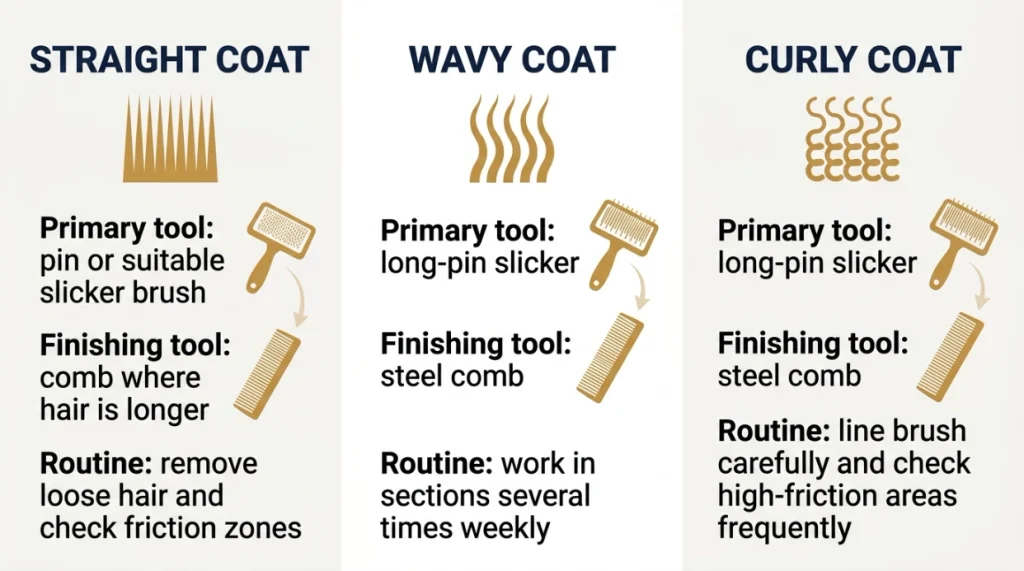
SaveThe best brushing method depends on coat depth and curl. For medium-to-long wavy or curly coats, I prefer a long-pin slicker followed by a stainless-steel comb.
The comb is important because it exposes what the brush missed. A fluffy finish means little if the comb stops close to the roots.
| Coat Type | Primary Tool | Finishing Tool | Practical Routine |
|---|---|---|---|
| Straight | Pin or suitable slicker brush | Comb where hair is longer | Remove loose hair and check friction zones |
| Wavy | Long-pin slicker | Steel comb | Work in sections several times weekly |
| Curly | Long-pin slicker | Steel comb | Line brush carefully and check high-friction areas frequently |
For a complete technique, follow my step-by-step Goldendoodle brushing guide. The basic method is to lift a thin layer of coat, brush it gently, and check that same section with the comb.
Do not compensate for the wrong tool by pressing harder. If the slicker repeatedly scrapes skin or cannot reach through the coat, change your technique or brush depth.
How Often Does a Goldendoodle Need Brushing?
Many Goldendoodles need brushing several times each week. Long, curly, dense, or fast-matting coats may need brief daily attention in problem areas.
PetMD’s Goldendoodle care guidance also recommends brushing at least a few times weekly. Your dog’s real matting rate should decide whether that schedule needs to increase.
- Long curly coat: Check mat-prone areas daily and perform thorough brushing frequently.
- Medium wavy coat: Start with several complete sessions each week.
- Short clipped coat: Brush as needed while continuing to check ears, legs, collar areas, and tail.
- After wet activity: Recheck the coat after swimming, rain, bathing, or muddy outdoor play.
I prefer short preventive sessions over one exhausting weekly detangling session. My broader guide to how coat type affects grooming frequency explains why no single schedule fits every dog.
Does a Curly Goldendoodle Shed Less?
Curly and furnished Goldendoodles may release less visible hair around the house because loose hairs can remain trapped in the coat. That does not mean every curly Goldendoodle is completely non-shedding.
Trapped hair is also part of the grooming problem. Instead of falling onto the floor, it can mix with surrounding hair and contribute to tangles.
This is why I would not choose a puppy based only on a promise of “zero shedding.” Individual genetics, adult coat development, and grooming habits matter.
Can a Goldendoodle Puppy Coat Change?
Yes. A Goldendoodle’s adult coat may become curlier, coarser, denser, or otherwise different as the puppy coat gives way to mature hair.
A puppy that seems easy to brush at four months can require considerably more coat work later. Build calm grooming habits before the adult coat becomes more demanding.
- Introduce tools early: Let the puppy investigate brushes and combs without turning every session into a full groom.
- Keep sessions short: Stop while the puppy is still cooperating.
- Handle mat zones: Gently touch paws, ears, legs, tail, chest, and armpits during training.
- Use rewards: Pair calm handling with small treats and praise.
The habit matters as much as the tool. A perfect brush is not useful if your dog panics whenever you pick it up.
Which Coat Type Is Easiest to Maintain?
A shorter, straighter Goldendoodle coat is often easier to keep tangle-free than a long, dense curly coat. However, straighter coats may release more visible hair.
The lowest-maintenance choice is often a manageable coat length combined with regular grooming. Professional clipping can reduce daily brushing work regardless of natural texture.
If your priority is a long teddy-bear style, plan for more brushing. Coat length creates more opportunities for friction, knots, debris, and hidden matting.
What Goldendoodle Coat Do You Have?
 Save
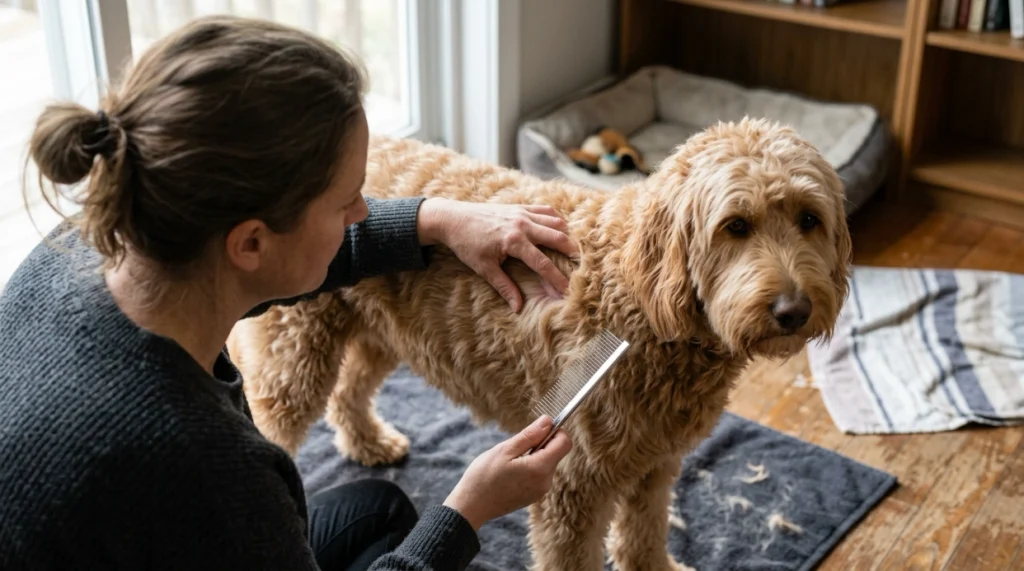
SaveStart by looking at the hair on the shoulders, sides, and back rather than judging only the face. Facial furnishings can make a dog look curlier than the body coat really is.
- Part the coat: Look from the ends all the way to the skin.
- Check the pattern: Decide whether the hair falls straight, bends in waves, or forms defined curls.
- Feel the density: Notice how much hair sits beneath the visible outer layer.
- Watch shedding: Check the brush, bedding, clothing, and floors for released hair.
- Run a comb through it: Note where the comb catches and how quickly tangles return.
That five-minute check tells me more about a grooming routine than a generation label. Your dog’s actual coat should drive your tool choice.
If you’re ready to match the brush to the coat you just identified, these are the three slickers I would put on my shortlist:
🏆 Best for Dense Curly Coats
Chris Christensen Big G Slicker Brush
★★★★★ 4.9/5 editorial fit
Its 27 mm stainless-steel pins, flexible cushion, and curved head are designed for long, dense coats. I would choose it when a full wavy or curly Goldendoodle needs more reach than a shallow everyday slicker.
💰 Best Value Doodle Pick
We Love Doodles Slicker Brush
★★★★☆ 4.6/5 editorial fit
The Doodle-focused design uses approximately one-inch stainless-steel pins angled for longer hair. I like it as a more budget-conscious option for owners maintaining a medium or long wavy coat at home.
🐕 Best Compact Pro-Style Pick
Show Tech Tuffer Than Tangles Long Pin Slicker
★★★★☆ 4.5/5 editorial fit
The long-pin version uses 20 mm angled pins with a flexible padded cushion. I would consider it for controlled section work on curly or tangle-prone coats when you want a smaller professional-style slicker.
Frequently Asked Questions
What is the most common Goldendoodle coat type?
Many Goldendoodles have a wavy coat that falls between the straighter Golden Retriever coat and the tightly curled Poodle coat. However, there is no single coat texture every Goldendoodle will develop, and individual puppies can mature differently.
How can I tell if my Goldendoodle will be curly?
Visible puppy curl provides a clue, but genetics gives a clearer answer. KRT71 curl testing can identify variants associated with straight, wavy, or curly hair. Adult coat texture can still be influenced by additional coat traits and may look different from the early puppy coat.
Do Goldendoodles with straight hair still need grooming?
Yes. Straight-coated Goldendoodles still benefit from regular brushing, skin checks, nail care, ear care, and professional grooming when needed. They may tangle less than a dense curly dog, but longer hair, friction areas, and loose shedding can still create maintenance work.
Is a wavy or curly Goldendoodle better?
Neither coat is automatically better. A wavy coat may be easier for some owners to maintain, while a curly coat can appeal to people who prefer the Poodle-like appearance. Choose according to grooming tolerance, shedding expectations, coat length, and the individual dog’s needs.
Can two Goldendoodles from the same litter have different coats?
Yes. Littermates can inherit different combinations of coat-related genes, so one puppy may develop a straighter coat while another becomes wavier or curlier. Facial furnishings, density, color, and shedding can also differ within the same litter.
Final Takeaway
A Goldendoodle can have a straight, wavy, or curly coat, and that texture is only part of the picture. Furnishings, length, density, shedding, and adult coat development all affect what grooming will look like.
I would focus less on the generation label and more on what your hands and comb tell you. Part the coat, check the roots, identify how easily it tangles, and choose your grooming routine from there.
Your next step is simple. Check your Goldendoodle’s coat today, decide whether it is mostly straight, wavy, or curly, and make sure your brush can reach through that specific coat without excessive pressure.

Thomas Cutter is a lifelong dog owner and the founder of FindOutAboutDogs.com. With over 10 years of hands-on experience owning multiple breeds, Thomas created this site to provide honest, research-based dog advice that real owners can actually trust.
