What Brush Is Best for a German Shepherd? Complete 2026 Guide
Quick Answer
The best brush for most German Shepherds is an undercoat rake, because it reaches the loose hair beneath their protective outer coat. I pair it with a slicker brush for surface hair and finishing, especially on longer coats. If your Shepherd has an especially dense coat, this guide to brushing a dog with a thick undercoat explains the deeper brushing technique.
What to look for
- Undercoat access: Long enough teeth should reach loose undercoat without requiring hard pressure.
- Rounded teeth: Smooth or rotating tips reduce pulling while moving through dense fur.
- Large brush head: German Shepherds have plenty of coat, so a larger tool saves time.
- Comfortable handle: A non-slip grip helps you keep strokes light and controlled.
- Second brush: A slicker is useful for collecting surface hair and smoothing the finished coat.
My simple choice
- Buy a good undercoat rake first. Add a slicker brush if you want a more complete two-tool grooming setup.
German Shepherd fur has a way of appearing everywhere. You brush the dog, clean the floor, and somehow another clump appears beside the sofa.
The solution isn’t simply finding the brush that removes the most hair. You need a tool that works with the German Shepherd’s dense double coat without encouraging rough, repetitive brushing.


Why Do German Shepherds Need a Special Type of Brush?
German Shepherds have a double coat, so one brush must often work through more than the hair you can see. The American Kennel Club’s German Shepherd grooming guidance specifically discusses their shedding and the need to reach loose undercoat.
A double coat is a coat with a softer insulating undercoat beneath tougher outer guard hairs. Loose undercoat can remain below the surface even when the outer coat looks smooth.
- Guard hairs: The tougher visible hairs form the outer protective layer.
- Undercoat: Softer, denser hair provides insulation and accounts for much of the loose seasonal fur.
- Stock coats: These usually need strong undercoat removal without excessive surface work.
- Long coats: These often need extra slicker or comb work around feathering and tangle-prone areas.
VCA Animal Hospitals also describes German Shepherds among breeds with a thick outer coat and fine undercoat. Their dog coat-care guidance notes that these dogs can experience substantial seasonal undercoat shedding.
What Brush Is Best for a German Shepherd?
An undercoat rake is my first choice for most German Shepherds. Its longer metal teeth can reach released undercoat that a shallow surface brush may leave behind.
The key word is released. You want to lift loose coat gently rather than drag healthy hair out through repeated aggressive passes.
The AKC’s guide to dog brush types describes undercoat rakes as tools designed to penetrate through the coat and remove loose undercoat. It also stresses matching tooth length to coat length.
Undercoat Rake — Best Primary Tool
An undercoat rake has longer, spaced metal teeth that move through the outer coat toward the softer hair underneath. Some designs use rotating teeth to reduce tugging.
This is the tool I would buy first for an average German Shepherd. It directly addresses the part of the coat that creates the biggest shedding challenge.
- Best for: Loose undercoat and seasonal shedding.
- Use it on: Neck, shoulders, back, sides, rump, and other densely coated areas.
- Main advantage: Reaches deeper than most ordinary brushes.
- Main caution: Never press hard or repeatedly scrape the same patch.
If the surface looks finished but deeper fur still feels packed, use a section-by-section method. My guide to brushing dense dog fur covers that approach in detail.
Slicker Brush — Best Finishing Tool
A slicker brush uses many fine, closely spaced pins. It catches loose surface hair, separates light tangles, and leaves the outer coat looking smoother.
I see the slicker as the partner to the rake rather than its replacement. That distinction saves a lot of unnecessary brushing.
- Best for: Surface fur, minor tangles, feathering, and finishing.
- Especially useful for: Long-coated German Shepherds.
- Main advantage: Covers a large surface quickly.
- Main caution: Fine pins can irritate skin if you press too hard.
Metal Comb — Best Final Check
A metal comb isn’t my primary shedding tool, but it provides excellent feedback. If a suitable comb glides through a finished section without force, you’ve probably cleared the hidden loose coat and tangles.
Brushes and combs perform different jobs. See why I use a dog brush and comb together if you want a complete grooming setup.
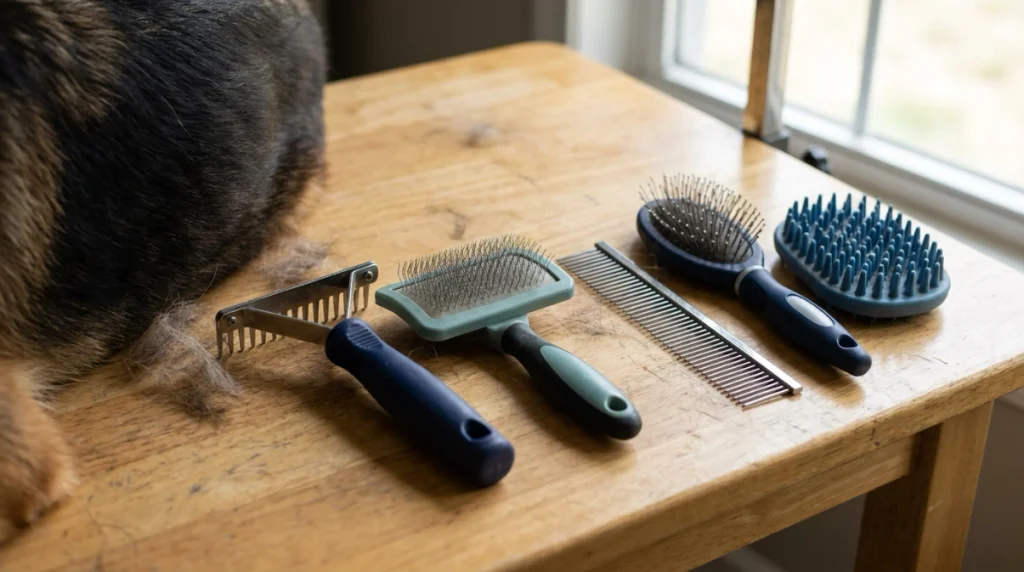
German Shepherd Brush Types Compared
 Save
SaveNo brush wins every category. This table shows where the common options fit in a German Shepherd grooming routine.
| Brush Type | Best Job | Undercoat Reach | Best GSD Use | Main Caution |
|---|---|---|---|---|
| Undercoat rake | Removing released undercoat | Excellent | Primary grooming tool | Overworking one area |
| Slicker brush | Loose surface hair and light tangles | Moderate | Finishing and long coats | Skin scraping from excess pressure |
| Metal comb | Finding remaining tangles | Good with long teeth | Final coat check | Pulling when teeth snag |
| Pin brush | Smoothing longer outer hair | Limited | Long-coat finishing | May miss deep undercoat |
| Rubber brush | Loose surface hair | Low | Supplementary grooming | Cannot penetrate most GSD coats well |
Is a Slicker Brush Enough for a German Shepherd?
A slicker brush can help, but I wouldn’t rely on one alone for most German Shepherds. It does an excellent job on surface hair and light tangles, yet dense undercoat can remain underneath.
That’s why a two-tool routine makes sense. The rake handles deeper loose coat, while the slicker cleans up what reaches the surface.
- Normal maintenance: Rake dense areas gently, then finish with the slicker.
- Long-coated GSD: Add more slicker work around the neck, tail, rear legs, and feathering.
- Tangle check: Finish difficult sections with a metal comb.
- Heavy shedding: Shorten the interval between grooming sessions rather than brushing harder.
One dog can benefit from several grooming tools without making the routine complicated. I explain the logic in my guide to using multiple brush types on one dog.
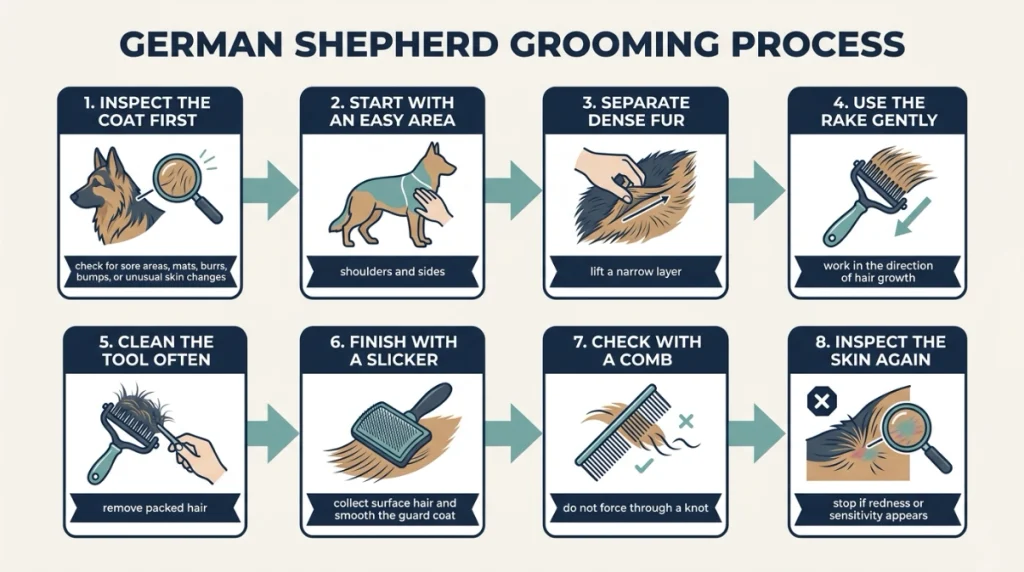
How Do You Brush a German Shepherd Correctly?
 Save
SaveBrush a German Shepherd in small sections using light strokes that follow the coat. Your goal is to remove loose fur without repeatedly dragging metal teeth against the skin.
- Inspect the coat first. Feel for sore areas, mats, burrs, bumps, or unusual skin changes.
- Start with an easy area. The shoulders and sides are often simpler than feathered areas.
- Separate dense fur. Lift a narrow layer so you can work below the visible surface.
- Use the rake gently. Pull through loose undercoat in the direction of hair growth.
- Clean the tool often. Packed teeth become less effective and encourage unnecessary extra strokes.
- Finish with a slicker. Collect surface hair and lightly smooth the guard coat.
- Check with a comb. Don’t force the comb if it stops at a knot.
- Inspect the skin again. Stop if you notice redness or increasing sensitivity.
The ASPCA’s dog grooming guidance also recommends regular brushing based on coat type. Grooming gives you a useful chance to notice skin changes, parasites, or tangles.
How Often Should You Brush a German Shepherd?
Most German Shepherds benefit from several brushing sessions each week, with more frequent grooming when loose undercoat increases. Coat length, environment, and the individual dog matter more than one rigid schedule.
The German Shepherd specialists quoted by the AKC use routines ranging from weekly deshedding to every-other-day brushing. Frequency can rise during periods of heavier shedding.
- Normal shedding: Start around two or three thorough sessions per week and adjust from the coat’s condition.
- Heavy shedding: Short daily sessions may be easier than one long weekly grooming session.
- Long-coated Shepherd: Check tangle-prone areas more often.
- Low shedding period: Don’t keep raking aggressively just because the tool can still collect hair.
I prefer watching the coat instead of blindly following a calendar. Loose clumps, new tangles, or packed areas tell you more than the date does.
These signs your dog needs more frequent brushing can help you decide when to increase the schedule.
Should You Use a FURminator on a German Shepherd?
You need to distinguish between a FURminator grooming rake and the brand’s bladed deShedding tools. They are different products and shouldn’t automatically be treated the same way.
The FURminator Grooming Rake uses rotating metal teeth designed for thick fur and dense double coats. The manufacturer’s instructions say to avoid excessive repeated strokes on one area.
Any aggressive de-shedding edge deserves more caution. Even the AKC notes that de-shedding tools can damage a German Shepherd’s coat when used incorrectly.
- Use light pressure: The tool should move through loose hair without digging into skin.
- Don’t chase endless fur: Some hair continuing to appear doesn’t mean one patch needs repeated scraping.
- Follow directions: Different tooth and blade designs have different intended uses.
- Stop with irritation: Redness or discomfort means the technique needs changing.
What Should You Avoid When Brushing a German Shepherd?
The biggest mistake is believing harder brushing means better grooming. Thick fur requires patience and access, not force.
- Don’t scrape the skin: Metal pins and teeth should work through hair, not dig into the body.
- Don’t keep repeating one spot: Move through the coat methodically.
- Don’t yank through mats: Tight tangles can pull painfully on skin.
- Don’t rely only on surface appearance: A smooth topcoat may still hide loose undercoat.
- Don’t use household scissors on tight mats: Dog skin can sit unexpectedly close beneath a mat.
- Don’t ignore behavior: Flinching, turning away, growling, or sudden sensitivity can signal discomfort.
If grooming reveals sores, persistent redness, bald areas, unusual odor, or obvious pain, stop working that area. A veterinarian should evaluate unexplained skin or coat problems.
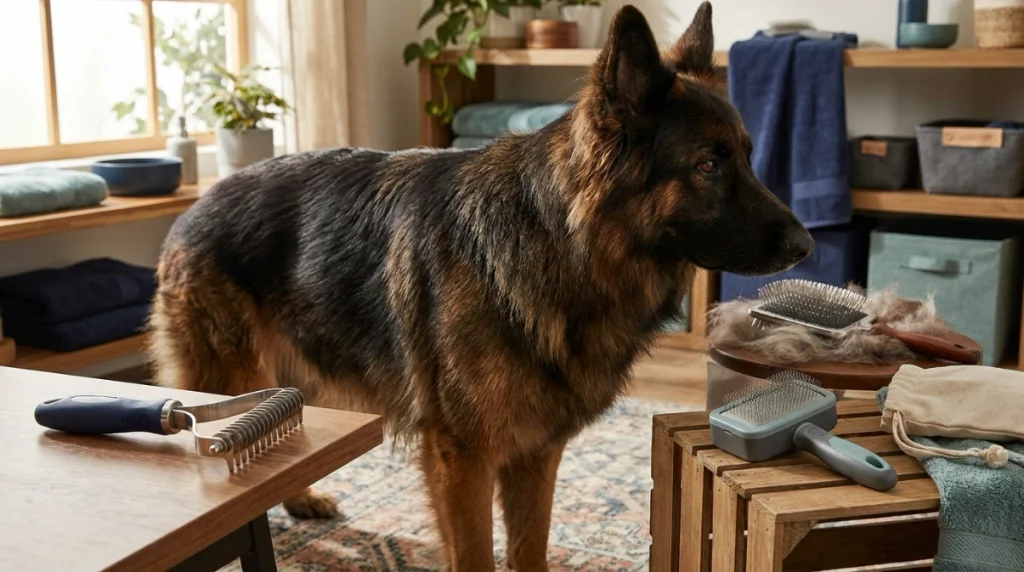
Which Brush Should You Buy for a German Shepherd?
 Save
SaveIf you’re ready to choose one, these are the three tools I would consider first. Each solves a different part of German Shepherd coat maintenance.
🏆 Best Overall
FURminator Grooming Rake
★★★★★ 4.8/5 coat-fit rating
Rotating metal teeth are designed to collect loose undercoat from thick and double coats while reducing tugging. This is my first pick when the main problem is deep loose German Shepherd undercoat rather than surface tangles.
💰 Best Budget Finisher
Hertzko Self-Cleaning Slicker Brush
★★★★☆ 4.4/5 coat-fit rating
Fine angled pins collect loose surface fur, while the retracting design makes packed hair easier to release from the brush. I like this as the affordable second tool after an undercoat rake, rather than the only brush for a thick Shepherd coat.
🐕 Best for Long Coats
Chris Christensen Big G Slicker Brush
★★★★★ 4.7/5 coat-fit rating
The Big G uses long 27 mm stainless-steel pins and a flexible cushion pad for substantial coat depth. I would spend the extra money on it for a long-coated German Shepherd where an ordinary shallow slicker struggles to reach through the coat.
Frequently Asked Questions
What is the best brush for German Shepherd shedding?
An undercoat rake is the best starting tool for German Shepherd shedding because its longer teeth can reach loose hair beneath the outer guard coat. A slicker brush works well afterward for surface fur and finishing. During heavier shedding, increase grooming frequency instead of applying more pressure.
Do German Shepherds need an undercoat rake?
Most German Shepherds benefit from an undercoat rake because they have a dense double coat. The rake reaches loose undercoat that shallow brushes may leave behind. Choose a tooth length suitable for your dog’s coat and use gentle strokes in the direction of hair growth.
Can I brush my German Shepherd every day?
Yes. Short daily brushing sessions can be useful during periods of heavy shedding, provided the brush suits the coat and you use light pressure. Daily aggressive raking isn’t necessary. Reduce the intensity or frequency if you notice redness, broken hair, soreness, or increasing sensitivity.
Is a slicker brush good for a German Shepherd?
Yes, a slicker brush is useful for removing loose surface hair, managing light tangles, and finishing a German Shepherd’s coat. It is especially helpful on longer coats. However, a slicker may not reach deep enough to replace an undercoat rake during heavy shedding.
Should I use a bristle brush on a German Shepherd?
A bristle brush can smooth surface hair, but it usually isn’t the best primary brush for a German Shepherd. Its bristles don’t penetrate a dense undercoat as effectively as a rake. Use one as an optional finishing tool rather than your main shedding brush.
Final Takeaway
If you’re wondering what brush is best for a German Shepherd, start with a well-designed undercoat rake. It tackles the loose undercoat that ordinary surface brushing often misses.
Add a slicker brush if you want a complete setup, particularly for a long-coated Shepherd. Keep your pressure light, work in small sections, and let the condition of your dog’s coat determine how often you brush.
That simple two-tool approach is more useful than buying a drawer full of grooming gadgets. The goal isn’t to pull out the biggest pile of fur; it’s to keep the coat comfortable, clean, and manageable.

Thomas Cutter is a lifelong dog owner and the founder of FindOutAboutDogs.com. With over 10 years of hands-on experience owning multiple breeds, Thomas created this site to provide honest, research-based dog advice that real owners can actually trust.
