7 Best Dog Brush for Bichon Frise 2026: Mat-Fighting Picks
The best dog brush for Bichon Frise coats is the Hertzko Self-Cleaning Slicker Brush, which clears trapped hair with one push. We evaluated 7 brushes by comparing pin design, expert guidance, and owner feedback, scoring each on tangle removal, skin comfort, and ease of use. Most brushes look identical on paper but snag in a Bichon’s dense curls, and that gap shaped every pick. Whether you need daily detangling, mat control, or a finishing comb, this guide gives you one clear answer.


Quick Comparison: All 7 Products Ranked
| # | Product | Best For | Rating | Badge | |
|---|---|---|---|---|---|
| 1 | Hertzko Self-Cleaning Slicker Brush | Daily detangling, easy cleanup | 4.8/5 | Best Overall | Buy → |
| 2 | Dog by Dr. Lisa Slicker Brush | Stubborn tangles, small dogs | 4.7/5 | Expert Favorite | Buy → |
| 3 | Chris Christensen Mark VII Curved Slicker Dog Brush | Curly coats, pro-level reach | 4.6/5 | Best Premium | Buy → |
| 4 | Les Poochs Pro Brush | Early mats near the skin | 4.5/5 | Best for Mats | Buy → |
| 5 | We Love Doodles Pin Brush | Finishing and fluffing | 4.4/5 | Best Pin Brush | Buy → |
| 6 | Wahl Premium Pet Slicker Brush | First-time owners, back-up brush | 4.3/5 | Best Budget | Buy → |
| 7 | Chris Christensen 7.5-Inch Greyhound Style Comb | Final tangle check | 4.2/5 | Best Finishing Comb | Buy → |
How We Chose These Brushes
What we evaluated
7 brushes and combs compared on pin design, head shape, cleaning method, and fit for a Bichon’s soft undercoat and curly outer coat.
Our 3 scoring criteria
Tangle removal, skin comfort, and ease of use, each scored out of 5 and applied the same way to every product.
Sources behind our picks
Expert brush recommendations from a national shopping editorial, Bichon grooming guidance that cites breed-club advice, and owner feedback on Bichon and doodle coats.
What we cut and why
Deshedding rakes and rubber curry brushes. Bichons shed little because loose hair stays trapped in the curls, so tools built for heavy shedders add little.
What to Look for When Buying a Brush for a Bichon Frise
A Bichon’s coat is a soft, dense undercoat beneath a curly outer layer, and loose hair gets trapped in those curls instead of falling out. That is why tool choice decides whether daily brushing prevents mats or only skims the surface.
1. Brush Head Type
Slicker brushes, with fine bent wires, do the heavy detangling on a Bichon. Pin brushes, with straight spaced pins, smooth and fluff the coat afterward, and a metal comb checks close to the skin where mats start. Most owners need a slicker plus a comb, and a pin brush is optional. To see the full picture, read how a slicker brush works before you buy.
2. Pin Length and Tip Safety
Pins must reach the undercoat, but tips matter just as much. Rounded or protected tips are kinder to the thin skin on the belly and behind the ears, and a smaller head helps around the face and paws. The best routine pairs a slicker with a comb, which slicker brush versus metal comb explains in detail.
3. Size and Handle Comfort
Daily brushing is the goal, so comfort is a feature. A lightweight, grippy handle keeps your wrist fresh through a full-body session, and a head sized to your dog’s body avoids awkward angles. Small Bichons usually do best with a small or medium head.
4. Cleaning and Durability
Hair packs between pins quickly on a curly coat. Self-cleaning heads save time, while traditional heads need manual cleaning but have fewer moving parts. After a few weeks, check that pins are firmly set and tips are not bent or exposed.
 Save
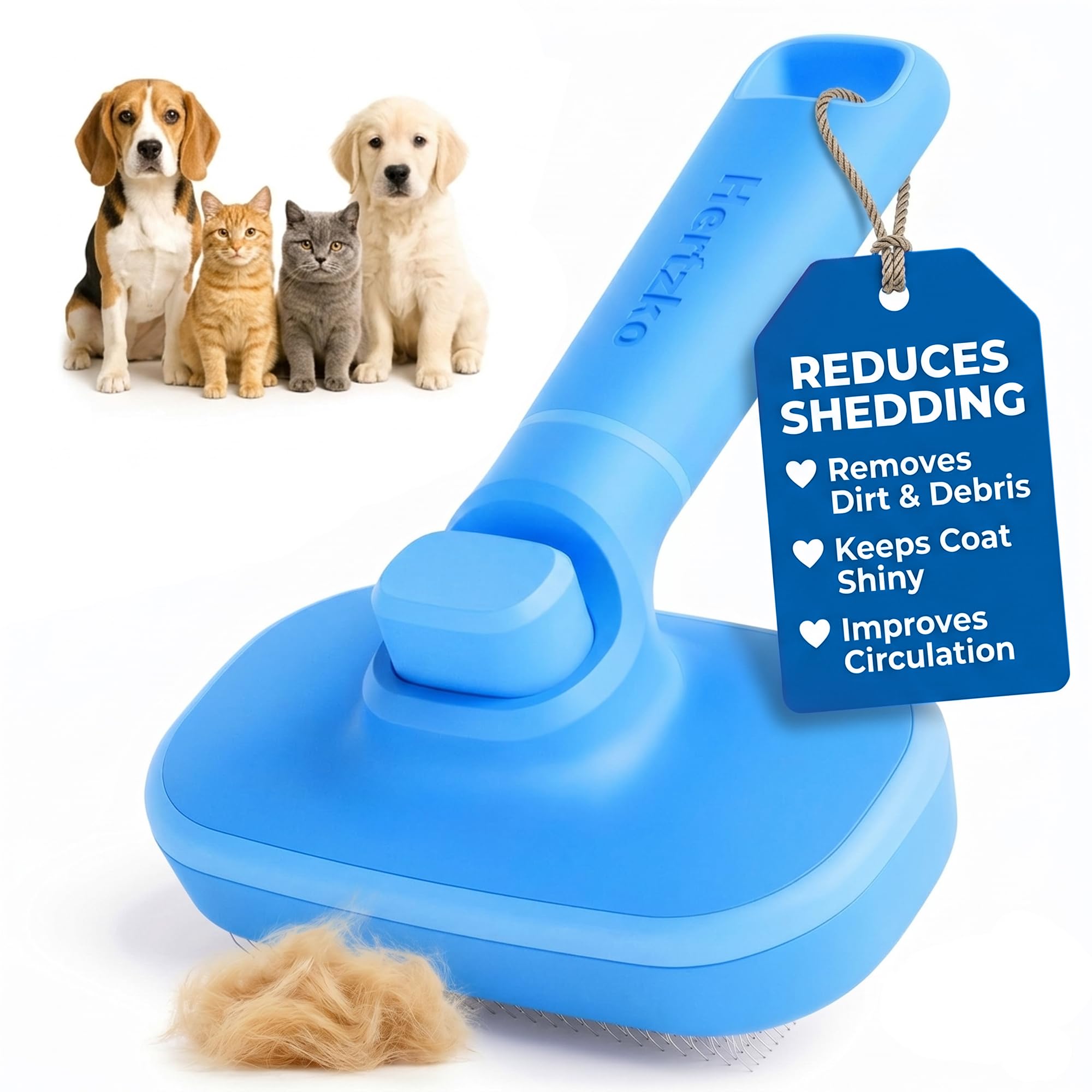
Hertzko Self-Cleaning Slicker Brush — The easiest daily slicker for Bichons
Best for: Daily detangling, easy cleanup
Bichon owners need a brush that reaches the soft undercoat without scratching delicate skin, and this slicker is built for that job. Its fine bent pins work through curls in small sections, while push-button retraction drops trapped hair into the trash so daily sessions stay quick. The ergonomic handle keeps wrist strain low during longer sessions. It works best on the body and legs, but the head is wider than some alternatives, so you will want a smaller tool or a comb for the face, paws, and tight areas around the eyes.
- Push-button retraction clears hair instantly
- Fine bent pins glide through curls
- Comfortable handle for daily sessions
- Head too wide for face and paws
- Pins need gentle pressure on skin
4.8/5
4.7/5
4.9/5
 Save
Dog by Dr. Lisa Slicker Brush — Expert-picked slicker for stubborn tangles
Best for: Stubborn tangles, small dogs
If your Bichon already fights a few stubborn tangles, a slicker with tightly packed, angled wire pins delivers more detangling power per stroke. Experts named this the best slicker in a national roundup, and one reviewer uses it on their Havanese and Bichon mix to keep knots from getting out of hand. The angled pins are designed to move through the coat without pressing hard on skin. It also comes in a larger size, though small dogs usually do better with the smaller head. Expect to pull hair from the pins by hand after each session.
- Tightly packed pins cut tangles fast
- Angled wires protect the skin
- Offered in small and large sizes
- Not self-cleaning; hair pulled out by hand
- Large size feels bulky on small dogs
4.8/5
4.6/5
4.6/5

Chris Christensen Mark VII Curved Slicker Dog Brush — Premium curved slicker for curly coats
Best for: Curly coats, pro-level reach
Professional groomers often reach for curved slickers because the head follows a dog’s body, and this Chris Christensen model is the premium pick for curly coats like the Bichon’s. Experts chose it as their curly-haired-dog winner. The curve contours gently around a Bichon’s ribs and shoulders, helping you reach close to the skin where mats begin. The trade-off is technique: professional-grade pins punish heavy-handed brushing, so use short, light strokes in sections. It also costs more than most home-grooming brushes, which makes sense mainly if you brush daily and groom between salon visits.
- Curved head follows body contours
- Built for curly coats
- Professional-grade construction
- Premium cost for casual home use
- Pins punish heavy-handed brushing
4.9/5
4.6/5
4.3/5

Les Poochs Pro Brush — Curved bristles for early mats
Best for: Early mats near the skin
When a Bichon has already started to mat behind the ears or under the legs, a standard slicker can drag and pull. This brush earned an expert nod for matting, with a head that glides through fur and curved bristles that reach closer to the skin, where mats form first. Use it gently on a dry, misted coat to loosen small knots section by section, then confirm with a comb. It is not the tool for a quick daily fluff, and tight mats still need a groomer rather than more force.
- Curved bristles reach close to skin
- Glides through fur without dragging
- Targets mats while still small
- Overkill for quick daily brushing
- Severe mats still need a groomer
4.7/5
4.4/5
4.4/5

We Love Doodles Pin Brush — A soft finishing brush, not a detangler
Best for: Finishing and fluffing
A pin brush will not replace a slicker on a Bichon, but it is a lovely finishing tool for the fluffy, rounded look. This curved-head brush has soft-tipped pins that stay gentle on sensitive skin and cover big areas like the back, sides, and chest quickly. Owners with doodle and Bichon-type coats report it glides through coats with little tugging. Treat it as a companion brush: use it after detangling to smooth and fluff, not as your only tool, because it will not tackle stubborn knots near the skin.
- Soft-tipped pins gentle on skin
- Curved head covers large areas fast
- Smooths and fluffs after detangling
- Cannot clear stubborn knots alone
- Best as a companion brush
4.1/5
4.8/5
4.3/5

Wahl Premium Pet Slicker Brush — A simple, forgiving starter slicker
Best for: First-time owners, back-up brush
Starting a grooming kit without overspending is easier with this basic slicker, made for medium and long coats like a Bichon’s. Its rounded pins are gentle on sensitive skin, and the simple design is easy for first-time owners to handle. It works well for everyday brushing of the body, but reviewers describe it as a secondary tool best paired with a larger slicker or a comb for thicker sections. The head is plain and the cleaning is manual, so it lacks the convenience of self-cleaning models.
- Rounded pins safe for sensitive skin
- Made for medium and long coats
- Budget-friendly way to start a kit
- Works best as a secondary tool
- Manual cleaning; no self-cleaning feature
4.2/5
4.5/5
4.3/5

Chris Christensen 7.5-Inch Greyhound Style Comb — The final check that catches hidden knots
Best for: Final tangle check
No brush can tell you whether a Bichon’s coat is truly tangle-free, but a metal comb can. Drag this 7.5-inch greyhound-style comb gently through each section after the slicker, using light pressure; if it glides from skin to tip, you are done, and if it catches, you have found a knot before it becomes a mat. The metal teeth also help part the coat and check around the face and legs. It is a finishing tool, so it cannot detangle severe mats or replace daily slicker work.
- Reveals hidden tangles near the skin
- Metal teeth glide through clean coat
- Length suits small dog bodies
- Cannot detangle severe mats
- Useless as a standalone grooming tool
3.9/5
4.5/5
4.2/5
Top 3 Head-to-Head: Hertzko vs Dr. Lisa vs Mark VII
These three are the usual final choices for Bichon owners: an everyday self-cleaning slicker, an expert-favorite slicker, and a curved premium slicker built for curly coats.
| Feature | #1 Hertzko | #2 Dr. Lisa | #3 Mark VII |
|---|---|---|---|
| Tangle removal | 4.8/5 | 4.8/5 | 4.9/5 — Best |
| Skin comfort | 4.7/5 — Best | 4.6/5 | 4.6/5 |
| Ease of use | 4.9/5 — Best | 4.6/5 | 4.3/5 |
| Cleaning | Self-cleaning — Best | Manual | Manual |
| Head shape | Standard | Standard | Curved |
| Choose if… | You want easy daily brushing and quick cleanup | You want an expert-recommended slicker for stubborn tangles | You groom between salon visits and want a professional curved head |
Who These Brushes Are NOT For
These picks are built for coats that are brushed out regularly, not for emergencies or for owners who want no daily routine.
They also fall short if you want zero daily effort. Bichons need brushing at least 3 to 4 times a week, and daily is ideal. If that is unrealistic, plan on a shorter trim with your groomer every 4 to 6 weeks.
Common Mistakes to Avoid
Even the right brush fails when the technique is off, and these four errors cause most Bichon mats.
Frequently Asked Questions About Bichon Frise Brushes
What is the best brush for a Bichon Frise?
A slicker brush is the best main tool for a Bichon Frise, paired with a metal comb for checking close to the skin. The fine bent wires work through curly hair and the soft undercoat without snagging. For most owners, our top pick, the Hertzko Self-Cleaning Slicker Brush, covers daily needs, while a pin brush is optional for finishing.
How often should you brush a Bichon Frise?
Daily brushing is ideal for a Bichon Frise, and 3 to 4 times a week is the minimum. Their coat grows continuously and loose hair stays trapped in the curls, so gaps between sessions let mats form. Work in small sections and finish each with a comb. For a deeper routine, see how often curly coats need brushing.
Is a slicker brush or pin brush better for a Bichon Frise?
A slicker brush is better for detangling, while a pin brush is better for smoothing and fluffing afterward. Slicker wires reach the dense undercoat where knots begin, but pins glide mostly through the surface layer. Most Bichon owners get the best results using a slicker first, a comb second, and a pin brush only as a finishing touch.
Should you use a comb after brushing a Bichon Frise?
Yes, a metal comb is the best way to confirm the coat is truly tangle-free. A brush can glide over the top layer and leave knots near the skin, but a comb exposes them immediately. Use it after the slicker, working in small sections from the ends toward the skin, and stop if the comb catches hard.
How do I prevent mats in my Bichon Frise’s coat?
Brush daily, comb through each section, and keep up regular professional trims. Lightly misting the coat with grooming spray or conditioner first reduces breakage, and drying thoroughly after baths reveals tangles early. Never pull or cut a mat; gently work small ones from the ends toward the skin, and ask a groomer to handle stubborn ones.
Do Bichon Frises shed?
Bichon Frises shed very little, but that does not mean they need less brushing. Their loose hair gets trapped in the curly coat instead of falling out, which makes mats likely without regular care. Because the hair grows continuously, like human hair, it needs steady brushing and trimming rather than a deshedding tool.
How often should a Bichon Frise see a professional groomer?
Most Bichon Frises do well with a professional groom every 4 to 6 weeks. The visit handles the rounded trim, bath, and any trouble spots, while your home routine keeps the coat comfortable in between. Brush thoroughly before an appointment, since heavy matting can mean a shorter cut than you planned.
Our Final Verdict
Bichon coats mat fast, so the right pairing matters more than any single tool. Start with the Hertzko slicker for daily detangling, then check close to the skin with a metal comb. Add a curved or matting-focused brush only if your dog tangles easily or you groom between salon visits.

Thomas Cutter is a lifelong dog owner and the founder of FindOutAboutDogs.com. With over 10 years of hands-on experience owning multiple breeds, Thomas created this site to provide honest, research-based dog advice that real owners can actually trust.
