How Do Self Cleaning Dog Brushes Work? A Simple Guide
Quick Answer
Self-cleaning dog brushes use a button or sliding mechanism to move a cleaning plate across the bristles, releasing the fur trapped between them. You brush your dog normally, press the release button when hair builds up, remove the collected fur, and continue grooming. The feature makes cleanup easier, but the brush still needs to match your dog’s coat.
How to use one effectively
- Choose the right brush: Look for a suitable pin length and brush-head size for your dog’s coat.
- Brush gently: Use short strokes without pressing hard against the skin.
- Release the fur: Press the cleaning button or operate the slider according to the manufacturer’s instructions.
- Remove the hair: Lift away the released clump and dispose of it.
- Inspect the coat: Use a suitable comb when you need to check for hidden tangles or mats.
One important limitation
- The button removes collected fur from the brush; it doesn’t automatically remove every loose hair, prevent all shedding, or untangle severe mats.
If you’ve ever spent more time pulling fur out of a brush than brushing your dog, a self-cleaning model can make grooming less frustrating. The clever part isn’t an electric motor or a special coating; it’s a simple mechanical design.
In this guide, I’ll explain how the mechanism works, which coat types benefit most, what it cannot do, and what to check before buying one. I’ll also cover the maintenance details that help a self-cleaning dog brush remain useful over time.


What Is a Self-Cleaning Dog Brush?
 Save
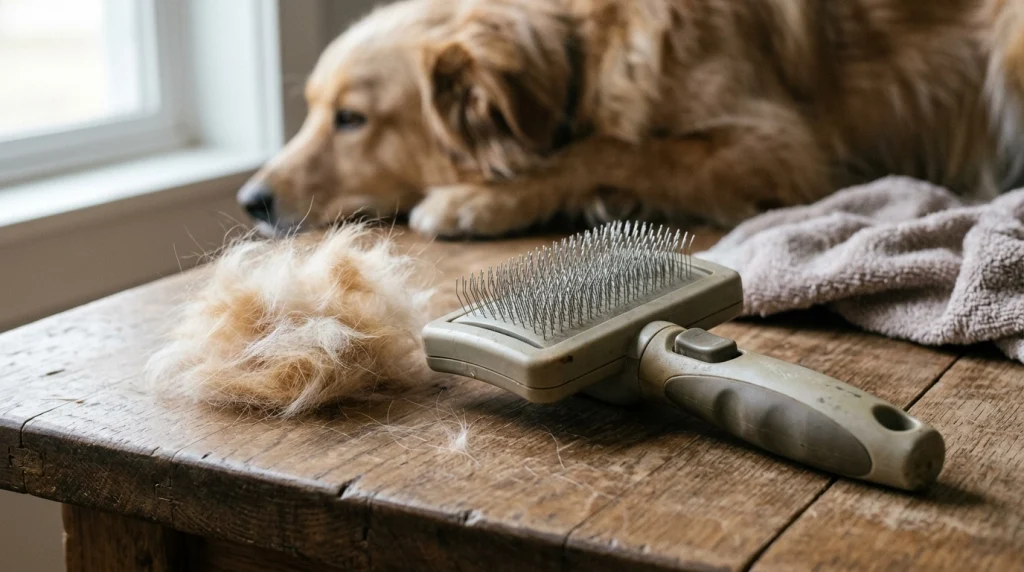
A self-cleaning dog brush is a grooming brush with a built-in mechanism that releases trapped hair when you press a button or move a slider. Most familiar models use a pin-covered head and a movable plate that pushes accumulated fur away from the bristles.
The term self-cleaning can be misleading because you still operate the mechanism and dispose of the hair yourself. The brush simply makes that task faster and less fiddly.
Many designs combine the release mechanism with a slicker brush. A slicker brush uses numerous fine wire pins to collect loose hair and help separate small tangles, making the design useful for many medium-haired, long-haired, and curly-coated dogs.
However, not every self-cleaning brush has the same pin shape, flexibility, or head design. Those differences matter more to your dog’s comfort and coat care than the cleaning button alone.
How Do Self-Cleaning Dog Brushes Work?
 Save
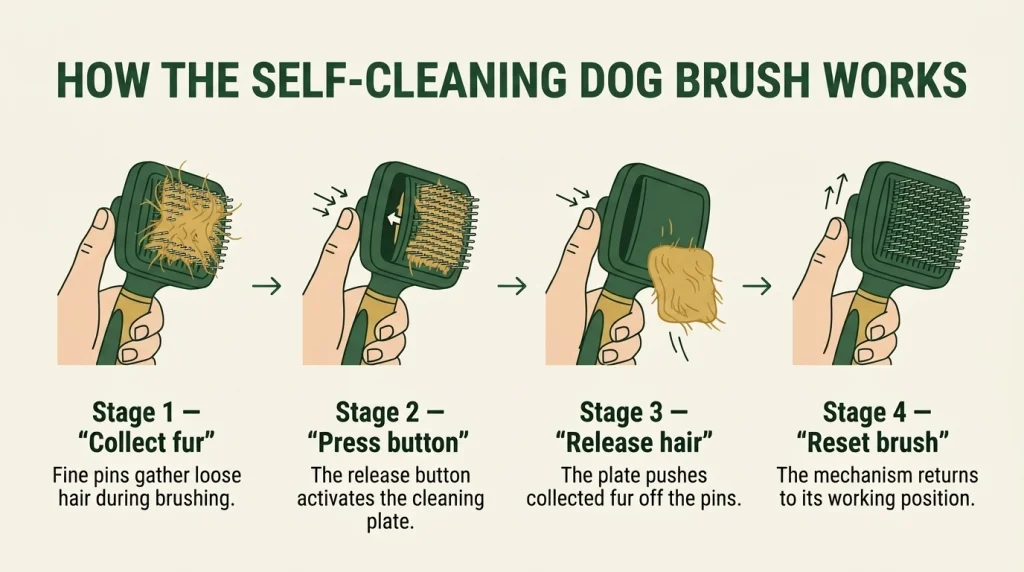
Most self-cleaning dog brushes work by moving a cleaning plate relative to the bristles. During grooming, the pins catch loose fur; when you activate the release mechanism, the plate moves and pushes the collected hair off the pins.
The precise movement depends on the model. Some plates move forward, while other designs retract the pins or use a different ejector arrangement.
1. The bristles collect loose fur
As you brush, the pins move through the coat and collect shed hair, small bits of debris, and some loose undercoat where the brush is suitable for that job. The hair gathers around the pins instead of falling away immediately.
Fine pins can also separate minor tangles in appropriate coats, but they shouldn’t be used to force apart tight mats. Gentle strokes and the correct pin length help reduce pulling on the skin.
2. The button activates the cleaning plate
Once the brush head has collected enough fur, you press its release button or move its slider. This action shifts a plate with openings around the pins, pushing the gathered hair toward the tips and off the brush head.
Think of the plate as a small built-in hair ejector. It doesn’t vacuum up fur or wash the brush; it mechanically separates collected hair from the bristles.
3. The fur comes off in a clump
Because loose hairs have become tangled together around the pins, they often lift away as one compact clump. You can then pick up the fur and throw it away instead of teasing individual strands out by hand.
Very fine hairs, damp fur, or tightly wrapped strands may not release completely in one press. You might need to remove a few remaining hairs manually or clean the head according to the manufacturer’s directions.
4. The brush resets for the next pass
After you remove the collected fur, you release or reset the mechanism so the pins return to their working position. The brush is then ready for another grooming pass.
On a well-made brush, this process should feel straightforward rather than stiff or unpredictable. If the button jams, the plate sticks, or the pins fail to return properly, stop and check the head instead of forcing the mechanism.
Practical tip
Press the release button over a bin or a washable surface. The released fur can cling to the plate or float away, particularly when the coat is dry and static builds up.
How Do You Use a Self-Cleaning Dog Brush Correctly?
Using the button is easy, but brushing technique still determines how comfortable and effective the session will be. I recommend treating the cleaning mechanism as a convenience feature, not a reason to brush harder or for longer.
- Check your dog’s coat: Look for mats, burrs, sore spots, redness, and sensitive areas before brushing.
- Start gently: Let your dog sniff the brush and begin with a few light strokes on an easy-to-reach area.
- Work in small sections: Brush manageable areas rather than dragging the head repeatedly over the entire coat.
- Use light pressure: Keep the pins moving smoothly, and avoid scraping the skin or repeatedly brushing one spot.
- Release accumulated fur: When hair begins covering the brush head, activate the cleaning mechanism as instructed.
- Check your progress: For longer or dense coats, use an appropriate comb to check for hidden tangles after brushing.
- Finish and clean up: Remove the fur, inspect the pins, and store the dry brush safely.
Pay attention to your dog’s response throughout the session. Pulling away, repeated licking of one area, flinching, growling, or sudden restlessness can indicate discomfort, so pause and investigate rather than brushing through it.
Do Self-Cleaning Dog Brushes Really Work?
Yes, they can work well for their intended purpose: releasing collected fur from the brush head with less manual effort. Their effectiveness at grooming, however, depends on the brush design and whether it suits your dog’s coat.
There are two separate jobs to consider: removing loose hair from the dog and removing collected hair from the brush. The cleaning button addresses the second job directly.
- Where they help: Regular grooming sessions involving loose fur, light tangles, and repeated brush cleanups.
- Where they struggle: Fine hair caught around pins, a crowded brush head, or a mechanism that doesn’t release fur cleanly.
- What they don’t replace: A coat-appropriate comb, an undercoat tool when needed, or professional help with severe matting.
A useful way to judge one is to watch both parts of the process. Does the brush move comfortably through the coat, and does the release button remove the accumulated fur without repeated attempts?
In 2026, I would still prioritize suitable pins, a comfortable handle, and a dependable release plate over extra features or marketing claims. A convenient button cannot compensate for a brush that scratches the skin or fails to reach the coat properly.
Which Dogs Benefit Most From Self-Cleaning Brushes?
Self-cleaning brushes are especially useful when a suitable brush collects enough hair to make frequent cleanup annoying. They can be a good fit for many long-coated, curly-coated, and medium-coated dogs, but no single design works equally well for every coat.
| Dog’s coat | Potential benefit | What to consider |
|---|---|---|
| Long, straight coat | Releases collected hair and helps with light tangles. | Choose suitable pins and use a comb to check the coat. |
| Curly coat | Can simplify cleanup after regular slicker brushing. | Work gently and check for tangles near the skin. |
| Dense double coat | Can release the loose fur collected during suitable brushing. | A slicker alone may not remove enough undercoat; choose tools carefully. |
| Short, smooth coat | May help if the design suits the coat and collects loose hair. | A rubber curry brush or grooming mitt may be gentler and more useful. |
| Tightly matted coat | Limited benefit from the self-cleaning feature. | Don’t pull through severe mats; seek experienced grooming help. |
These are practical guidelines, not guarantees for every breed or individual dog. The American Kennel Club’s guide to choosing the right dog brush explains how brush styles differ according to coat type and grooming needs.
What about dogs with thick undercoats?
Dogs such as Huskies, German Shepherds, and many retrievers can have a dense undercoat beneath longer guard hairs. Loose undercoat may require a purpose-designed rake or another appropriate de-shedding tool rather than a standard self-cleaning slicker alone.
For more detail, see this guide on how to brush a dog with a thick undercoat. The main lesson is to remove loose fur without scraping the skin or damaging the protective outer coat.
Self-Cleaning Brush vs. Traditional Dog Brush
The main difference is the cleanup process, not necessarily the grooming result. Two brushes with similar pins may groom similarly, even if one has a release button and the other requires manual hair removal.
| Feature | Self-cleaning brush | Traditional brush |
|---|---|---|
| Removing collected fur | A button or slider releases much of the hair. | Hair usually needs to be lifted off manually. |
| Grooming ability | Depends on pin design and coat suitability. | Also depends on pin design and coat suitability. |
| Moving parts | Has a release mechanism that needs care. | Usually has a simpler head. |
| Maintenance | Requires cleaning around the plate and button. | Requires cleaning between the bristles. |
| Best reason to choose it | You want easier cleanup after brushing. | You prefer a simpler tool without a release mechanism. |
Neither type is automatically safer or more effective. A well-designed traditional brush can outperform a poorly made self-cleaning model, particularly if its pins suit your dog’s coat better.
What Are the Advantages and Limitations?
The biggest advantage is convenience. When collected fur comes off in a compact clump, you can clear the head quickly and resume brushing without picking through every pin.
- Less manual cleanup: The release plate does much of the work of removing collected hair.
- More convenient sessions: Frequent cleanup is easier when a dog sheds heavily.
- Reusable design: You can clean and reuse the brush instead of relying on disposable adhesive pads.
- Potential storage benefit: Some designs retract or protect their pins when not in use, although this feature varies by model.
There are trade-offs, too. Moving parts add complexity, and hair or dirt around the plate can interfere with the release mechanism if you neglect maintenance.
- Not completely hands-free: You still need to dispose of fur and clean the head.
- Quality varies: A weak button or poorly aligned plate may stick or release hair unevenly.
- Not ideal for every coat: Some short-haired dogs do better with a rubber brush or grooming mitt.
- Not a mat remover: The release feature doesn’t make tight tangles safe to pull through.
If your current brush already works well and takes little effort to clean, a self-cleaning version may offer only a modest improvement. If fur repeatedly packs around the pins, the release feature may be worth considering.
How Do You Clean and Maintain a Self-Cleaning Dog Brush?
The self-cleaning button removes fur, but it doesn’t sterilize the brush or remove every trace of oil, dander, and dirt. Regular maintenance keeps the head cleaner and helps the moving parts work as intended.
- Release the collected fur: Use the button or slider and remove the clump after grooming.
- Inspect the head: Check for strands wrapped around the pins, trapped debris, bent pins, or residue around the plate.
- Remove remaining hair: Use your fingers or a suitable cleaning tool carefully, following the manufacturer’s guidance.
- Wash only as directed: Some brushes tolerate gentle washing, while others shouldn’t be submerged because water may enter the mechanism.
- Dry it thoroughly: Let the head dry completely before storing it to help prevent corrosion or moisture-related damage.
- Check the mechanism: Test the button gently and stop using the brush if parts become loose, sharp, or unreliable.
Don’t assume every brush is waterproof. Read the care instructions for your particular model before rinsing it under a tap.
Brush cleanliness matters because grooming tools come into contact with your dog’s skin and coat. For broader coat-care guidance, VCA Animal Hospitals’ dog grooming advice covers brushing, tangles, and when professional help may be appropriate.
What Should You Look for When Buying One?
 Save
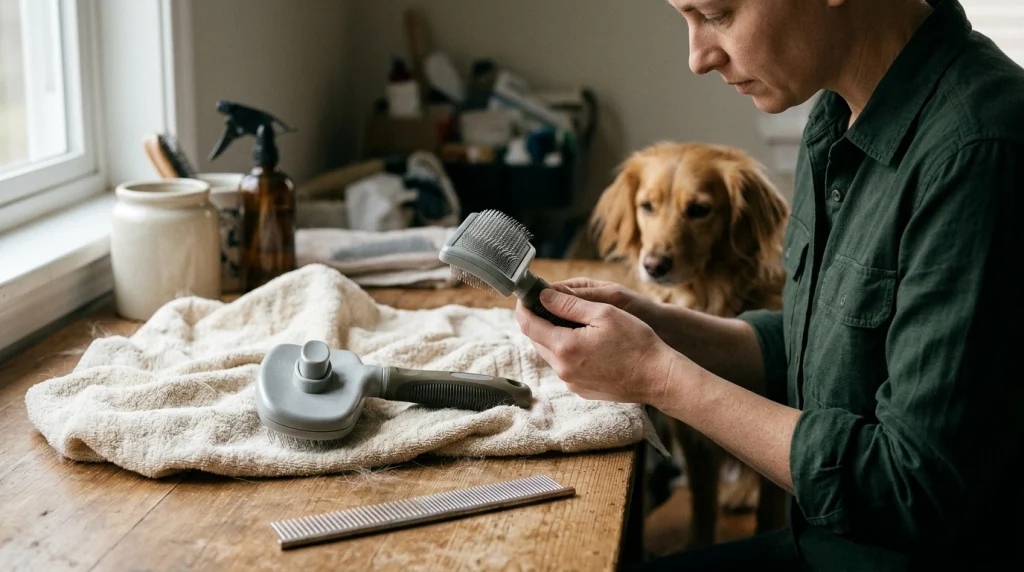
Choose a self-cleaning dog brush by starting with your dog’s coat, not the button. The best design should brush comfortably, release fur reliably, and remain easy to maintain.
- Suitable bristle length: Pins must work with your dog’s coat without digging into the skin or merely skimming the surface.
- Comfortable pin tips: Look for a design appropriate for your dog’s sensitivity and coat texture, and always use gentle pressure.
- Dependable release plate: The mechanism should move smoothly and return to its normal position without excessive force.
- Useful head size: A smaller head can make precise work easier on small dogs, while a larger head may cover more area on bigger dogs.
- Comfortable handle: A secure grip helps you control pressure during longer grooming sessions.
- Clear care instructions: Check how to remove trapped hair, wash the brush, and store it safely.
Look for a seller that provides clear product photos and explains the cleaning mechanism. Avoid assuming that every brush advertised as self-cleaning has the same construction or performance.
Before purchasing, it’s also worth reviewing the American Kennel Club’s home-grooming guidance to understand which tools fit your dog’s coat and how to introduce grooming gently.
When Should You Avoid Using a Self-Cleaning Brush?
Don’t use a self-cleaning slicker simply because it collects fur efficiently. Stop brushing if you find painful mats, inflamed skin, open sores, or areas that cause your dog to react strongly to touch.
- Tight mats: Don’t drag the brush through compacted hair or pull hard against the skin.
- Skin irritation: Avoid brushing over wounds, rashes, or painful areas until you know how to care for them safely.
- Uncomfortable reactions: Pause if your dog flinches, repeatedly tries to escape, growls, or shows increasing distress.
- Damaged brush heads: Retire a brush with bent or broken pins, sharp edges, or a faulty release plate.
For extensive matting, a professional groomer can assess the safest way to remove it. If the skin looks sore, smells unusual, or has persistent redness or hair loss, contact your veterinarian rather than trying to solve the problem with more brushing.
Are Self-Cleaning Dog Brushes Worth It?
A self-cleaning dog brush is worth considering if you already use a compatible brush regularly and dislike removing packed fur by hand. Its main benefit is a simpler cleanup routine, not a special ability to eliminate shedding.
If your dog has a long or curly coat, a suitable self-cleaning slicker may be a convenient part of your grooming kit. For a short, smooth coat, a rubber grooming brush may be all you need.
I would make the decision in this order: choose the right brush style, confirm that it feels comfortable to use, and then compare the quality of the release mechanism. That way, you’re paying for a grooming tool that works for your dog rather than a button that looks useful in a product photo.
Self-Cleaning Dog Brushes Worth Considering
If you’re ready to choose one, these are three practical options to compare by design and use case. Confirm the current model’s features, pin construction, and care instructions before buying; product versions can vary, and no single brush suits every coat.
Best for routine slicker brushing
Hertzko Self-Cleaning Slicker Brush
★★★★☆
A familiar push-button slicker design to investigate for loose hair and light tangles in suitable coats. I’d prioritize the pin feel, button action, and head size for your dog rather than choosing by the cleaning feature alone.
Best for a compact grooming kit
Safari Self-Cleaning Slicker Brush
★★★★☆
Safari grooming tools are another option to compare when looking for a slicker with a convenient cleanup system. Check the exact model’s dimensions and release design, since brush sizes and features can differ.
Best for comparing brush sizes
Pecute Self-Cleaning Slicker Brush
★★★☆☆
Pecute is another search option for owners comparing self-cleaning slicker designs. Check the current listing for pin details, dimensions, cleaning instructions, and whether the head is suitable for your dog’s coat before deciding.
The star symbols above are editorial comparison scores for this guide, not verified customer-review ratings or the results of hands-on testing. Check current specifications and independent customer feedback before choosing a model.
Frequently Asked Questions
1. Do self-cleaning dog brushes remove all loose hair?
No. They release hair that has already collected on the brush, but some loose fur can remain in the coat. Results depend on the dog’s coat, the brush design, and your technique. A suitable comb or undercoat tool may be necessary for a more thorough grooming routine.
2. Does the button retract the bristles or push the hair off?
It depends on the design. Many models move a plate around the pins to push collected hair away, while some retract the bristles or use another release mechanism. Check the product instructions to see how a specific brush operates and resets.
3. Are self-cleaning brushes safe for puppies?
They can be suitable if the brush has gentle, appropriate bristles and you use light pressure. Introduce grooming gradually, allow your puppy to investigate the brush, and begin with brief sessions. Stop if the puppy shows discomfort, and ask a veterinarian or groomer about sensitive skin or coat-specific needs.
4. Can a self-cleaning dog brush remove mats?
It may help prevent small tangles from developing when used correctly, but the release button does not make severe mats easier or safer to remove. Never force the brush through tightly knotted hair. Extensive matting can pull painfully on the skin and may require professional grooming.
5. How often should I clean a self-cleaning dog brush?
Remove collected fur after each grooming session, then inspect the head for trapped strands and debris. Wash the brush when needed and when its instructions allow it. Dry it thoroughly before storage, and check the release mechanism regularly for sticking, damage, or loose parts.
6. Are self-cleaning brushes better than regular slicker brushes?
Not automatically. A self-cleaning model makes removing collected fur easier, while a traditional slicker may offer similar grooming performance with fewer moving parts. Choose based on coat suitability, pin quality, comfort, durability, and how much you value quick cleanup.
The Takeaway
Self-cleaning dog brushes work through a simple mechanical release system that pushes collected fur off the bristles when you activate a button or slider. They can make regular grooming less messy, but they don’t replace proper technique or the right tools for your dog’s coat.
Choose a brush that feels gentle, suits your dog’s hair, and releases fur reliably. Use it with light pressure, keep the mechanism clean, and treat persistent mats or skin problems as reasons to seek appropriate grooming or veterinary help.

Thomas Cutter is a lifelong dog owner and the founder of FindOutAboutDogs.com. With over 10 years of hands-on experience owning multiple breeds, Thomas created this site to provide honest, research-based dog advice that real owners can actually trust.
