What Are the Main Types of Dog Coats? Complete Guide
Quick Answer
The main dog coat types include smooth or short, long, double, curly, wiry, silky, corded, and hairless coats. Your dog’s coat type affects shedding, matting risk, brushing frequency, and which grooming tools work best, so identifying it first makes coat care much easier. For a practical example, see how brush choice changes for a double-coated Husky.
Main dog coat types at a glance
- Smooth or short: Close-fitting hair that usually needs simple brushing to collect loose fur.
- Long: Longer hair that can tangle and mat without regular brushing and combing.
- Double: A protective outer coat sits over a softer, denser undercoat.
- Curly: Dense curls or waves can trap loose hair and require careful detangling.
- Wiry: Coarse outer hair often needs brushing and, for some dogs, professional hand-stripping.
- Silky, corded, or hairless: These specialized coats each need their own maintenance routine.
How to confirm your dog’s coat
- Part the hair with your fingers and look for a softer undercoat beneath the visible outer hairs.
- Consider length, texture, curl, density, shedding, and whether the hair keeps growing between trims.
Dog coats can look simple until you start shopping for a brush. Then terms like double coat, wiry coat, furnishings, and undercoat suddenly matter.
I’ve found that coat type explains many grooming problems owners blame on the brush. Once you know what is growing on your dog, choosing the right tool becomes much easier.


What Is a Dog Coat Type?
A dog coat type is the combination of hair length, texture, density, growth pattern, and layering that gives a dog’s coat its appearance and grooming needs.
Two dogs can both look fluffy yet need completely different grooming routines. One may have a dense shedding undercoat, while another has continuously growing curly hair.
Researchers at the National Human Genome Research Institute found that variants involving three genes explain much of the variation in canine coat length, curl, and furnishings.
- FGF5: Associated with short versus long coat length.
- KRT71: Influences straight, wavy, and curly hair.
- RSPO2: Influences wiry coats and facial furnishings such as beards and eyebrows.
That genetics lesson matters because coat appearance is more than decoration. It determines how hair grows, sheds, tangles, and responds to grooming.
What Are the Main Types of Dog Coats?
 Save
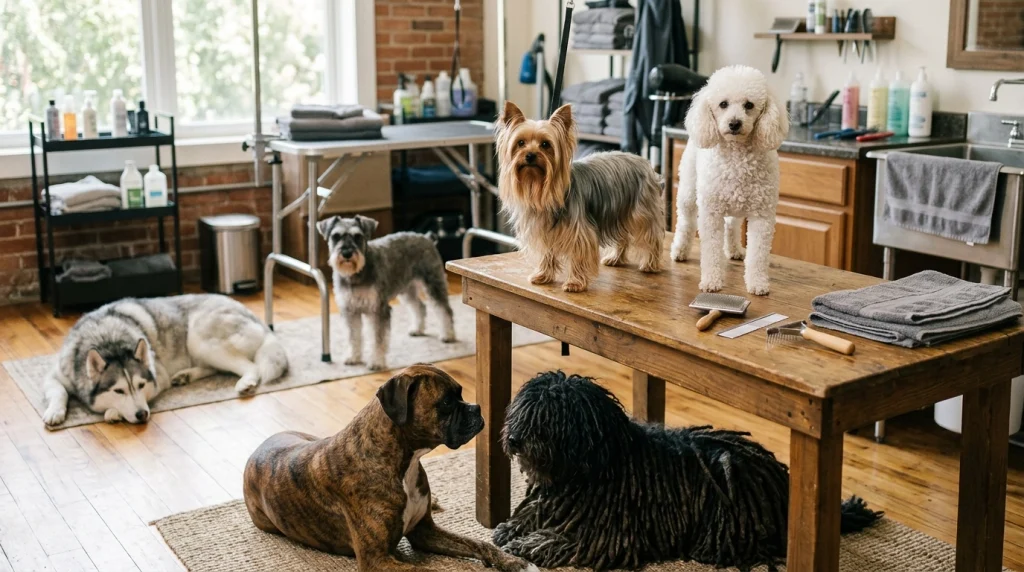
SaveMost pet owners can place their dog into one or more practical coat categories. The most useful groups are smooth, long, double, curly, wiry, silky, corded, and hairless.
These groups sometimes overlap. A dog can have a long double coat, for example, or a short double coat.
| Coat Type | Typical Feel | Example Breeds | Useful Grooming Tool |
|---|---|---|---|
| Smooth/short | Short and close to skin | Boxer, Pointer | Rubber curry or grooming glove |
| Long | Long, flowing, or feathered | Afghan Hound, Yorkshire Terrier | Pin brush and metal comb |
| Double | Coarse topcoat over soft undercoat | Husky, Labrador, Border Collie | Undercoat rake and slicker |
| Curly | Dense curls or waves | Poodle, Bichon Frise | Slicker and comb |
| Wiry | Coarse and bristly | Schnauzer, Wire Fox Terrier | Pin brush, comb, stripping tools |
| Silky | Fine, soft, flowing | Maltese, Yorkshire Terrier | Pin brush and fine comb |
| Corded | Rope-like cords | Puli, Komondor | Mostly hand separation |
| Hairless | Little or no body hair | Xoloitzcuintli, Chinese Crested | Skin-care supplies rather than brushes |
What Is a Smooth or Short Dog Coat?
A smooth coat has short hairs that lie close to the body. It may look low-maintenance, but short-haired dogs can still shed plenty.
Boxers and many Pointers are familiar examples. A flexible grooming glove or short-bristled brush usually works better than an aggressive rake.
- Main concern: Loose surface hair and skin debris.
- Matting risk: Usually low.
- Useful tool: Rubber curry brush, grooming glove, or short bristle brush.
- Common mistake: Assuming a short coat never needs brushing.
VCA Animal Hospitals’ coat-care guidance also recommends flexible grooming gloves or short-bristled brushes for smooth-coated dogs.
What Is a Double Coat on a Dog?
 Save
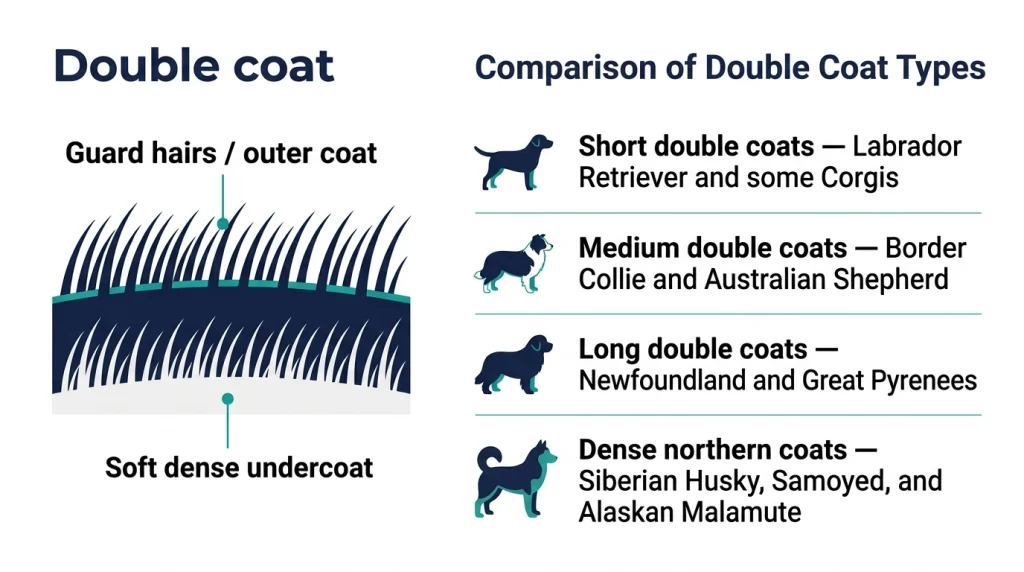
SaveA double coat has two functional layers: a longer outer coat and a softer undercoat underneath. The layers behave differently during grooming and shedding.
The outer hairs are often called guard hairs. The softer undercoat can become especially noticeable when seasonal shedding increases.
- Short double coats: Labrador Retriever and some Corgis.
- Medium double coats: Border Collie and Australian Shepherd.
- Long double coats: Newfoundland and Great Pyrenees.
- Dense northern coats: Siberian Husky, Samoyed, and Alaskan Malamute.
The American Kennel Club’s double-coat guide describes the protective topcoat and softer insulating undercoat as separate layers with different functions.
My biggest grooming lesson with dense coats is simple: don’t judge your progress by the visible surface. Part the coat and check what is happening underneath.
During heavy shedding, you can also use this guide to managing Husky shedding as an example of working through a dense double coat safely.
What Is a Long or Silky Dog Coat?
Long-coated dogs grow hair that can feather, flow, or hang around the body. Silky coats are usually finer and smoother, which can make tangles surprisingly easy to miss.
Common trouble areas include behind the ears, under the front legs, around collars, and behind the back legs.
- Best first tool: Pin brush for gentle separation.
- Best finishing tool: Stainless-steel comb to find hidden tangles.
- Main risk: Mats forming close to the skin.
- Good habit: Work in small sections instead of brushing only the surface.
I like using a comb as the final test. If the comb stops, I know the coat still needs attention even if the top looks perfect.
How Is a Curly Coat Different From a Straight Coat?
Curly coats bend or spiral rather than lying straight. Loose hairs can remain trapped among neighboring curls instead of falling directly onto your floor.
Poodles and Bichon Frises are classic examples. Their coats can mat quickly when brushing only skims across the top.
- Use a slicker: Work through small sections with controlled pressure.
- Follow with a comb: Check that you reached through the coat.
- Watch friction areas: Ears, legs, collar areas, and armpits tangle easily.
- Plan regular trims: Continuously growing coats often need clipping as well as brushing.
As of 2026, coat genetics research still provides a useful explanation for these differences. The KRT71 gene is strongly associated with curl variation in many dogs.
What Is a Wiry Dog Coat?
A wiry coat has coarse, stiff outer hairs that create a rough texture. Terriers and Schnauzers are common examples.
Some wire coats are maintained through hand-stripping, which removes dead outer hairs rather than simply shortening them with clippers.
- Routine care: Brush and comb out loose hair and tangles.
- Specialized care: Some coats benefit from professional hand-stripping.
- Key feature: Facial furnishings such as eyebrows and beards are common.
- Owner caution: Ask an experienced groomer before changing a traditional wire-coat routine.
The AKC’s hand-stripping guidance explains why this specialized technique is commonly associated with wire-haired breeds.
What Is a Corded Dog Coat?
A corded coat forms rope-like strands as compatible hair textures naturally intertwine. Pulis and Komondors are the examples most people recognize.
These coats don’t follow an ordinary brush-and-comb routine. Owners usually separate forming cords by hand and pay close attention to cleanliness and drying.
- Brushing: Usually limited once mature cords are developing.
- Main task: Keep individual cords separated appropriately.
- Bathing challenge: Dense cords can hold substantial moisture.
- Drying: Thorough drying is especially important after bathing.
Do Hairless Dogs Have a Coat?
Hairless breeds have little or no hair across much of the body, although some have hair on the head, feet, or tail. Their care shifts from brushing toward skin maintenance.
Examples include hairless varieties of the Xoloitzcuintli and Chinese Crested. Their exposed skin still needs regular inspection and appropriate care.
- Brush requirement: Minimal on hairless body areas.
- Main focus: Clean, comfortable skin.
- Outdoor care: Consider sun and weather exposure.
- Veterinary help: Persistent bumps, irritation, or skin changes deserve professional advice.
Single Coat vs Double Coat: What Is the Difference?
A single-coated dog lacks the obvious dense undercoat found beneath a typical double coat. A double-coated dog has a distinct underlayer plus protective outer hairs.
This difference matters most when choosing tools and dealing with seasonal shedding.
| Feature | Single Coat | Double Coat |
|---|---|---|
| Layers | One main visible coat layer | Outer coat plus softer undercoat |
| Seasonal shedding | Varies by breed | Can become heavy when undercoat loosens |
| Tool priority | Match tool to length and texture | Reach loose undercoat without rough treatment |
How Can I Tell What Coat Type My Dog Has?
 Save
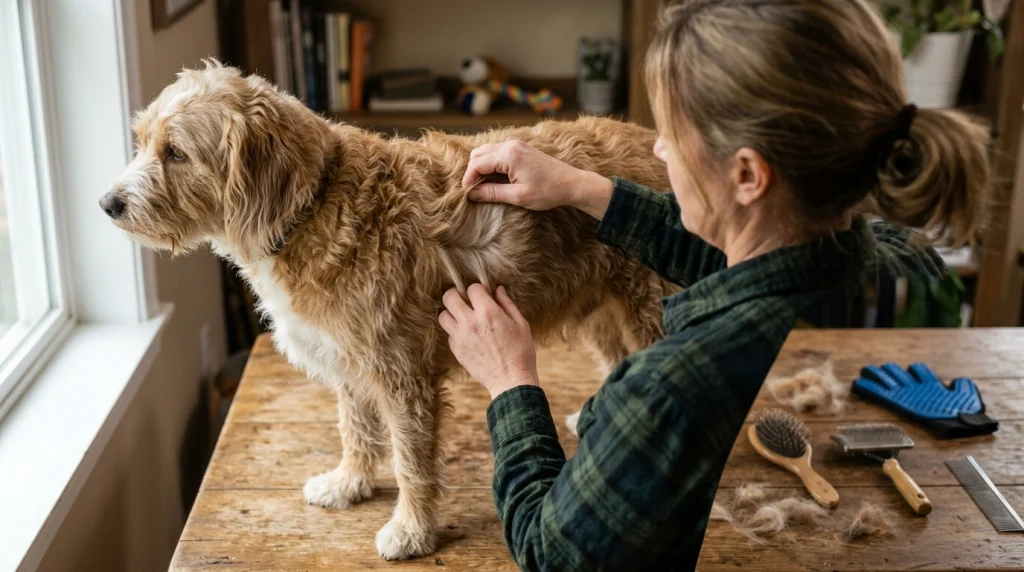
SaveStart with your fingers, not the product aisle. Look closely at the hair before deciding which brush you need.
- Check the length. Decide whether the hair is short, medium, or long.
- Feel the texture. Look for smooth, silky, coarse, wiry, wavy, or curly hair.
- Part the coat. Search for a soft, dense undercoat beneath longer hairs.
- Watch shedding. Notice whether loose fur appears year-round or increases dramatically at certain times.
- Check growth. Some coats keep lengthening and need regular clipping.
- Ask when uncertain. A groomer, breeder, or veterinarian can help identify unusual or mixed coat types.
Mixed-breed dogs can combine characteristics from several coat types. Treat the coat you can see and feel rather than relying only on breed appearance.
Which Brush Should You Use for Each Dog Coat Type?
The best dog brush depends on what you need to accomplish. A tool designed for loose undercoat may be unnecessary on a smooth Boxer and inadequate as the only tool for a curly Poodle.
- Smooth coat: Rubber curry brush, grooming glove, or short bristle brush.
- Long coat: Pin brush plus metal comb.
- Double coat: Appropriate undercoat rake plus slicker or comb.
- Curly coat: Slicker brush plus stainless-steel comb.
- Wiry coat: Pin brush or slicker, comb, and professional stripping tools when appropriate.
- Silky coat: Gentle pin brush and fine-to-medium comb.
One rule has saved me more trouble than any brush recommendation: never force a tool through resistance. Stop and find out whether you’re hitting a tangle, packed undercoat, or tender skin.
Dog Grooming Tools I Would Actually Consider
If you’re ready to build a basic grooming kit, I’d choose tools that solve different coat problems rather than buying several versions of the same brush.
🏆 Best for Dense Double Coats
Safari Double Row Undercoat Rake
★★★★½
The double-row rake format is made for reaching loose undercoat beneath longer outer hairs. I like this style during seasonal shedding because it targets a job that an ordinary surface brush can miss.
✨ Best Premium Slicker
Chris Christensen Big G Slicker Brush
★★★★½
This long-pin slicker is designed for fuller, denser coats and detailed brushing. I would use it for separating hair, collecting loosened fur, and working through sections rather than pressing hard against the skin.
🐾 Best for Smooth Coats
KONG ZoomGroom Dog Brush
★★★★☆
The flexible rubber design suits short, smooth coats where deep metal teeth are unnecessary. I like rubber grooming tools for lifting loose surface hair while keeping the session simple and comfortable.
Frequently Asked Questions
What is the most common dog coat type?
There isn’t one coat type that describes every common breed, because dogs vary in length, texture, density, and layering. Double coats appear in many retrievers, herding dogs, and northern breeds, while smooth, curly, silky, and continuously growing coats are also widespread.
How do I know if my dog has a double coat?
Part the visible outer hair and look close to the skin. A double-coated dog typically has softer, shorter, denser hair beneath longer guard hairs, and the undercoat may loosen heavily during seasonal shedding periods.
Which dog coat type needs the most brushing?
Long, curly, silky, and dense double coats generally need the most consistent attention, although the exact schedule varies by dog. Curly and long coats can mat, while double coats may release large amounts of loose undercoat during seasonal shedding.
Do short-haired dogs need brushing?
Yes. Short-haired dogs can still shed and collect loose hair, dirt, and dead skin. A rubber curry brush, grooming glove, or short-bristled brush usually provides enough grooming without using tools designed for deep undercoat removal.
Can a dog have more than one coat type?
Yes. Coat descriptions often overlap because one term may describe length while another describes layering or texture. A Border Collie, for example, can have a medium or longer coat while also being double-coated.
Choose the Brush After You Identify the Coat
The main types of dog coats are smooth, long, double, curly, wiry, silky, corded, and hairless. Those categories give you a practical starting point, even when a dog’s coat combines several traits.
Part the hair, feel the texture, check for undercoat, and notice how the coat sheds. Once you understand those basics, you’ll have a much easier time choosing a brush that works with your dog’s coat instead of fighting against it.
Thomas Cutter is a lifelong dog owner and the founder of FindOutAboutDogs.com. With over 10 years of hands-on experience owning multiple breeds, Thomas created this site to provide honest, research-based dog advice that real owners can actually trust.
