How to Identify Your Dog’s Coat Type: Easy Guide
Quick Answer
To identify your dog’s coat type, look at four things: hair length, texture, whether an undercoat is present, and how the coat sheds or grows. Part the hair down to the skin, feel for a softer second layer, and compare the coat with common smooth, double, long, curly, wire, or silky patterns. If you discover a dense double coat, this guide to the best brushes for a Husky shows why tool choice changes with coat structure.
Five quick checks
- Check the length: Decide whether the coat is short, medium, long, or continuously growing.
- Part the hair: Look beneath the visible coat for soft, dense undercoat.
- Feel the texture: Notice whether the hair feels smooth, silky, wiry, woolly, or curly.
- Watch shedding: Heavy seasonal shedding often points toward a double coat.
- Check growth: Hair that keeps lengthening usually needs different maintenance from fur that reaches a set length.
When you are unsure
- Ask a professional groomer to examine the coat before buying specialized de-shedding or stripping tools.
I’ve found that choosing a dog brush becomes much easier once you stop looking at breed names and start looking at the actual coat in front of you.
That matters even more with mixed breeds. Two dogs of similar size can have completely different undercoats, shedding patterns, and grooming needs.


What Is a Dog Coat Type?
A dog coat type describes the structure, texture, length, growth pattern, and layering of the hair covering a dog’s skin.
It is more useful for grooming than simply calling a dog “short-haired” or “fluffy.”
The American Kennel Club explains that canine coats are made from keratin, but their growth patterns can differ. Some coats grow to a predetermined length, while others continue growing much longer.
- Length: Short, medium, long, or continuously growing.
- Layers: Single coat or double coat.
- Texture: Smooth, silky, curly, wiry, dense, or woolly.
- Shedding pattern: Light, steady, or heavy seasonal shedding.
- Growth pattern: Coat that stops at a certain length versus hair that keeps growing.
You can read more about the difference between hair, fur, outer coat, and undercoat in the American Kennel Club’s coat guide.
How Can You Tell If Your Dog Has a Single or Double Coat?
Part your dog’s hair with your fingers until you can see the skin. A double coat usually reveals a softer, denser layer beneath longer or coarser outer hairs.
A single coat generally looks more uniform from the surface down toward the skin.
What does a double coat feel like?
A double coat has two distinct layers. The outer hairs are usually stronger, while the undercoat feels softer and finer.
- Topcoat: Longer guard hairs form the visible surface.
- Undercoat: Soft, dense hairs sit closer to the skin.
- Seasonal change: Large amounts of undercoat may loosen during shedding periods.
- Examples: Huskies, German Shepherds, Golden Retrievers, Labradors, and many Collies.
I usually check the shoulders, sides, and rear first. Those areas often make the difference between the coarse outer coat and softer undercoat easy to feel.
If your dog has a dense double coat, our guide to managing Siberian Husky shedding shows how that second layer changes a grooming routine.
What does a single coat feel like?
A single-coated dog lacks the thick, distinct insulating undercoat found in classic double-coated breeds. The hair may still be short, long, straight, curly, or silky.
That means “single coat” does not automatically mean low maintenance.
- Poodle-type coats: Dense curls can mat despite low loose-hair shedding.
- Silky coats: Long fine hair can tangle easily.
- Smooth coats: Short hair may shed but usually needs simpler brushing.
Which Dog Coat Type Does Your Dog Have?
 Save
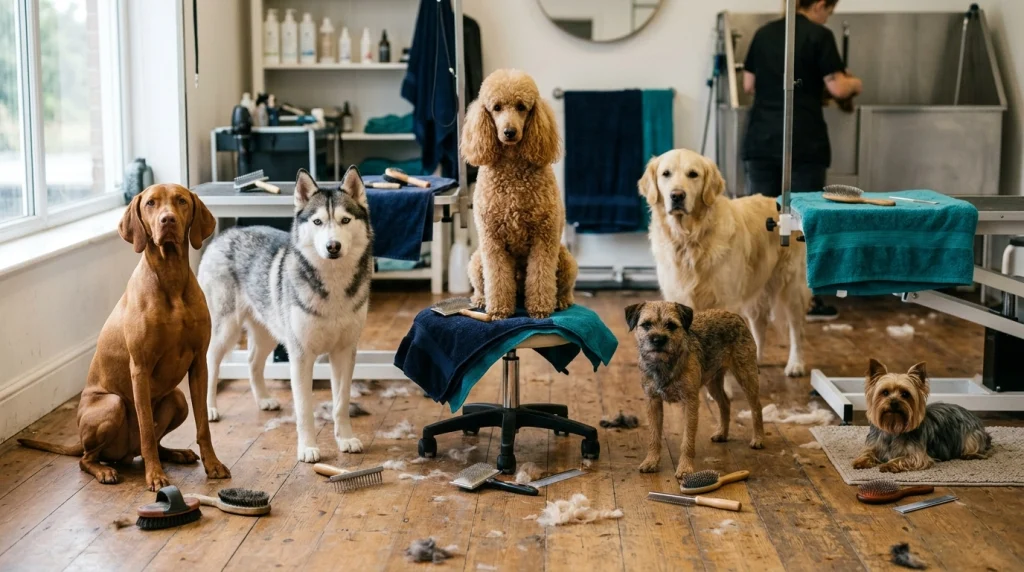
SaveMost pet dogs fit reasonably well into one of the coat groups below, although mixed breeds often combine traits.
Use the table as a starting point rather than forcing every dog into one perfect label.
| Coat Type | What It Feels Like | Common Examples | Typical Brush Choice | Main Grooming Concern |
|---|---|---|---|---|
| Smooth/short | Close, sleek hair | Boxer, Beagle, Doberman | Rubber curry or bristle brush | Loose surface hair |
| Double | Coarser outer layer plus soft undercoat | Husky, German Shepherd, Labrador | Undercoat rake plus slicker | Seasonal shedding and packed undercoat |
| Long | Long straight or slightly wavy hair | Afghan Hound, long-coated breeds | Pin brush and metal comb | Tangles and mats |
| Curly | Dense curls or waves | Poodle, Bichon Frise | Slicker plus metal comb | Hidden mats close to skin |
| Wire | Coarse, crisp, bristly outer hair | Wirehaired Dachshund, Schnauzer types | Pin brush, comb, specialist tools | Preserving wiry texture |
| Silky | Fine, smooth, flowing hair | Yorkshire Terrier, Maltese | Pin brush and comb | Breakage and tangling |
How Do You Identify a Smooth or Short Coat?
A smooth coat lies close to the body and usually has little visible feathering. Run your hand backward over it and you will feel short hairs resisting your palm.
Boxers, Beagles, and many short-haired dogs fit this general pattern.
- Hair length: Short and close to the body.
- Tangles: Usually uncommon.
- Loose hair: Can still be surprisingly noticeable.
- Useful tools: Rubber curry brush, grooming mitt, or bristle brush.
The ASPCA recommends rubber and bristle brushes for many smooth, short coats. Regular brushing also gives you a chance to inspect the skin.
For broader grooming guidance, see the ASPCA dog grooming tips.
How Do You Identify a Curly or Woolly Coat?
A curly coat forms waves, curls, or tight spirals instead of lying flat. It may also keep growing and hold shed hairs inside the surrounding coat.
That is why a dog can appear to shed very little while still needing frequent brushing.
- Look for curls: Hair bends or coils across much of the body.
- Test for tangles: Separate curls with your fingers and check near the skin.
- Check friction areas: Ears, legs, collar areas, and armpits can mat quickly.
- Use a comb: A metal comb helps confirm whether brushed sections are tangle-free.
One mistake I avoid is judging a curly coat only from the surface. A fluffy top can hide tight tangles underneath.
How Can You Recognize a Wire Coat?
A wire coat has a coarse, firm outer texture that can feel bristly between your fingers. It is common in several terrier and wirehaired breeds.
These coats can require specialized maintenance if you want to preserve their natural texture.
- Outer texture: Crisp and rough rather than soft or silky.
- Facial furnishings: Beards and eyebrows are common in some wire-coated breeds.
- Undercoat: Some wire coats also have a softer layer underneath.
- Specialist grooming: Hand stripping may be used for certain coats and purposes.
I would not start pulling or stripping a wiry coat simply because an online breed description recommends it. A skilled groomer can tell you whether that technique suits your individual dog.
How Can You Tell If Your Dog Has a Long or Silky Coat?
Long and silky coats are easiest to recognize by length, movement, and fine texture. The hair may feather around the ears, chest, legs, belly, or tail.
These coats often need more detangling than de-shedding.
- Long coat: Hair extends well away from the body and may be straight or wavy.
- Silky coat: Fine hair feels smooth and may resemble human hair.
- Feathering: Longer sections appear behind legs, ears, chest, or tail.
- Common problem: Friction creates knots before they become obvious from above.
A pin brush can separate long hair without the dense field of fine wires found on a slicker. I still finish with a comb when I need to check for hidden snags.
Does Shedding Help Identify Your Dog’s Coat Type?
Yes, shedding provides clues, especially when identifying a double coat. Heavy releases of soft fluff often indicate an undercoat changing seasonally.
However, shedding alone cannot identify every coat correctly.
- Heavy soft fluff: Often associated with dense undercoat.
- Short individual hairs: Common with many smooth-coated dogs.
- Low loose-hair shedding: Common in continuously growing curly or silky coats.
- Sudden bald patches: Not a normal coat-type feature and should be checked.
German Shepherds are a useful double-coat example because loose undercoat and visible guard hairs can appear together. Our guide to managing German Shepherd shedding explains that pattern in detail.
Which Brush Should You Use for Each Coat Type?
 Save
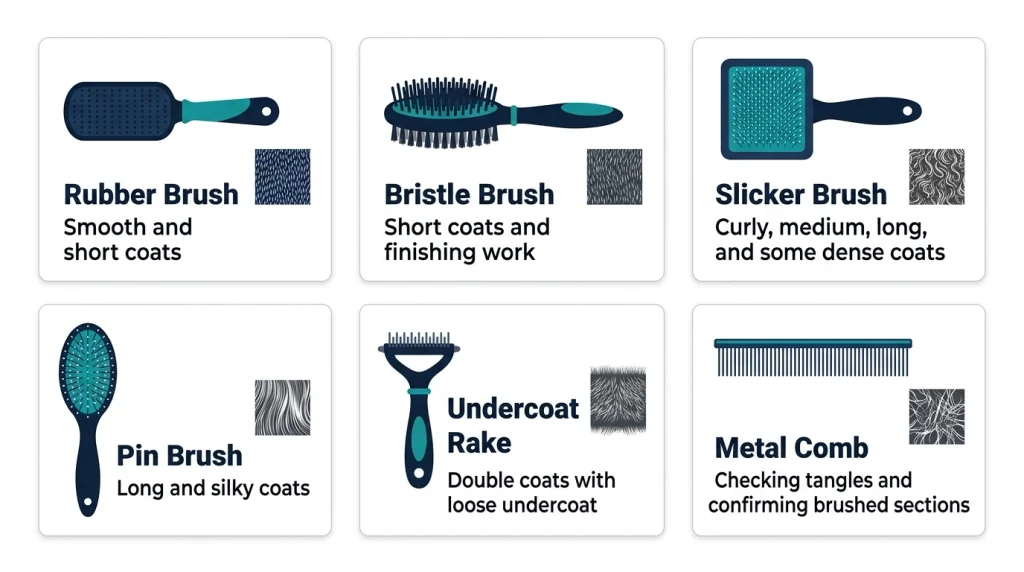
SaveThe best dog brush depends more on coat structure than marketing labels. A brush that works well on a Boxer may barely reach the undercoat of a Husky.
The AKC also recommends choosing grooming tools according to breed, size, and coat type.
- Rubber brush: Smooth and short coats.
- Bristle brush: Short coats and finishing work.
- Slicker brush: Curly, medium, long, and some dense coats.
- Pin brush: Long and silky coats.
- Undercoat rake: Double coats with loose undercoat.
- Metal comb: Checking tangles and confirming a section is brushed through.
The AKC dog brush guide gives a useful breakdown of slickers, bristle brushes, pin brushes, rakes, and rubber grooming tools.
What Mistakes Make Coat Identification Harder?
The most common mistake is assuming breed alone tells you everything. Individual coat density, length, trimming history, age, and mixed ancestry can change what you see.
- Looking only at the surface: A double coat may hide beneath sleek outer hair.
- Checking one body area: Coat length and density can vary across the same dog.
- Confusing mats with thickness: Compacted hair may feel like dense undercoat.
- Using shedding as the only clue: Both short and double-coated dogs can shed heavily.
- Buying tools too early: Identify the coat before choosing aggressive de-shedding equipment.
I like to inspect at least three areas before deciding: the shoulder, side, and rear thigh. That small check reveals far more than looking at the back alone.
When Should a Groomer or Veterinarian Check the Coat?
 Save
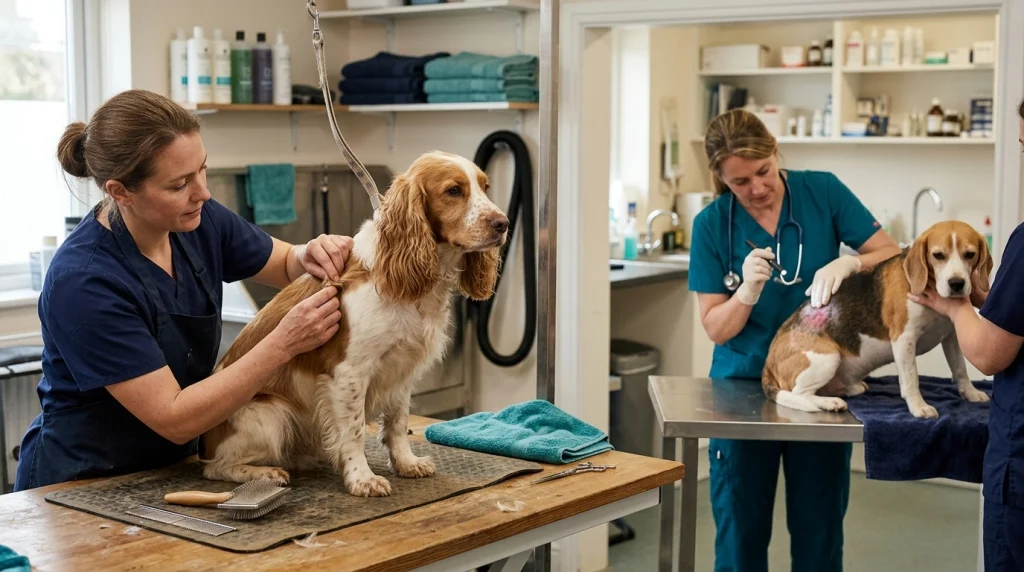
SaveA groomer can help when you cannot distinguish between undercoat, matting, or coat texture. A veterinarian is the better choice when the problem looks medical rather than cosmetic.
- Ask a groomer: When you need help identifying tools, matting, trimming, or coat-specific technique.
- Ask a veterinarian: When you notice bald patches, sores, redness, odor, persistent scratching, or sudden coat changes.
- Stop brushing: If a tool repeatedly catches or causes visible discomfort.
- Avoid blind cutting: Tight mats can sit close to the skin.
The AKC’s home grooming guidance also recommends checking the skin while grooming and choosing tools suited to the individual coat.
Dog Brushes I Would Consider After Identifying the Coat
If you know the basic coat type, you can choose tools for a real job instead of buying a generic “all coats” brush. Here are three different starting points I would consider.
🏆 Best for Curly & Longer Coats
Hertzko Self-Cleaning Slicker Brush
★★★★☆
This style of slicker uses fine bent wires to separate hair and collect loose coat. I would consider it for curly, medium, or longer coats where tangles are the main problem rather than deep undercoat removal.
🐾 Best for Smooth Coats
KONG ZoomGroom Dog Brush
★★★★½
Its flexible rubber fingers suit short, smooth coats and can lift loose surface hair while massaging the skin. I like this type of tool when metal pins would add complexity without improving the job.
❄️ Best for Double Coats
Safari Double Row Undercoat Rake
★★★★☆
The spaced metal pins are designed to reach loose undercoat rather than only brushing the surface. I would consider it after confirming that a dog truly has a dense undercoat and that the pin length suits the coat.
Frequently Asked Questions About Dog Coat Types
How do I know if my dog has an undercoat?
Part the coat until you can see close to the skin. If you find a second layer of softer, denser hair beneath the longer outer hairs, your dog probably has an undercoat. Check several body areas because density can vary around the shoulders, sides, neck, and rear.
Can a short-haired dog have a double coat?
Yes. A double coat describes layers, not simply length. Labradors are a familiar example of dogs with relatively short outer hair and a dense undercoat. Part the hair and feel near the skin rather than judging coat type from length alone.
What dog coat type needs the most brushing?
There is no single answer because the grooming problem differs by coat. Long and curly coats may need frequent tangle prevention, while dense double coats need extra attention during heavy shedding. The individual dog’s lifestyle and coat condition also affect the schedule.
How can I tell whether my dog has hair or fur?
Hair and fur are both made from keratin, but owners often use the terms to describe different growth patterns. Coats called “hair” may keep growing much longer, while many fur-type coats reach a genetically determined length and shed as part of their normal cycle.
Does coat type change as a puppy grows?
Yes. Puppy coat can differ noticeably from the adult coat that replaces it. Texture, density, curl, and undercoat development may become clearer with age, so reassess your dog’s grooming tools as the mature coat develops.
Start by Looking Beneath the Surface
If you want to identify your dog’s coat type, do not start with the brush aisle. Start by using your hands.
Check the length, part the hair, feel for undercoat, notice the texture, and watch how the coat sheds. Those five observations usually tell you more than a generic breed label.
Once you know what the coat is doing, choose grooming tools for that specific job. Your dog will be more comfortable, and you will spend less time fighting the wrong brush.
Thomas Cutter is a lifelong dog owner and the founder of FindOutAboutDogs.com. With over 10 years of hands-on experience owning multiple breeds, Thomas created this site to provide honest, research-based dog advice that real owners can actually trust.
