How Fast Should You Progress Through Grooming Stand Training?
Quick Answer
Train your dog to stand for grooming by first teaching a simple stand cue, then rewarding one or two seconds of stillness. Gradually add body handling, the dog brush, and longer grooming periods while your dog stays relaxed. If brushing already causes worry, first desensitize your dog to brushing before asking for longer standing sessions.
Quick training steps
- Choose good footing: Use a quiet area and a non-slip mat where your dog feels secure.
- Teach “stand”: Lure your dog from sitting into a standing position and reward immediately.
- Add duration: Reward one or two seconds of standing before slowly asking for more time.
- Practice handling: Briefly touch the shoulders, sides, legs, paws, tail, and other grooming areas.
- Introduce the brush: Start with one gentle stroke, reward, and stop before your dog becomes restless.
- Build gradually: Increase grooming time only while your dog remains comfortable and cooperative.
Most important rule
- If your dog freezes, repeatedly pulls away, growls, or stops taking treats, make the next session easier rather than forcing the position.
A dog that constantly sits, spins, backs away, or lies down can turn a five-minute brushing job into a wrestling match. The solution isn’t holding your dog harder; it’s teaching standing as a separate grooming skill.
As of 2026, I prefer a cooperative approach that builds the position before adding the difficult parts of grooming. That makes the lesson clearer for both dog and owner.


What Does It Mean to Train a Dog to Stand for Grooming?
 Save
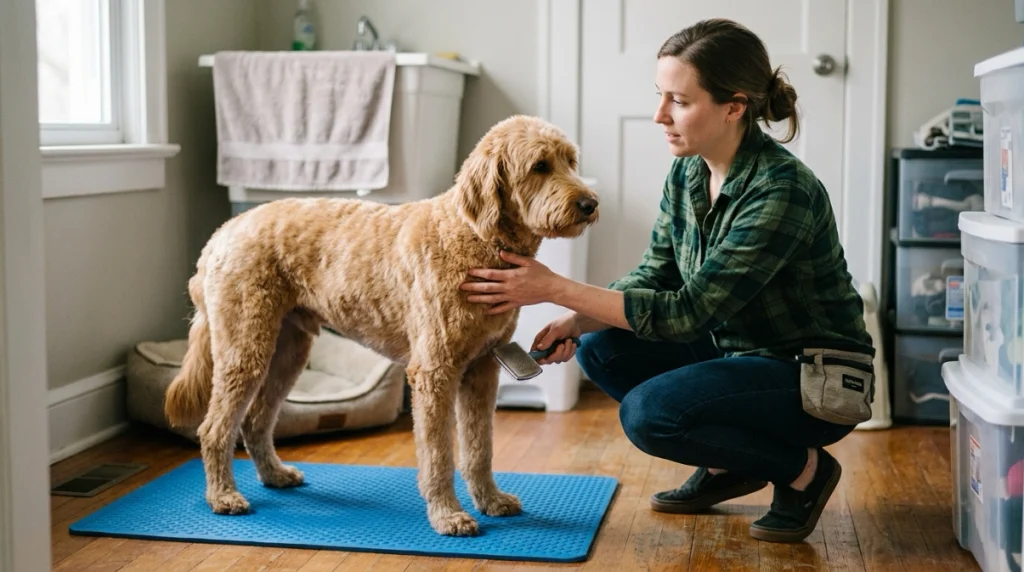
SaveTraining a dog to stand for grooming means teaching the dog to remain comfortably on all four feet while you brush, inspect, dry, trim, or handle the body. The position should become predictable and rewarding rather than something created through physical restraint.
Grooming stand training combines three skills: standing on cue, remaining in position, and accepting gentle handling. Each skill becomes easier when you teach it separately first.
- Position: Your dog understands what “stand” means.
- Duration: Your dog can hold that position for gradually increasing periods.
- Handling: Your dog accepts touch on grooming-sensitive areas.
- Tool tolerance: Brushes, combs, towels, and other tools don’t immediately trigger avoidance.
- Release: Your dog understands when the exercise has ended.
The American Kennel Club also teaches standing as a useful everyday cue for brushing, bathing, veterinary examinations, and other handling. You can review its stand-cue training guidance for the underlying behavior.
How Do You Train a Dog to Stand for Grooming Step by Step?
Start without a brush in your hand. Your first goal is simply to make standing in the grooming area easy and worthwhile.
Step 1: Choose a Stable Grooming Station
Use a quiet location with enough room for your dog to turn around safely. Put a rubber-backed bath mat, yoga mat, or another non-slip surface under the dog’s feet.
Slippery footing can make handling harder because the dog may keep repositioning to regain balance. Professional grooming safety standards also emphasize secure, non-slip surfaces.
Step 2: Teach the Stand Position
Ask your dog to sit, then place a small treat close to the nose. Slowly move the treat straight forward until your dog rises onto all four feet.
- Start with your dog sitting.
- Place a treat near the nose.
- Move your hand forward rather than upward.
- Mark the moment all four feet are standing with “yes” or a clicker.
- Give the treat while your dog is still standing.
- Release your dog after one or two seconds.
Repeat several easy repetitions instead of holding the dog in place. Once the movement becomes predictable, say “stand” just before giving the hand signal.
Step 3: Add a Release Cue
A release cue tells your dog when standing is finished. I like simple words such as “okay,” “free,” or “all done.”
Without a release cue, the dog has to guess how long the behavior lasts. Clear beginnings and endings make grooming practice easier to understand.
Step 4: Increase Standing Time Slowly
Once your dog understands the position, begin rewarding slightly longer periods of standing. Think in seconds, not minutes.
- Reward after 1 second.
- Try 2 seconds.
- Return to 1 second occasionally.
- Build toward 3–5 seconds.
- Add longer periods only when your dog remains relaxed.
Don’t make every repetition harder than the last. Mixing easy repetitions into training keeps success frequent.
Step 5: Add Gentle Body Handling
Standing still without being touched is different from standing while someone lifts a leg or handles the tail. Add touch as a new training difficulty.
- Touch the shoulder briefly and reward.
- Stroke along the side and reward.
- Touch one front leg and reward.
- Briefly touch the rear leg and reward.
- Touch the chest, tail area, ears, and paws separately.
VCA’s handling guidance recommends breaking care procedures into small steps and pairing accepted handling with rewards. Their handling and desensitization guidance also recommends backing up when a pet becomes concerned.
How Fast Should You Progress Through Grooming Stand Training?
 Save
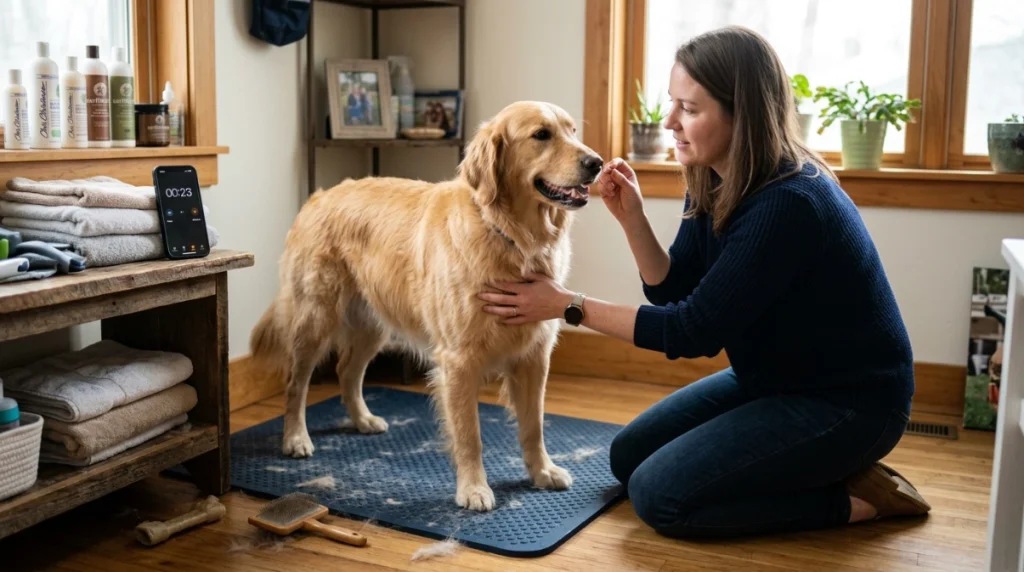
SaveProgress should depend on your dog’s body language rather than a fixed calendar. A confident adult may move quickly, while a dog with unpleasant grooming history may need many short sessions.
| Training Stage | Starting Goal | Reward | Move Forward When |
|---|---|---|---|
| Stand cue | 1–2 seconds standing | Every successful stand | Dog stands readily |
| Duration | 3–5 seconds | While still standing | Feet remain quiet |
| Body handling | One brief touch | After each touch | Dog stays loose and engaged |
| Brush contact | One light stroke | Immediately afterward | Brush predicts calm rewards |
| Real grooming | Small body section | Intermittently | Dog remains comfortable |
I use a simple rule: change only one major difficulty at a time. If you increase duration, don’t also introduce a difficult body area and a new grooming tool during that same repetition.
How Do You Introduce a Dog Brush While Your Dog Is Standing?
Introduce the dog brush only after your dog can stand comfortably for short periods. Start with an easy body area such as the shoulder or upper back.
- Ask for “stand.”
- Show the brush briefly.
- Reward calm behavior.
- Touch the coat with the back of the brush.
- Reward again.
- Make one gentle brushing stroke.
- Reward and release.
Don’t begin by dragging a brush through a stubborn knot. Check first for tangles using this guide to finding hidden mats in a dog’s coat.
Coat type also determines which grooming tool feels appropriate. My breed-based dog brushing guide explains how short, long, curly, wire, and double coats need different tools and routines.
What Should You Do If Your Dog Keeps Sitting Down?
If your dog repeatedly sits, the exercise may be too long or unclear. Shorten the standing period and reward earlier.
- Dog sits immediately: Return to teaching the basic stand cue.
- Dog sits after several seconds: Reward before that point and build duration more slowly.
- Dog sits when touched: Practice handling separately.
- Dog sits when the brush appears: Rebuild the brush association before grooming.
- Dog moves on the table: Check the surface for slipping or instability.
A dog lying down isn’t being disobedient by definition. The dog may simply have learned that lying down has been rewarded more often than standing.
Should You Use a Grooming Table?
You don’t need a grooming table to teach this skill. Many dogs can learn on a non-slip floor mat first and move to a table later.
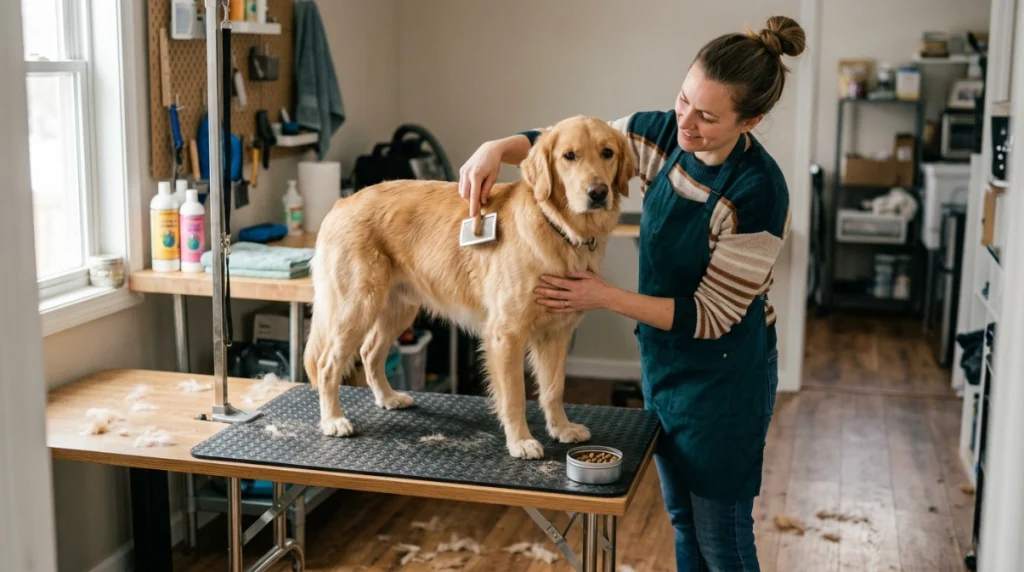
If you use a grooming table, it must be stable and appropriately sized. Never leave a dog unattended on an elevated grooming surface or restrained in grooming equipment.
AKC grooming education standards emphasize humane handling, safe equipment, stable tables, and direct supervision. Their professional grooming safety standards provide useful safety context.
How Can You Tell When Your Dog Needs a Break?
Stop or make the exercise easier when your dog’s behavior changes from relaxed participation to avoidance. Don’t wait for growling or snapping before listening.
- Repeatedly turning the head away
- Trying to leave the grooming station
- Freezing or becoming unusually stiff
- Repeated paw lifting unrelated to the task
- Suddenly refusing normally valuable treats
- Tucking the tail or lowering the body
- Whining, growling, air snapping, or biting attempts
Cooperative-care training aims to make dogs active participants instead of forcing them through routine care. Fear Free also discusses this approach in its training and grooming resources.
If resistance begins suddenly in a dog that previously accepted grooming, check for a physical cause. Sore skin, painful joints, wounds, tight mats, or another problem can make normal handling uncomfortable.
What Grooming Stand Training Mistakes Should You Avoid?
 Save
SaveThe biggest mistake is trying to complete the grooming job before the dog understands the training. Successful practice may involve only a few brush strokes at first.
- Holding the dog in place: Physical restraint doesn’t teach a voluntary stand cue.
- Training too long: Several short successful repetitions usually beat one exhausting session.
- Brushing through painful mats: Pulling can quickly create brush avoidance.
- Using the wrong brush: Match the grooming tool to coat type and condition.
- Ignoring footing: Dogs struggle to stand calmly when their feet slide.
- Skipping the release cue: Your dog needs to understand when standing is finished.
- Increasing everything together: Add duration, handling, or tool difficulty one piece at a time.
Your brushing workload may also change throughout the year. The guide to seasonal dog brushing frequency can help you adjust sessions during heavier shedding periods.
Outdoor dogs may bring extra debris into grooming sessions as well. If that happens, use gentle removal methods such as those in this guide to removing burrs from dog fur safely.
A Simple Grooming Stand Practice Routine for 2026
You don’t need a complicated training schedule. A repeatable routine makes it easier for your dog to predict what happens next.
- Place the non-slip mat in your normal grooming area.
- Have several small, high-value treats ready.
- Ask your dog to step onto the mat.
- Cue “stand.”
- Reward the standing position.
- Add one easy touch or brush stroke.
- Reward again while your dog remains standing.
- Say the release cue.
- Repeat only while your dog remains interested.
The goal isn’t perfect statue-like stillness. The useful goal is a dog that understands the position and feels safe enough to cooperate.
If you’re ready to pair the training with a suitable dog brush, these are three tools I’d match to different coat types:
🏆 Best for Long & Curly Coats
Chris Christensen Big G Slicker Brush
★★★★★ coat-fit rating
Its long 27 mm pins are designed for long, dense, curly, and cottony coats. I would choose this when reaching through deeper coat and separating tangles is the priority.
💰 Best Gentle Starter Brush
KONG ZoomGroom
★★★★☆ coat-fit rating
Flexible rubber fingers collect loose surface hair and can also be used during bathing. I like this style for short, smooth coats and dogs beginning gentle grooming practice.
🐕 Best Everyday Pin Brush
Andis Large Pin Brush 68555
★★★★☆ coat-fit rating
The broad brushing surface and longer pins are designed for detangling, smoothing, and finishing larger coat areas. I would consider it when you want controlled everyday strokes rather than aggressive de-shedding.
Frequently Asked Questions
How long does it take to teach a dog to stand for grooming?
There isn’t one reliable timeline for every dog. A dog already comfortable with handling may learn the basic stand quickly, while a fearful dog may need weeks of short sessions before brushing can be added comfortably. Progress according to relaxed behavior rather than a deadline.
How do I stop my dog from sitting while I brush them?
Reward your dog before the usual moment they sit, then gradually increase standing duration. If sitting happens when brushing begins, separate the two skills by practicing standing without the brush and brush exposure without requiring a long stand.
Should I give treats while grooming my dog?
Yes, food can be useful for building positive associations and reinforcing the standing position. Use small rewards your dog enjoys, deliver them while the dog is still standing, and adjust the exercise if your dog becomes too worried to eat normally.
Can an older dog learn to stand for grooming?
Yes. Adult and senior dogs can learn cooperative grooming behaviors, although physical comfort matters more with age. Use secure footing, shorter sessions, gentle handling, and a position your dog can maintain comfortably. Ask your veterinarian about sudden stiffness, pain, or unusual resistance.
What if my dog growls when I try to groom them?
Don’t punish the growl or force the grooming session to continue. Growling communicates discomfort or fear. Stop, identify the trigger, reduce the difficulty, and consider help from a qualified reward-based trainer, veterinary behavior professional, veterinarian, or experienced low-stress groomer.
Final Takeaway
Teaching a dog to stand for grooming works best when you train the position before demanding a complete grooming session. Build from a simple stand to duration, handling, one brush stroke, and eventually normal coat care.
Keep the footing secure, reward cooperation, and release your dog before patience runs out. A calm thirty-second practice session can be more useful than fighting through ten minutes of brushing.

Thomas Cutter is a lifelong dog owner and the founder of FindOutAboutDogs.com. With over 10 years of hands-on experience owning multiple breeds, Thomas created this site to provide honest, research-based dog advice that real owners can actually trust.
