Rubber vs Metal Dog Grooming Tools: Which Is Better for Your Dog?
Quick Answer
Rubber and metal dog grooming tools serve different jobs. Rubber tools are usually gentler for short coats, surface shedding, bathing, and dogs sensitive to firm brushing, while metal tools reach deeper into longer, curly, thick, or double coats. The best choice depends more on your dog’s coat structure than on which material feels more durable, and using multiple brush types for different grooming jobs can often make more sense than choosing only one.
The main differences
- Rubber contact: Flexible fingers usually work best on surface hair and short, smooth coats.
- Metal reach: Pins and teeth can move deeper through thicker and longer coats.
- Gentleness: Rubber often feels softer, but any tool can cause discomfort when used too aggressively.
- Detangling: Metal pins and comb teeth are generally more useful for separating longer hair and finding tangles.
- Best strategy: Match the tool to the coat and the specific grooming job.
My simple rule
- If a tool pulls, scratches, or repeatedly catches on the coat, stop and reassess the tool, technique, and coat condition.
When I compare rubber vs metal dog grooming tools, I don’t think of one material as automatically better.
I think about what the tool needs to do once it touches the coat.
A flexible rubber grooming brush and a metal slicker may both remove loose hair, but they work in completely different ways.
That difference matters when you’re trying to choose a tool your dog will actually tolerate and one that can do the job without unnecessary pulling.


What Is the Difference Between Rubber and Metal Dog Grooming Tools?
 Save
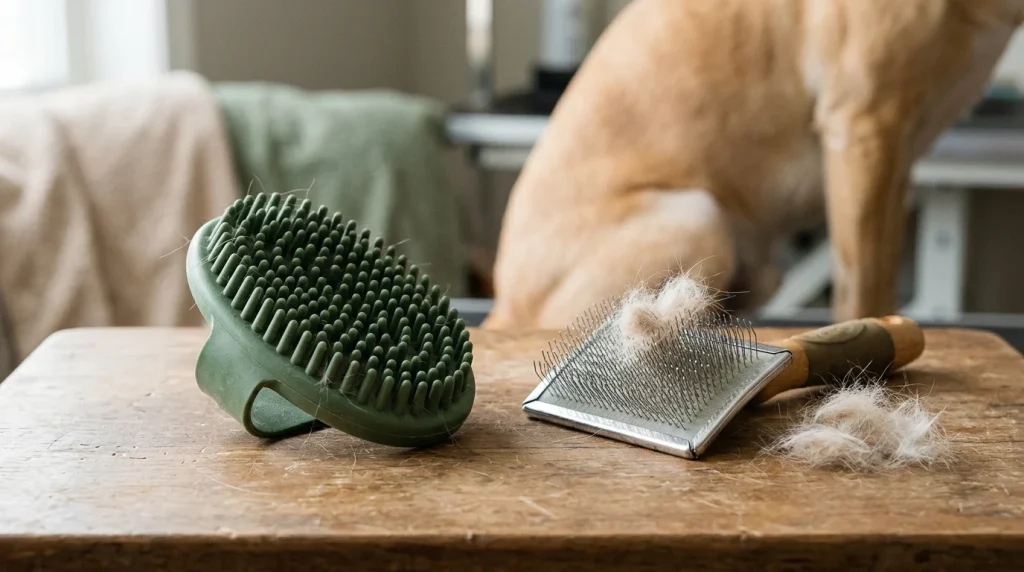
Rubber dog grooming tools use flexible fingers, nubs, or teeth to create gentle surface contact, while metal tools use pins or teeth that can separate hair and reach farther into the coat.
Neither material works best for every dog.
Rubber tools commonly include curry brushes, grooming mitts, bath brushes, and flexible shedding brushes.
They are especially useful when the goal is to loosen surface hair while keeping the brushing sensation relatively gentle.
Metal tools include slicker brushes, pin brushes, metal combs, and undercoat rakes.
These tools can provide more precision and coat penetration, but they also require better technique.
| Feature | Rubber Tools | Metal Tools |
|---|---|---|
| Typical contact | Flexible and broad | Pins or teeth with more precise contact |
| Coat penetration | Usually low to moderate | Moderate to high, depending on design |
| Best common use | Short coats and surface shedding | Longer, thicker, curly, or dense coats |
| Bath use | Often useful with shampoo | Usually used primarily on a dry coat |
| Tangle handling | Limited | Generally much better |
| Main caution | Aggressive rubbing can still irritate skin | Excessive pressure can scratch or irritate skin |
Are Rubber Dog Grooming Tools Better for Short-Haired Dogs?
For many short, smooth-coated dogs, a rubber grooming tool can be an excellent choice because it loosens surface hair without needing deep coat penetration.
That makes the simple design surprisingly effective.
Short coats usually don’t need long pins pushed through multiple layers of hair.
A flexible rubber curry brush can instead grip loose hairs and move them toward the surface.
Why rubber works well on short coats
- Flexible contact: Rubber fingers can follow the contours of the body.
- Loose-hair removal: The surface can gather hairs that are already shedding.
- Easy cleanup: Hair often collects into visible clumps that you can remove by hand.
- Bath versatility: Many rubber grooming designs can help distribute shampoo through a short coat.
- Gentler introduction: Some dogs accept flexible contact more easily than stiff pins.
I especially like rubber-style tools as a starting point for dogs that have short coats and don’t need serious detangling.
A short-haired dog can often get everything it needs from a simple, coat-appropriate rubber or bristle tool.
That doesn’t mean rubber is always softer in every situation.
If you scrub the same spot repeatedly with too much force, the skin can still become uncomfortable.
When Are Metal Dog Grooming Tools the Better Choice?
Metal grooming tools become more useful when you need to separate hair, reach beneath the surface, remove loose undercoat, or check a longer coat for hidden tangles.
That’s where flexible rubber tools can start to reach their limits.
A slicker brush, for example, uses many fine metal pins to move through the coat and collect loose hair.
A metal comb provides a more precise check because its teeth reveal resistance that a surface brush may miss.
Common metal grooming tools and their jobs
- Slicker brush: Often useful for loose hair, light tangles, and many medium, long, or curly coats.
- Pin brush: Commonly used for smoothing longer and flowing coats.
- Metal comb: Useful for checking whether longer hair is fully detangled.
- Undercoat rake: Designed to help remove loose undercoat from suitable dense or double coats.
The key word is suitable.
A deeper-reaching metal tool isn’t automatically an upgrade for every coat.
For example, using an undercoat-focused tool on a dog without the coat structure that needs one can be ineffective or unnecessarily harsh.
Choosing the right tool matters more than choosing the toughest-looking tool.
Rubber vs Metal Dog Brushes for Shedding
Rubber brushes are usually better for loose surface hair on short coats, while metal tools can handle deeper loose hair and undercoat when the dog’s coat requires more reach.
The type of shedding matters as much as the amount.
When a short-haired dog is dropping visible hair from the surface, a rubber curry brush may collect plenty of it.
When a dense double-coated dog is releasing packed undercoat, surface contact alone may not reach the loose material underneath.
| Coat Situation | Often Better Starting Tool | Why |
|---|---|---|
| Short, smooth coat | Rubber curry brush | Surface contact can loosen shedding hair effectively |
| Long coat with loose hair | Pin or slicker brush | Pins can move through more of the coat |
| Curly coat | Slicker plus comb | Helps separate hair and check for hidden tangles |
| Dense double coat | Coat-appropriate undercoat tool | Loose hair may sit beneath the outer coat |
I wouldn’t choose a shedding tool based only on how much fur it removes during the first few strokes.
A tool that aggressively pulls healthy hair can look impressive while creating a worse grooming experience.
Which Material Is Gentler on Sensitive Dogs?
Rubber often provides a gentler starting sensation, especially for short-coated or brush-sensitive dogs, but comfort depends on pressure, technique, coat type, and the condition of the skin.
Material alone doesn’t guarantee comfort.
A rubber brush can irritate skin when someone rubs aggressively over the same area.
A properly used metal brush can also feel comfortable when its design matches the coat and the handler uses light pressure.
I pay attention to the dog’s response instead of assuming the brush label tells the whole story.
- Relaxed posture: Your dog remains comfortable and doesn’t repeatedly move away.
- Normal skin appearance: You don’t see increasing redness after routine brushing.
- Smooth strokes: The tool moves without constant catching and pulling.
- No repeated flinching: Occasional sensitivity is different from obvious discomfort.
- Consistent tolerance: Your dog doesn’t become progressively more resistant during the session.
If brushing reveals sores, swelling, painful areas, unusual hair loss, or significant skin irritation, stop treating it as a normal grooming problem.
A veterinarian can help determine whether an underlying skin issue is involved.
Can You Use Rubber and Metal Grooming Tools Together?
 Save
Yes. In many cases, the most practical grooming routine uses different tools for different jobs rather than expecting one brush to do everything.
That approach is especially useful when a dog has more than one grooming need.
A short-coated dog might use a rubber brush for routine loose-hair removal and need nothing else most days.
A long-coated dog may need a brush to work through the coat and a metal comb to confirm that hidden tangles are gone.
A dense double coat may require a suitable tool for loose undercoat followed by a lighter finishing step.
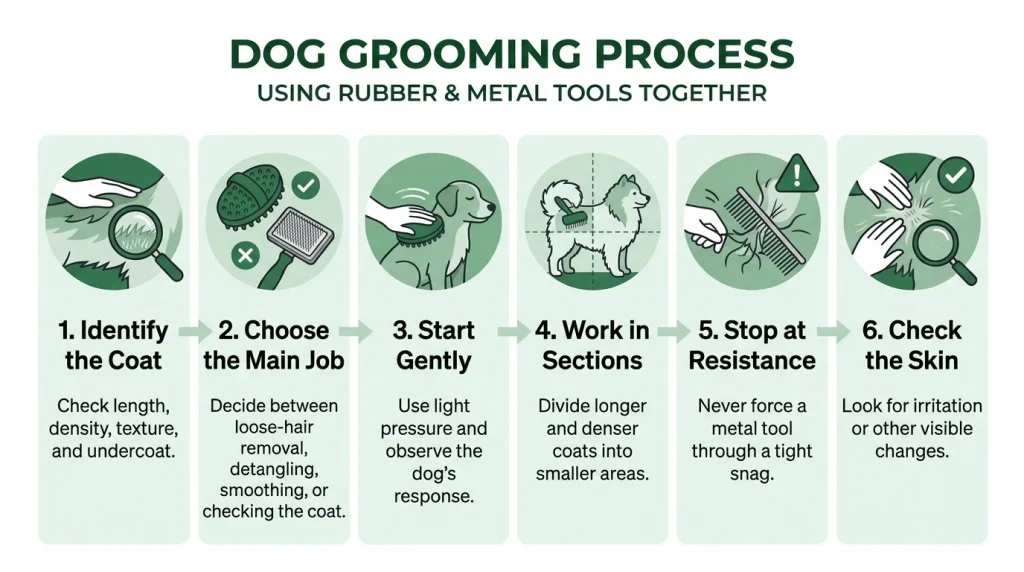
A simple tool-selection routine
- Identify the coat: Look at length, density, texture, and whether the dog has an undercoat.
- Choose the main job: Decide whether you’re removing loose hair, detangling, smoothing, or checking the coat.
- Start gently: Use light pressure and watch how the dog responds.
- Work in sections: Longer and denser coats are easier to manage in smaller areas.
- Stop at resistance: Don’t force a metal tool through a tight snag.
- Check the skin: Regular grooming gives you a chance to notice changes.
As of 2026, my preference is still a small, purposeful grooming kit over a drawer full of overlapping tools.
Each tool should earn its place by solving a different problem.
What Should You Avoid When Using Metal Dog Grooming Tools?
The biggest mistake is treating a metal grooming tool like a tool for scraping or forcing through the coat.
More pressure rarely produces better grooming.
Slicker pins can irritate skin when pressed too firmly, and comb teeth can create painful pulling when forced through knots.
Undercoat tools also need to match the dog’s actual coat structure.
- Don’t dig into the skin: Let the pins work through the coat with controlled strokes.
- Don’t repeat the same area endlessly: Stop when loose hair stops releasing.
- Don’t yank through mats: Tight matting can pull painfully on the skin.
- Don’t use damaged tools: Bent pins, rough edges, or broken teeth can create unnecessary discomfort.
- Don’t copy another dog’s routine blindly: Coat type should guide tool choice.
For difficult matting, pain, or skin problems, professional help is often safer than trying to finish the job quickly at home.
Brushing should make routine coat care easier, not turn every session into a struggle.
If you’re unsure how coat structure affects your routine, you can also see this guide on how dog breed affects grooming frequency.
My Verdict: Rubber vs Metal Dog Grooming Tools
Choose rubber when your dog mainly needs gentle surface grooming, loose-hair removal, massage-like contact, or bath-time brushing.
Choose metal when the coat needs more reach, separation, detangling, undercoat work, or precise checking.
For many dogs, the answer isn’t rubber or metal.
It’s using the right tool at the right stage.
I would never buy a grooming tool simply because its material sounds stronger or because it promises dramatic shedding removal.
I’d start with the dog’s coat, identify the grooming problem, and then choose the least aggressive tool that can do the job properly.
That’s usually the safer and more useful approach.
Dog Grooming Tools I Would Consider
 Save
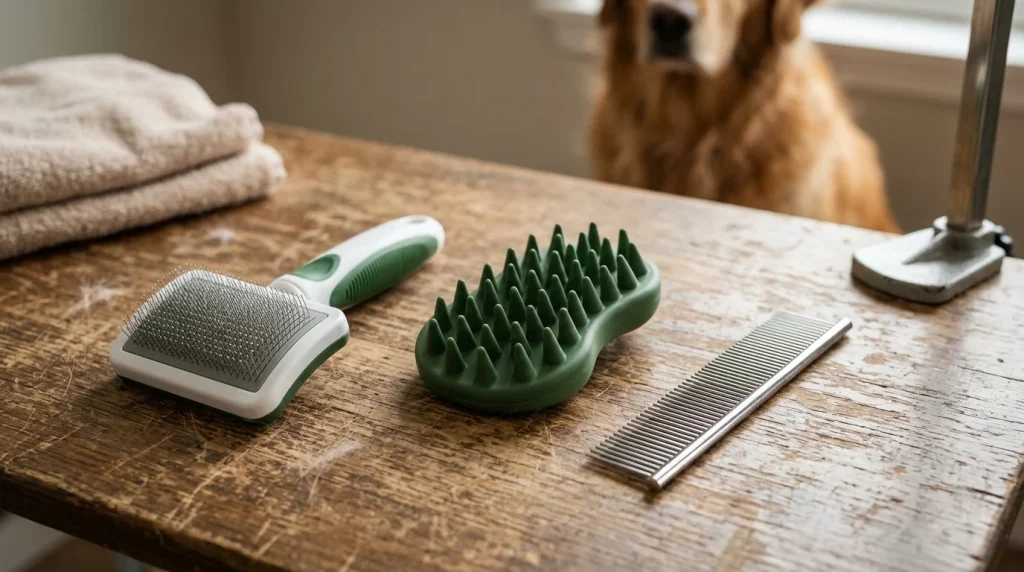
If you’re ready to build a practical grooming kit, these are three distinctly different tool types I’d consider for their specific jobs.
BEST FOR SHORT COATS
KONG ZoomGroom Dog Brush
★★★★☆
This flexible rubber-style grooming tool is suited to surface loose hair and can also be useful during bathing. I’d consider this style first for a short, smooth coat that doesn’t need deep pin penetration.
BEST METAL PIN OPTION
Hertzko Self-Cleaning Slicker Brush
★★★★☆
A slicker-style design uses fine metal pins for loose hair and routine coat separation. I’d choose this type only when the dog’s coat benefits from deeper brushing and I’d always use light pressure.
BEST FOR COAT CHECKING
Andis Steel Pet Comb
★★★★☆
A metal comb gives you precise feedback when checking longer hair for remaining tangles. I see a comb as a finishing and checking tool rather than something to force through a severely matted coat.
Frequently Asked Questions
Is a rubber brush or metal brush better for dog shedding?
A rubber brush is often better for loose surface hair on short, smooth coats. A metal tool may work better when shedding comes from deeper layers, especially in longer, denser, or double coats. Match the tool to where the loose hair sits.
Can a metal dog brush hurt my dog?
Yes, a metal brush can cause discomfort if you use too much pressure, repeatedly brush the same spot, or choose the wrong design for the coat. A suitable metal tool used gently can be effective, so technique matters as much as the material.
Are rubber dog brushes good for double-coated dogs?
Rubber brushes can remove some surface hair, but they often don’t provide enough reach for heavy loose undercoat. A dense double coat may need a more suitable deeper-reaching grooming tool, followed by gentle finishing work where needed.
Can I use a rubber brush during my dog’s bath?
Many rubber grooming brushes are useful during bathing because flexible fingers can help move shampoo through the outer coat. Check the manufacturer’s instructions for the specific tool, and avoid aggressive scrubbing over irritated or damaged skin.
Do long-haired dogs need metal grooming tools?
Many long-haired dogs benefit from tools with pins or metal teeth because those tools can separate longer hair and help detect tangles. The exact choice still depends on coat texture, density, sensitivity, and whether the dog is prone to matting.
Should I choose one grooming tool or build a small kit?
Start with one tool that matches your dog’s main grooming need. Add another only when it performs a clearly different job, such as using a brush for routine grooming and a comb to check for hidden tangles.
Final Takeaway
Rubber vs metal dog grooming tools isn’t a battle with one universal winner.
Rubber usually wins for gentle surface grooming, while metal usually wins when the coat needs more reach and precision.
The best tool is the one that matches your dog’s coat and solves the problem without unnecessary pulling or irritation.
Keep the routine simple, use light pressure, and pay attention to how your dog responds during every grooming session.

Thomas Cutter is a lifelong dog owner and the founder of FindOutAboutDogs.com. With over 10 years of hands-on experience owning multiple breeds, Thomas created this site to provide honest, research-based dog advice that real owners can actually trust.
