What Brush Is Best for a Labradoodle? 2026 Grooming Guide
Quick Answer
The best brush for most Labradoodles is a long-pin slicker brush that can reach through a wavy, curly, or dense coat without only smoothing the surface. Pair it with a metal grooming comb to find hidden tangles after brushing, similar to the two-tool approach explained in this Goldendoodle brush guide.
What to look for in a Labradoodle brush
- Long pins: They need enough reach to work through a fluffy coat instead of brushing only the tips.
- Flexible cushion: A little give makes controlled brushing easier and reduces harsh pulling.
- Curved head: A curved slicker can follow the body and reach dense coat sections more efficiently.
- Comfortable handle: Labradoodle grooming takes time, so a secure grip matters during longer sessions.
- Metal comb: Use one after brushing to check whether knots remain close to the skin.
Best starting choice
- Choose a long-pin slicker for a medium-to-long Labradoodle coat, then adjust the brush size and pin density to your dog’s curl, coat thickness, and haircut.
Labradoodle coats can fool you. The outside may look fluffy and smooth while small tangles are tightening underneath.
That is why I focus less on making the coat look brushed and more on whether a comb can pass through it comfortably. This guide shows you how to choose the right brush for your individual Labradoodle.


Why does a Labradoodle need a different type of brush?
Labradoodles can inherit very different coat traits from Labrador Retrievers and Poodles. Some coats stay loose and wavy, while others become thick, curly, and quick to mat.
A Labradoodle brush therefore needs to reach below the visible surface. A shallow brush may make the top look beautiful while leaving knots closer to the skin untouched.
Definition: A slicker brush is a grooming brush with many fine wire pins designed to separate hair, remove loose coat, and work through light tangles. Long-pin versions are especially useful on longer, curly, and dense coats.
The PetMD Labradoodle care guide notes that Labradoodle coats vary and can develop uncomfortable tangles and mats without regular grooming.
- Wavy fleece-style coat: Usually needs regular detangling but may be easier to brush than a tight curl.
- Curly coat: Loose hair can remain trapped inside the curls, increasing mat risk.
- Dense long coat: A longer-pin brush usually reaches deeper than a small surface slicker.
- Short clipped coat: A less aggressive slicker may be easier to control and more comfortable.
- Puppy coat: Gentle, short sessions matter more than aggressive detangling.
If your Labradoodle has strong Poodle-like curls, this guide to choosing a brush for a Poodle explains why pin length and coat density matter so much.
What type of brush is best for a Labradoodle?
 Save
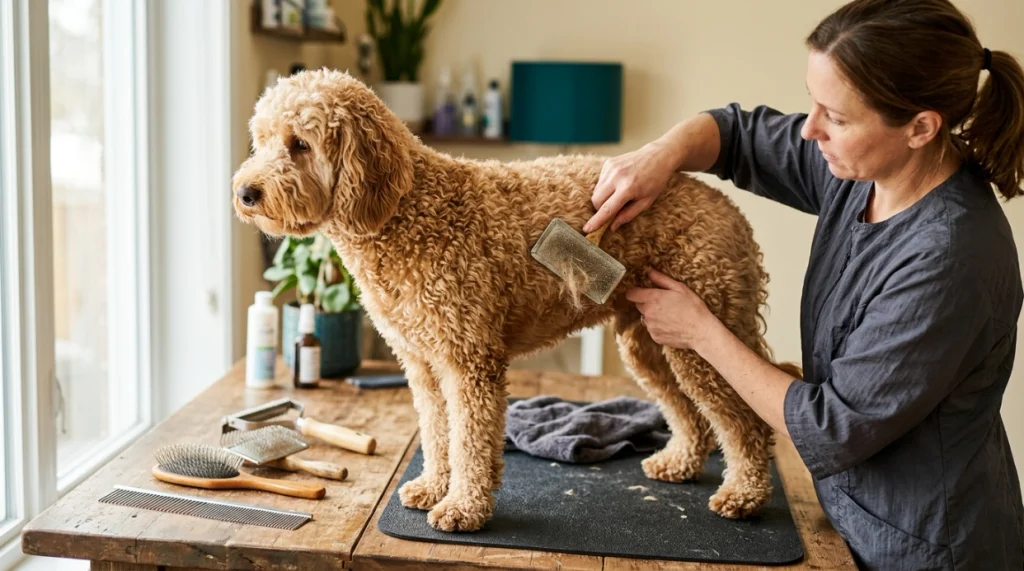
SaveFor most medium-to-long Labradoodle coats, I would start with a long-pin slicker brush. It gives you a better chance of reaching through the coat instead of polishing only the outer fluff.
You should still keep a metal comb beside it. The brush does most of the detangling, while the comb acts as your quality-control tool.
| Tool | Best Use | Best Coat Situation | Depth Example | Main Limitation |
|---|---|---|---|---|
| Long-pin slicker | Primary detangling and line brushing | Long, curly, wavy, or dense coats | Premium models such as Big G use 27 mm pins | Can irritate skin when pressed too hard |
| Medium slicker | Routine maintenance and shorter trims | Medium-length or recently clipped coat | Some medium-coat models use about 17 mm pins | May not reach through a long dense coat |
| Pin brush | Finishing and gentle maintenance | Loose wavy coats with few tangles | Long pins are available for longer hair | Not my first choice for hidden mats |
| Metal comb | Final tangle check | Every Labradoodle coat | 7.5-inch combs offer useful control | Should not be forced through tight mats |
| Undercoat or de-shedding tool | Removing specific loose coat | Only when suitable for the individual coat | Design varies by product | Not a replacement for routine slicker brushing |
The exact pin length is not a universal rule. Your dog’s coat length and density should decide how much reach you need.
The American Kennel Club brush guide also recommends matching the brush type to the dog’s coat rather than treating one brush as suitable for every dog.
Should you use a slicker brush or pin brush on a Labradoodle?
A slicker brush is usually the stronger primary choice when your Labradoodle has a curly, thick, or mat-prone coat. A pin brush is better suited to light maintenance, finishing, and some looser coats.
If I could choose only one brush for a typical fluffy Labradoodle, I would choose the slicker. I would then add a metal comb before buying another specialty brush.
- Choose a long-pin slicker when the coat is long, curly, dense, or difficult to separate with your fingers.
- Choose a gentler slicker when the dog has a shorter maintenance clip or sensitive skin.
- Use a pin brush for finishing, loose hair, and coats that rarely form tight tangles.
- Use a metal comb after brushing to expose sections the brush did not fully clear.
A Labradoodle with a fresh short haircut may not need the same brush as a dog carrying several inches of curly coat. Buying by breed name alone misses that difference.
What features should you check before buying a slicker brush?
Pin reach, flexibility, head size, and handle comfort matter more than flashy packaging. These details decide whether the brush can work through your dog’s coat without turning every session into a struggle.
- Pin length: Longer pins help penetrate longer coats.
- Pin density: Dense pins can grab more hair, while wider spacing can move more easily through extremely thick coats.
- Cushion movement: A flexible pad can make controlled strokes easier.
- Head size: Large heads cover the torso quickly, while smaller heads help around legs and tight areas.
- Handle grip: A secure ergonomic handle reduces fatigue during a full-body session.
For comparison, Chris Christensen lists 27 mm pins on both its Big G and Big K slickers. The Big K uses fewer pins to move through particularly dense coats more easily.
How should you brush a Labradoodle without missing hidden tangles?
 Save
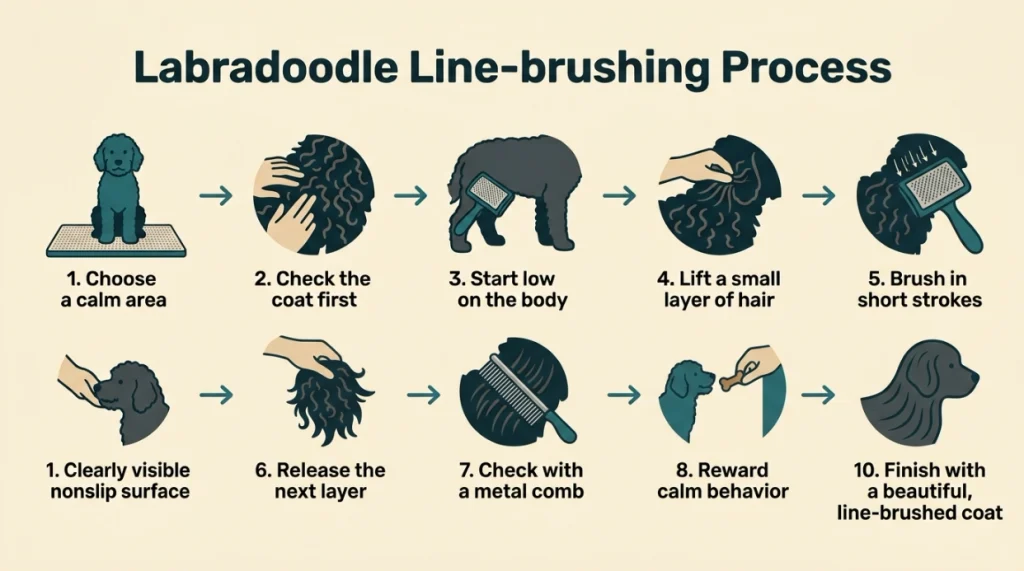
SaveWork in small layers instead of dragging the brush across the entire fluffy surface. This technique is often called line brushing.
My finishing rule is simple: the section is not finished just because it looks smooth. I want the metal comb to pass from near the skin toward the ends without repeated catching.
- Choose a calm area. Put your dog on a stable, nonslip surface.
- Check the coat first. Feel for tight knots, sore skin, debris, or damp areas.
- Start low on the body. Working from the legs upward makes it easier to follow an organized pattern.
- Lift a small layer of hair. Part the coat until you can see or feel close to the roots.
- Brush in short strokes. Work from the outer edge of a small tangle instead of yanking through it.
- Release the next layer. Continue across the body without skipping sections.
- Check with a metal comb. Stop when the comb catches instead of forcing it through.
- Reward calm behavior. Short breaks can keep grooming positive and manageable.
If you want a more detailed line-brushing routine, the same fundamentals are demonstrated in this step-by-step Poodle brushing guide.
The VCA coat-care guidance recommends gentle brushing and warns against excessive pulling on tangles. Severe or skin-level mats are better handled by a professional groomer.
Where do Labradoodles mat the fastest?
Friction and moisture make certain areas especially easy to miss. I would inspect these spots even when you do not have time for a complete grooming session.
- Behind and underneath the ears
- Under the front legs and around the armpits
- Under collars and harness straps
- Around the chest and neck
- Along the legs and feet
- Around the tail and rear
- Any area that remains damp after swimming or bathing
The Australian Labradoodle Association of America also emphasizes consistent coat maintenance rather than relying only on occasional professional grooming.
How often should you brush a Labradoodle?
Many Labradoodles need brushing several times each week, while long, curly, or fast-matting coats may need daily attention. The comb test is more useful than following one schedule for every dog.
As of 2026, I would adjust frequency according to coat condition, haircut, activity, moisture, and how quickly your dog’s trouble spots begin to snag.
- Long curly coat: Check daily and expect frequent full brushing sessions.
- Medium wavy coat: Start with several thorough sessions each week.
- Short maintenance clip: Brush less intensively, but continue checking ears, legs, and friction areas.
- After swimming or rain: Dry the coat properly and inspect it for new tangles.
- Puppy: Use short, gentle sessions to build a lifelong grooming habit.
You can compare those starting points with this guide to how often to brush a Goldendoodle, since both dogs can have similar curly or wavy grooming challenges.
What brush should you avoid using incorrectly on a Labradoodle?
The wrong technique can make a good brush uncomfortable. More pressure does not automatically remove tangles more effectively.
- Do not scrape the skin: Slicker pins should move through hair, not dig into the dog’s body.
- Do not repeatedly attack one spot: Excessive passes can irritate sensitive skin.
- Do not force a comb: Resistance means you should inspect the tangle first.
- Do not use household scissors under tight mats: Skin can become pulled into the tangled hair.
- Do not rely on surface brushing: Fluffiness does not prove the coat is clear underneath.
A severe mat that sits tightly against the skin is a grooming problem, not a challenge to solve with extra force. Ask a groomer or veterinarian for help when removal becomes painful or unsafe.
Which Labradoodle grooming tools would I choose?
 Save
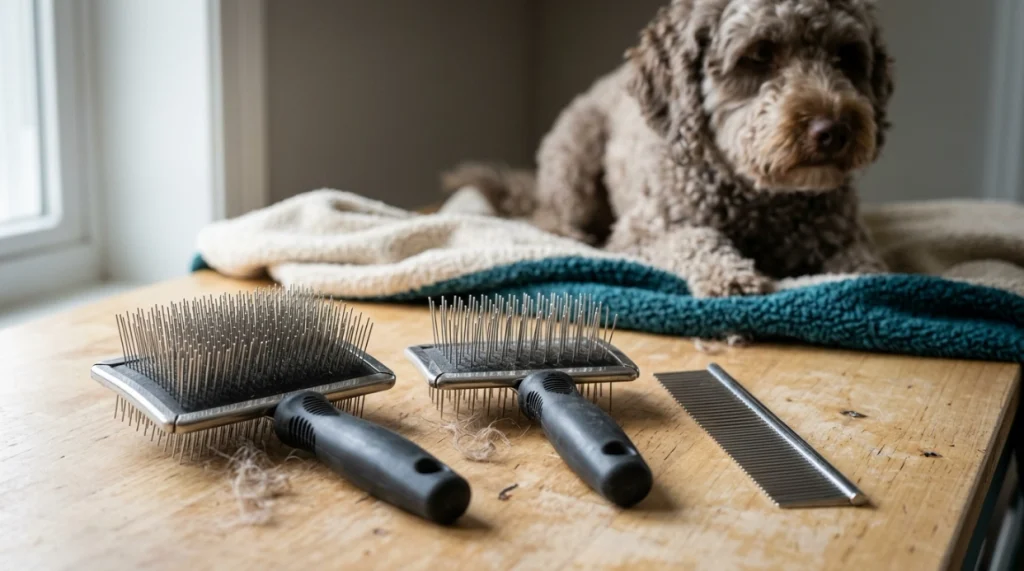
SaveIf you’re building a simple Labradoodle grooming kit, I would start with one capable slicker and one dependable metal comb. Owners of exceptionally dense coats may benefit from a second slicker with wider pin spacing.
Affiliate note: As an Amazon Associate, this site may earn from qualifying purchases.
🏆 Best Overall
Chris Christensen Big G Slicker Brush
★★★★★ 4.9/5 editorial fit
The Big G uses 27 mm stainless-steel pins and a dense pin layout designed for long coats. I like it as the main option for a fluffy Labradoodle because the long pins give you useful reach for line brushing.
🌀 Best for Very Dense Coats
Chris Christensen Big K Slicker Brush
★★★★★ 4.7/5 editorial fit
The Big K also uses 27 mm pins but has a more open pin arrangement than the Big G. I would consider it when a thick, curly Labradoodle coat feels difficult to penetrate with a denser slicker.
🔎 Best Tangle Checker
Andis 7-1/2 Inch Steel Comb
★★★★★ 4.8/5 editorial fit
This 7.5-inch steel comb has coarse and fine tooth spacing for grooming and finishing. I would use it after the slicker because it quickly exposes sections that still have resistance below the fluffy surface.
Frequently Asked Questions
Can I use a regular slicker brush on a Labradoodle?
Yes, if its pins reach through your dog’s coat comfortably. However, small shallow slickers can struggle with long, dense Labradoodle hair, so a longer-pin model is often easier for full-coat line brushing.
Is a slicker brush or undercoat rake better for a Labradoodle?
A slicker brush is the better everyday starting tool for most Labradoodles because it handles tangles and routine coat separation. An undercoat or de-shedding tool is more specialized and should only be used when it suits your dog’s actual coat type.
Should I brush my Labradoodle wet or dry?
Do not aggressively brush a soaking-wet or tightly tangled coat. After bathing or swimming, dry the coat properly and work gently, using a dog-safe conditioning product only when its directions support that use.
How do I know if my Labradoodle is completely brushed?
Run a metal grooming comb through each finished section from near the skin toward the ends. If it moves comfortably without repeatedly catching, you have much better evidence that hidden tangles are gone than appearance alone provides.
What should I do if my Labradoodle already has tight mats?
Stop pulling when a mat is dense, painful, or tight against the skin. A professional groomer can decide whether it can be safely worked apart or should be clipped, while irritated or injured skin deserves veterinary attention.
Final Takeaway
For most Labradoodles, the best starting brush is a long-pin slicker brush paired with a metal grooming comb. Choose the exact slicker according to coat length, curl, density, and your dog’s comfort.
Do not let the fluffy surface make the decision for you. Brush in sections, check your work with the comb, and deal with small tangles before they become tight mats.
If your Labradoodle stays comfortable and the comb passes cleanly through the finished coat, your brush-and-technique combination is doing its job.

Thomas Cutter is a lifelong dog owner and the founder of FindOutAboutDogs.com. With over 10 years of hands-on experience owning multiple breeds, Thomas created this site to provide honest, research-based dog advice that real owners can actually trust.
