How to Brush a Labradoodle: Step-by-Step Without Hurting the Coat
Quick Answer
To brush a Labradoodle, divide the coat into small sections and brush from near the skin outward with a slicker brush. Finish each section with a metal comb to catch hidden tangles, following established Australian Labradoodle grooming guidance.
Quick brushing steps
- Check the coat: Feel for knots behind the ears, under the collar, in the armpits, and around the legs.
- Work in layers: Lift the coat and expose a narrow line of hair rather than brushing only the surface.
- Brush gently: Use short slicker-brush strokes from near the skin toward the ends.
- Check with a comb: Run a metal comb from the skin to the hair tips after each section.
- Handle tangles slowly: Hold hair near the skin while gently separating small knots to reduce pulling.
- Stop at tight mats: Ask a professional groomer for help when a mat is dense, painful, or close to the skin.
The most important check
- If your comb cannot travel smoothly from the skin through the ends, that section is not fully brushed yet.
Labradoodles can look beautifully fluffy while hiding knots underneath. That is why simply running a brush across the top of the coat often is not enough.
I prefer a simple system: slicker brush first, metal comb second. The comb tells you whether you actually reached through the coat.
If grooming commitment matters when choosing a dog, it also helps to compare the care needs of low-shedding breeds for first-time owners before bringing one home.


Why Does a Labradoodle Need Regular Brushing?
A Labradoodle needs regular brushing because curly and wavy hair can trap loose strands instead of dropping them onto the floor. Those trapped hairs can combine with friction and form tangles or mats.
Line brushing is a grooming method where you separate the coat into narrow sections, expose the hair near the skin, and brush one section at a time. It helps prevent the common problem of leaving the lower coat tangled while the surface looks smooth.
The Australian Labradoodle Association describes fleece and wool as two major Australian Labradoodle coat types. Fleece may be wavy or softly curled, while wool has a denser, more curled texture.
- Wavy fleece: Usually easier to separate, but longer hair can still knot around friction points.
- Curly fleece: Needs careful sectioning because curls can conceal small tangles.
- Wool coat: Dense curls often demand more careful skin-level checking.
- Hair-type coat: Texture and shedding can vary, so the brushing routine should match the individual dog.
You can review the breed association’s Labradoodle coat-type guide if you are unsure which texture your dog has.
What Tools Do You Need to Brush a Labradoodle?
You do not need a drawer full of grooming equipment. A good slicker brush and sturdy metal comb handle most routine Labradoodle brushing.
A light detangling spray can also help with manageable knots. It should make the hair easier to work through, not replace careful brushing.
| Tool | Best Job | When I Use It | Main Caution |
|---|---|---|---|
| Long-pin slicker brush | Separating curls and removing loose hair | Main brushing tool | Do not press hard against skin |
| Metal comb | Finding hidden tangles | After every brushed section | Never force it through a knot |
| Pin brush | Light maintenance and finishing | Longer, loose fleece coats | May miss deeper tangles |
| Dog detangling spray | Adding slip to light tangles | Before working a knot gently | Not a fix for tight mats |
The American Kennel Club’s brush guide recommends slicker brushes for curly and longer coats because their angled pins can remove loose hair and help control mats.
Whatever tool you choose, use light pressure. The goal is to move through the coat, not scrape the dog’s skin.
How Do You Brush a Labradoodle Step by Step?
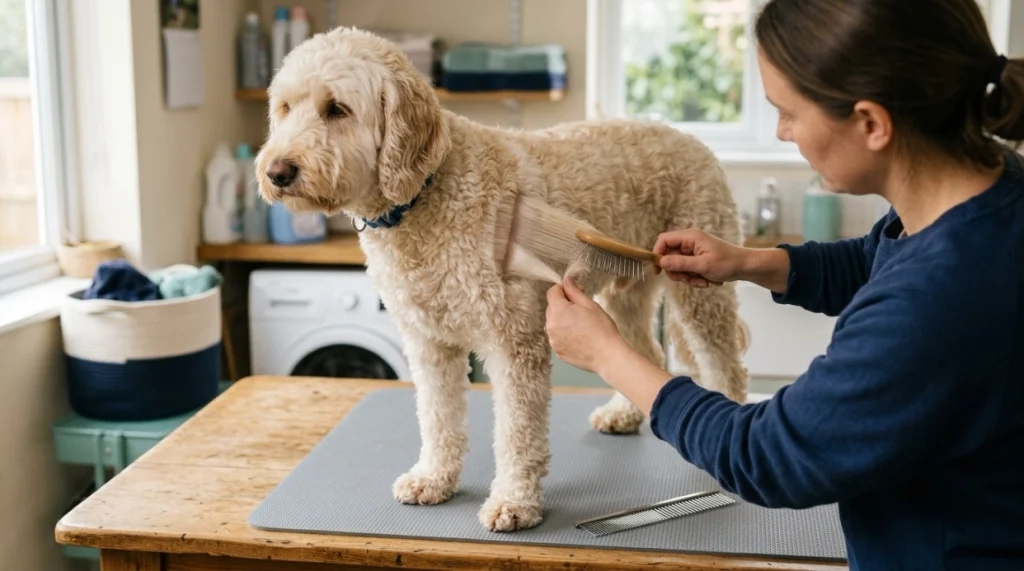 Save
SaveThe easiest way to brush a Labradoodle thoroughly is to work systematically from one area to the next. Small sections make it harder to accidentally skip the hair closest to the skin.
- Start with a dry, calm dog. Put your Labradoodle on a nonslip surface and let them settle before you begin.
- Inspect with your hands. Feel behind the ears, under the collar, around the chest, armpits, legs, belly, and tail for knots.
- Choose a starting point. I find the lower leg or rear quarter easy because you can clearly see each completed section.
- Lift the coat. Use one hand to push the hair upward until you can see a narrow line near the skin.
- Brush the exposed section. Use short, gentle slicker strokes in the direction the coat grows.
- Move up one small layer. Release a little more hair and repeat the brushing process.
- Use the metal comb. Comb from near the skin through the full hair length before leaving that area.
- Repeat across the body. Work through the legs, sides, chest, back, neck, and tail without rushing.
- Finish sensitive zones carefully. Use lighter strokes around the face, ears, groin, feet, and armpits.
- Reward the dog. Short praise and small treats can help make future grooming sessions easier.
My comb-check rule: Do not call a section finished just because it looks fluffy. A metal comb should pass through from near the skin to the ends without repeatedly catching.
Where should you start brushing a Labradoodle?
You can start anywhere that lets you work in an organized direction. Starting low and gradually moving upward makes line brushing easier to see.
I avoid randomly jumping between the back, legs, neck, and tail. That makes missed sections much more likely.
How much pressure should you use?
Use enough pressure to move the pins through the hair, but not enough to scrape the skin. Slicker pins can irritate skin when repeatedly dragged across one spot.
The AKC recommends working down through the coat with gentle strokes. If your dog flinches or the skin becomes pink, reduce pressure and inspect the area.
Where Do Labradoodles Mat the Most?
Labradoodles often mat where hair rubs against hair, skin, collars, harnesses, or moving limbs. These areas deserve a quick check even when you cannot complete a full-body brushing session.
- Behind the ears: Soft hair and frequent movement create tangles quickly.
- Under the collar: Constant rubbing can compress the coat.
- Armpits: Leg movement creates friction every time your dog walks or runs.
- Chest: Harnesses and lying down can encourage knots.
- Inside the legs: These areas are easy to miss during surface brushing.
- Belly and groin: Fine hair can knot while remaining difficult to see.
- Tail base: Dense hair can hide tangles underneath the visible coat.
- Feet: Long hair collects moisture, dirt, and outdoor debris.
Veterinary grooming guidance from VCA Animal Hospitals also highlights the ears, armpits, groin, and backs of the legs as common areas for tangles.
A thirty-second friction-zone check can catch a small knot before it becomes a dense mat. That is much easier on both you and your dog.
How Often Should You Brush a Labradoodle?
Many Labradoodles benefit from brushing several times each week, while dense or mat-prone coats may need daily attention. Coat length, curl, activity, moisture, and grooming style all affect the schedule.
Australian Labradoodle grooming organizations commonly suggest brushing or combing multiple times weekly. During the puppy-to-adult coat change, some dogs may need daily combing because old and new hair tangle together faster.
| Coat Situation | Practical Starting Routine | Adjust When |
|---|---|---|
| Shorter, manageable fleece | 2–3 thorough sessions weekly | The comb starts catching between sessions |
| Long or curly coat | 3 or more checks weekly | Friction zones knot quickly |
| Mat-prone coat | Brief daily maintenance | A groomer recommends a different schedule |
| Puppy coat transition | Often daily comb checks | The adult coat has settled and matting slows |
Do not judge the routine only by shedding. Low-shedding dogs can require more coat maintenance because loose hairs remain trapped inside curls.
This is an important point for families comparing indoor dog breeds with different grooming needs. Less loose hair on the floor does not automatically mean less grooming work.
How Do You Brush Tangles Without Hurting a Labradoodle?
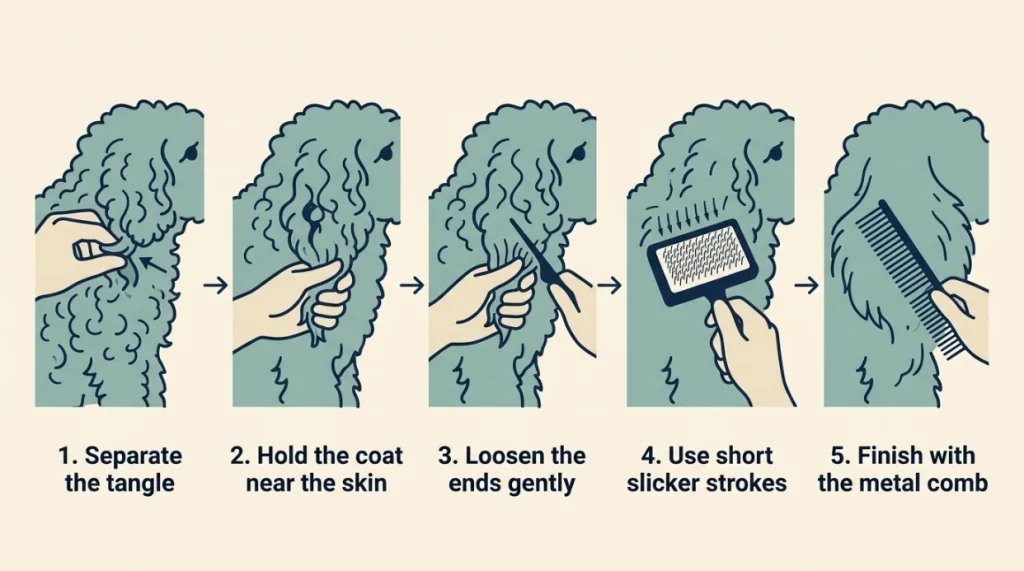 Save
SaveFor a small tangle, hold the hair between the knot and the skin so your fingers absorb some pulling. Work from the outer edge of the knot instead of dragging a brush straight through its center.
A little dog-safe detangling spray can add slip. Use your fingers, comb, and slicker brush patiently rather than trying to remove the knot in one hard pass.
- Separate the tangle from surrounding loose hair.
- Hold the coat near the skin with one hand.
- Loosen the ends with your fingers or wide comb teeth.
- Use short slicker strokes on the loosened hair.
- Finish by passing the metal comb through the entire section.
Safety note: Do not use household scissors to cut a tight mat sitting close to the skin. Dog skin can be pulled into the mat, making accidental cuts much easier than they appear.
When a mat is dense, widespread, painful, or stuck close to the skin, stop home detangling. A professional groomer can decide whether clipping is safer.
Should You Brush a Labradoodle Before or After a Bath?
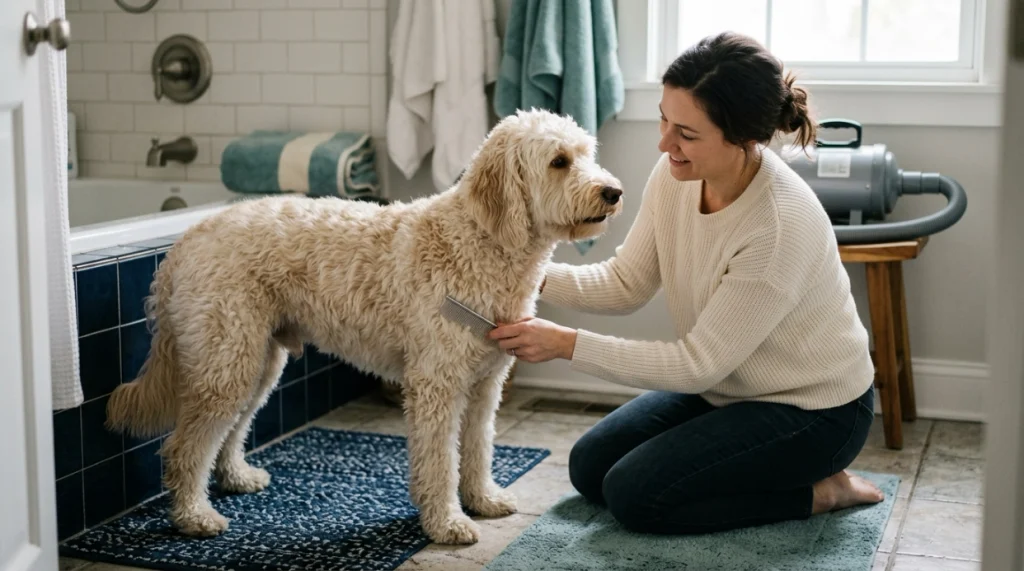 Save
SaveBrush and comb out tangles before bathing whenever practical. Water can tighten existing knots and make a neglected coat harder to work through afterward.
After bathing, dry the coat thoroughly according to your groomer’s recommendations. Then comb-check the finished coat once it is dry or nearly dry.
If your Labradoodle stays indoors much of the day, routine coat care is still important. You can compare broader care demands in my guide to friendly family dog breeds.
What Labradoodle Brushing Mistakes Should You Avoid?
The biggest brushing mistake is assuming a fluffy surface means a tangle-free coat. Many serious mats begin underneath hair that still looks neat from above.
- Surface brushing only: Lift the coat so your tool reaches deeper layers.
- Skipping the comb: A comb is one of the fastest ways to expose missed knots.
- Pressing too hard: More pressure does not make a slicker brush work better.
- Repeatedly scraping one spot: This can irritate sensitive skin.
- Ignoring friction zones: Check ears, armpits, collar areas, legs, and tail regularly.
- Bathing over tangles: Remove manageable knots before getting the coat wet.
- Pulling through mats: Dense mats can hurt and may require professional clipping.
- Making sessions too long: Short successful sessions are better than turning grooming into a battle.
As of 2026, the core technique has not changed: brush in sections, use gentle pressure, and verify your work with a comb. Good technique matters more than buying the largest collection of grooming tools.
If you’re ready to build a simple Labradoodle grooming kit, these are the three tools I would consider first:
🏆 Best Overall Brush
Chris Christensen Big G Slicker Brush
★★★★★ 5/5 editorial fit
The Big G uses long 27 mm stainless-steel pins and a curved, densely pinned head designed for longer, dense coats. I like this style for line brushing because the longer pins can work through more coat without encouraging hard pressure.
🔎 Best Comb Check
Andis 7.5-Inch Steel Pet Comb
★★★★☆ 4.7/5 editorial fit
This steel comb combines coarse and fine teeth, letting you check thicker sections before moving into finer finishing work. For me, the comb is less about styling and more about confirming that the slicker brush did its job.
💧 Best for Light Tangles
Burt’s Bees Detangling Spray for Dogs
★★★★☆ 4.4/5 editorial fit
This rinse-free detangling spray uses lemon and linseed ingredients and is designed to loosen manageable knots while conditioning the coat. I would use it for added slip during routine brushing, not as a shortcut for removing a tight mat.
Frequently Asked Questions About Brushing a Labradoodle
What is the best way to brush a Labradoodle?
The best method is line brushing. Separate the coat into small layers, brush gently from near the skin outward with a slicker brush, then pass a metal comb through the section before moving on.
How often should I brush my Labradoodle?
Start with two or three thorough brushing sessions each week and adjust for coat texture, length, and tangling. Long, curly, or changing puppy coats may need much more frequent attention, including daily comb checks.
Can I use a human hairbrush on a Labradoodle?
A human brush may smooth the surface, but it often cannot reach through a dense Labradoodle coat effectively. A dog slicker brush plus a sturdy metal grooming comb gives you a better way to find hidden tangles.
Should I brush my Labradoodle wet or dry?
For routine home grooming, work through tangles before bathing and avoid dragging a brush aggressively through soaked hair. Follow your professional groomer’s advice when using grooming sprays or brushing during the drying process.
What should I do if my Labradoodle is badly matted?
Do not repeatedly pull at a dense mat or cut close to the skin with household scissors. A professional groomer or veterinarian should assess severe matting, especially when it causes redness, pain, odor, sores, or restricted movement.
The Bottom Line
Learning how to brush a Labradoodle comes down to one habit: reach the coat near the skin instead of polishing only the fluffy surface. Work in small sections, keep the slicker pressure light, and let a metal comb confirm your progress.
Make the routine regular before mats appear. Ten calm minutes of preventive coat care is far easier than trying to rescue a tightly tangled coat later.

Thomas Cutter is a lifelong dog owner and the founder of FindOutAboutDogs.com. With over 10 years of hands-on experience owning multiple breeds, Thomas created this site to provide honest, research-based dog advice that real owners can actually trust.
