What Is a Dog Mat Breaker? A Practical Guide to Removing Dog Mats
Quick Answer
A dog mat breaker is a grooming tool with several sharp or serrated teeth that separate a loose or moderate mat into smaller sections. Unlike a normal brush, it cuts through tangled hair instead of simply pulling across it. For everyday coat maintenance, pair careful dematting with the right brush for your dog’s coat.
What a mat breaker does
- Splits tangles: Its teeth divide larger mats into smaller, easier-to-manage sections.
- Reduces pulling: Controlled short strokes can create less tugging than forcing a comb through a knot.
- Targets problem areas: It works best on manageable mats that are not tightly attached to the skin.
- Uses real blades: Many mat breakers have sharpened edges, so they require careful handling.
- Doesn’t replace brushing: A slicker, pin brush, or comb is still needed for routine grooming.
When not to use one
- Stop if the mat is tight against the skin, your dog shows pain, or you cannot clearly control the tool.
I think the name “mat breaker” makes this tool sound more aggressive than it should be. Used correctly, the goal isn’t to rip a knot apart.
The goal is controlled separation. This guide explains what the tool does, how it differs from other dog brushes, and when I would leave a mat to a professional groomer.


What Exactly Is a Dog Mat Breaker?
A dog mat breaker is a specialized dematting tool designed to divide tangled or matted fur. Most versions have a handle attached to several curved, sharpened, or serrated metal teeth.
Those teeth are the important difference. They can slice through portions of tangled hair while the tool moves through the mat.
Definition: A dog mat breaker is a bladed grooming tool used to separate manageable mats into smaller sections so remaining tangles can be gently combed or brushed out.
- Handle: Gives the groomer control and keeps the hand away from the working teeth.
- Curved teeth: Enter a tangle and separate groups of intertwined hairs.
- Sharpened edges: Cut some hair rather than depending entirely on pulling force.
- Rounded outer surfaces: On well-designed tools, the skin-facing side is smoother than the cutting edge.
I never treat a mat breaker like an ordinary brush. If I can run a tool quickly over the entire dog, I’m probably using the wrong technique.
It’s a spot-treatment tool. You use it only where a specific tangle needs attention.
How Does a Dog Mat Breaker Work?
 Save
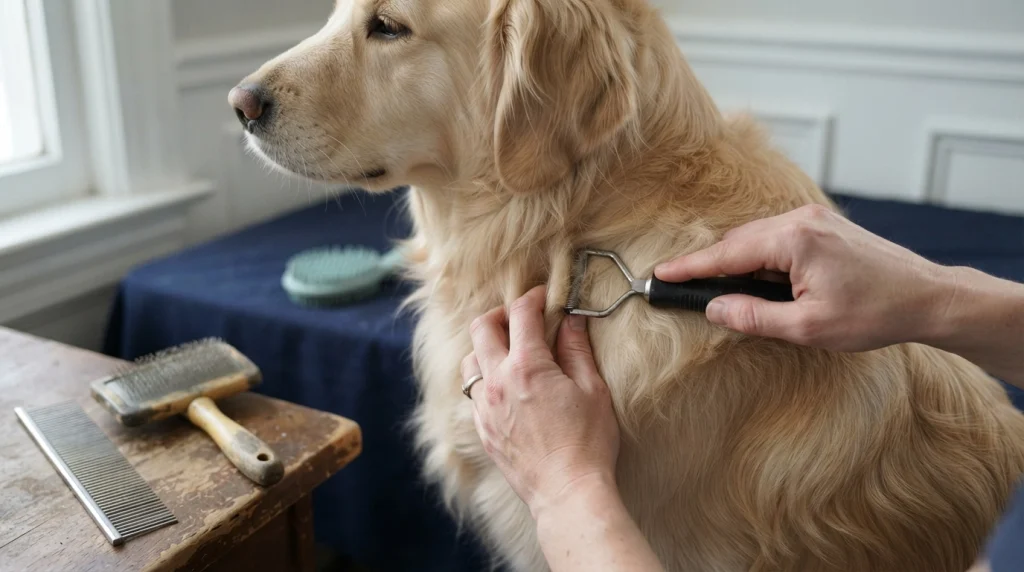
SaveA mat breaker works by splitting a tangled mass of hair into smaller pieces. That makes the remaining sections easier to loosen with your fingers, a slicker brush, or a metal comb.
Think of a mat as hundreds of hairs twisted together. Pulling straight through all of them at once creates tension on the coat and skin.
- Identify the edge of the mat. Start where the hair is loosest rather than attacking the dense center.
- Hold the coat near the skin. Your fingers can absorb some pulling and help you control the area.
- Insert only a small portion of the tool. Avoid burying the entire blade assembly in the mat.
- Use short controlled movements. Work outward through a small section rather than sawing repeatedly.
- Separate loosened hair. Use your fingers or an appropriate brush after the mat begins opening.
- Recheck with a comb. Never force a comb through resistance.
The American Kennel Club recommends working gradually from the outside of a mat and controlling the hair near the body to reduce pulling. That slow approach matters more than speed.
You can review broader AKC guidance on dealing with matted dog hair before attempting a difficult tangle.
Mat Breaker vs Slicker Brush vs Undercoat Rake: What’s the Difference?
A mat breaker cuts into tangles, while most brushes primarily separate or collect hair. An undercoat rake has another job: reaching loose undercoat below the outer coat.
I choose the tool based on the problem in front of me rather than trying to make one brush perform every grooming task.
| Tool | Main Job | Cuts Hair? | Best Use | Main Caution |
|---|---|---|---|---|
| Mat breaker | Separates mats | Usually yes | Loose to moderate localized mats | Sharp edges require control |
| Slicker brush | Separates hair and collects loose coat | No | Routine brushing and light tangles | Too much pressure can scratch skin |
| Undercoat rake | Removes loose undercoat | Depends on design | Dense and double coats | Should not be forced through mats |
| Metal comb | Checks and separates coat | No | Finding remaining tangles | Never yank through resistance |
For a double-coated dog, an undercoat rake may be more important for routine shedding control. My guide to managing heavy double-coat shedding explains that job in more detail.
When Should You Use a Mat Breaker on a Dog?
I would consider a mat breaker when I can still identify and control a small or moderate localized tangle. The skin should not be trapped tightly inside the mat.
Common problem areas include places where movement, moisture, collars, and harnesses create repeated friction.
- Behind the ears: Fine hair can twist together quickly.
- Under the collar: Repeated friction can compact longer hair.
- Armpits: Leg movement makes this a common tangling area.
- Chest: Harness straps may rub against longer coats.
- Feathering: Long hair behind the legs can collect debris and tangles.
- Tail: Long feathered tails may develop knots if brushing is skipped.
PetMD also identifies friction areas, including behind the ears and under the legs, as common matting locations. Regular brushing remains the easier solution.
See PetMD’s veterinary-reviewed matting guidance for more background on mat prevention and professional removal.
How Do You Use a Dog Mat Breaker Safely?
 Save
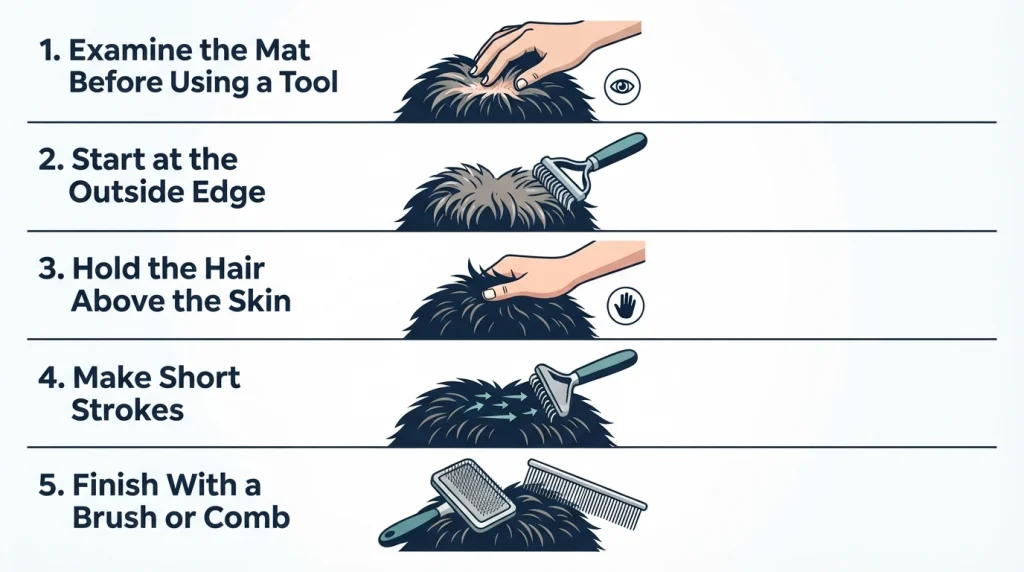
SaveUse a mat breaker slowly, on dry coat, and only where you can control the hair and tool. Never use fast brushing strokes with a bladed dematting tool.
Before I begin, I first inspect the skin and test whether the mat can be loosened with my fingers.
1. Examine the Mat Before Using a Tool
Separate the surrounding coat and look at the base of the mat. Stop if you cannot tell where the skin ends and the tangled hair begins.
Redness, sores, moisture, odor, or obvious pain are also reasons to stop.
2. Start at the Outside Edge
Don’t begin at the tightest center. Pick a loose outside portion where the teeth can enter without forcing them.
This gives you more control. It also reduces the amount of hair trapped in each pass.
3. Hold the Hair Above the Skin
Support the coat between the mat and your dog’s body whenever possible. This helps keep tugging from transferring directly to the skin.
Keep your fingers away from the cutting direction. Remember that a mat breaker’s inner edges may be sharp.
4. Make Short Strokes
Work a small section at a time. If nothing moves without significant force, stop rather than pulling harder.
I would rather leave part of a mat unfinished than turn grooming into a painful experience.
5. Finish With a Brush or Comb
Once the mat has separated, switch tools. A mat breaker shouldn’t be used repeatedly on already loosened coat.
- Use your fingers to separate loosened strands.
- Use a slicker appropriate for the coat to tidy the area.
- Check the section gently with a metal comb.
- Stop if the skin becomes red or sensitive.
When Should You Not Use a Mat Breaker?
Do not use a mat breaker on severe, skin-tight matting that you cannot clearly control. Those cases are safer in the hands of a professional groomer or veterinarian.
ASPCA guidance warns that advanced mats may require clipping rather than brushing. It also warns owners not to cut mats out with household scissors because skin can be caught inside the mat.
- Skin-tight mats: There may be almost no safe working space beneath the tangle.
- Large felted areas: A solid sheet of matting is not a normal home dematting job.
- Open sores: Grooming tools can worsen irritated or injured skin.
- Extreme sensitivity: Repeated flinching, crying, snapping, or struggling means stop.
- Delicate locations: Eyes, ears, genital areas, and other sensitive zones need extra caution.
- Unknown lumps: Don’t drag a bladed tool across a bump hidden beneath the coat.
The ASPCA provides additional information about when matted coats need professional attention.
Can a Mat Breaker Hurt a Dog?
Yes. A mat breaker can hurt a dog if its blades contact skin, if excessive force pulls the coat, or if the same area is worked for too long.
That’s why I don’t describe these tools as automatically “safe.” The design and the person using it both matter.
- Check the blade direction: Know which edge cuts before touching your dog’s coat.
- Use minimal pressure: More force doesn’t equal better dematting.
- Avoid repeated passes: Skin can become irritated even without an obvious cut.
- Watch body language: Turning, sitting, licking, flinching, or moving away can signal discomfort.
- Take breaks: Several calm sessions are often better than one long struggle.
A calm dog can also move suddenly. Never assume good behavior makes a sharp grooming tool risk-free.
How Can You Prevent Dog Mats From Coming Back?
The best mat breaker is the one you rarely need. Consistent brushing prevents loose hair and small tangles from becoming dense mats.
As of 2026, that basic advice hasn’t changed: match your grooming routine to the individual coat rather than waiting for obvious knots.
- Brush to the coat’s base: Surface brushing can miss tangles underneath longer hair.
- Check friction zones: Inspect behind the ears, under collars, armpits, and feathering.
- Remove outdoor debris: Burrs, grass, and damp material can help start tangles.
- Keep the coat dry: Don’t leave dense fur damp after bathing or swimming.
- Use the right tools: Slickers, pin brushes, combs, and rakes have different jobs.
- Book grooming early: Don’t wait for a difficult coat to become severely matted.
My simplest test is a metal comb check after brushing. If the comb stops repeatedly beneath a tidy-looking surface, I haven’t finished the coat.
That small habit catches problems early.
Dog Mat Breakers I Would Consider
 Save
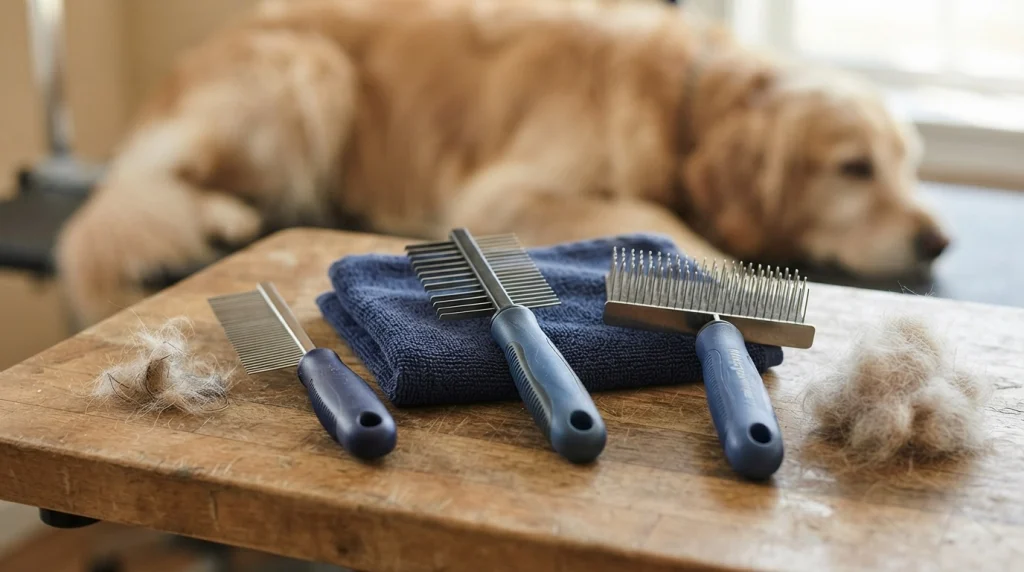
SaveIf you’re ready to choose a dematting tool, I’d focus on control, tooth design, and the type of mat you’re trying to manage. I wouldn’t buy purely based on how much hair a product advertisement shows.
🏆 Best Traditional Mat Breaker
Safari De-Matting Dog Comb
★★★★½
This dedicated dematting design uses metal blades for breaking manageable tangles into smaller sections. I like this style when I want more precise control than a wide general-purpose rake provides.
🐾 Best Dual-Sided Option
GoPets Dematting Comb
★★★★☆
This style combines differently spaced teeth for working through tangles and dense coat. I’d choose a dual-sided tool when I want flexibility, but I would still avoid forcing either side through a skin-tight mat.
💰 Best Multi-Purpose Rake Style
Maxpower Planet Pet Grooming Rake
★★★★☆
The common dual-sided format combines wider and narrower teeth for dense coats, tangles, and loose undercoat. I see it as a more general grooming tool than a narrow mat breaker, especially for dogs with substantial undercoat.
Frequently Asked Questions
Does a dog mat breaker cut the hair?
Yes, most true mat breakers use sharpened or serrated edges that cut some tangled hairs while separating the mat. That’s why they should be handled differently from a normal brush. Check the tool’s blade direction before use and keep the cutting edges away from your dog’s skin.
Is a mat breaker the same as an undercoat rake?
No. A mat breaker is mainly designed to divide tangles or mats, while an undercoat rake primarily removes loose hair from beneath the outer coat. Some grooming tools combine features of both, so always check the tooth design and intended use before grooming.
Can I use a mat breaker on a severely matted dog?
I wouldn’t use one at home on extensive, felted, or skin-tight matting. Severe mats can pull on the skin and hide sores or other problems underneath. A professional groomer or veterinarian can decide whether controlled clipping is safer.
Should I wet a mat before using a mat breaker?
Not as a general rule. Wetting an already matted coat can make some mats tighter as the hairs compact together. For a difficult mat, follow the directions for any dog-safe detangling product and stop if the tangle doesn’t loosen comfortably.
Can I cut a dog mat out with scissors instead?
Household scissors are a poor choice for removing close mats because dog skin can be pulled up inside the tangled hair. A sudden movement can cause a serious cut. For tight mats near the skin, professional clipping is the safer option.
Final Takeaway: A Mat Breaker Is a Precision Tool, Not an Everyday Brush
A dog mat breaker is useful because it can separate a manageable mat without forcing an ordinary comb through one solid knot. Its sharpened teeth are also the reason it deserves extra care.
Use it slowly, work from loose edges, and stop before discomfort turns grooming into a battle. For tight or extensive matting, let a professional handle the difficult part.
The long-term goal is simpler: find tangles before they become mats. Regular coat checks and the right everyday brush will save both you and your dog far more trouble than aggressive dematting later.

Thomas Cutter is a lifelong dog owner and the founder of FindOutAboutDogs.com. With over 10 years of hands-on experience owning multiple breeds, Thomas created this site to provide honest, research-based dog advice that real owners can actually trust.
